Big Enough
Regina Linke
(Little, Brown and Company Books for Young Readers)
(Little, Brown and Company Books for Young Readers)
- Fiction
- Set in China
Key words: Journey, self-esteem, responsibility, animals
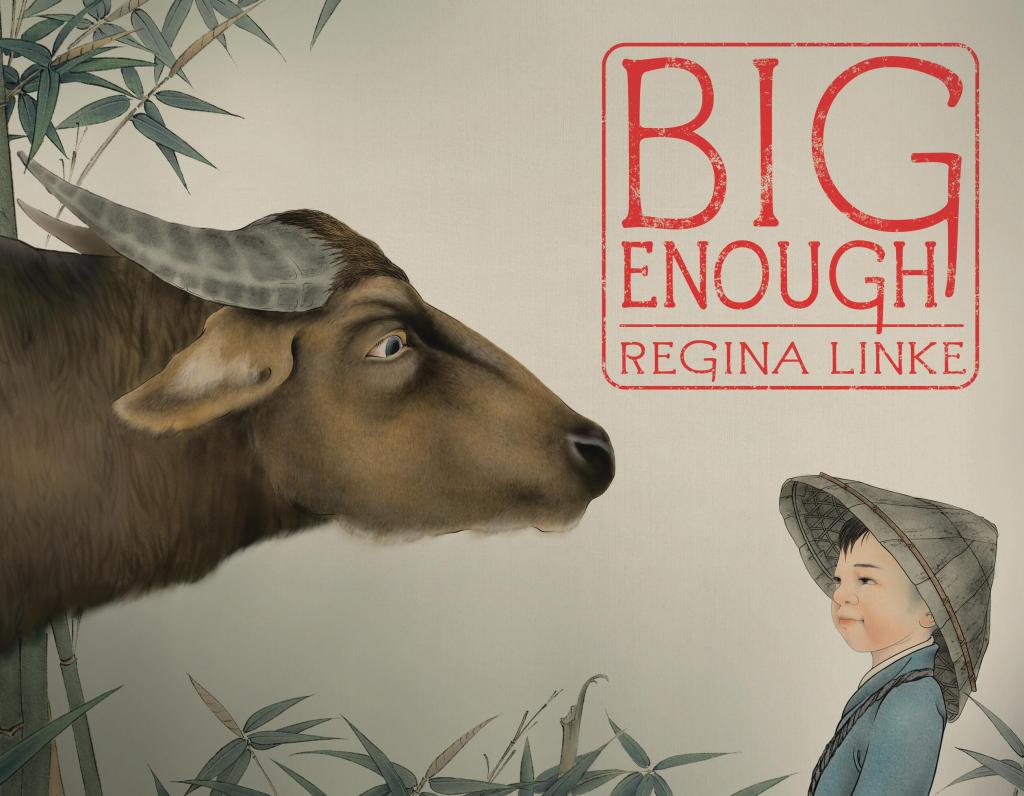
Little Ah-Fu has a big imagination, but he can’t imagine being the Oxherd Boy . . . yet. When the day comes for Ah-Fu to bring the huge family ox home from the woods, he worries that he’s not big enough to do the job. Will fear and self-doubt drive Ah-Fu home empty-handed? Or can he rely on his wits and compassion to become the Oxherd Boy his family expects—and prove to himself that he is, indeed, big enough?
“Thank you for bringing me home,” said the ox.
“Thank you,” replied the boy, “for helping me see I was big enough to do it.”
—Big Enough
1. Introduction
Little Ah-Fu has a big imagination, but he can’t imagine being the oxherd boy yet. When the day comes for Ah-Fu to bring the huge family ox home from the woods, he worries that he’s not big enough to do the job. Can he rely on his wits and compassion to become the Oxherd Boy his family expects and prove to himself that he is, indeed, big enough?
Big Enough is a beautifully illustrated picture book inspired by Chinese philosophy and traditional ink painting. Written and illustrated by Regina Linke, the story follows Ah-Fu, a young boy who grows “big enough” to accomplish difficult tasks. Along his journey, he learns that courage is not measured by size or strength, but by compassion, perseverance, and the willingness to help others.
The illustrations are deeply influenced by traditional Chinese shan shui (mountain-water) painting and incorporate symbolic elements such as lotus flowers, birds, rivers, mountains, bamboo, and ox. The text and artwork invite readers to observe nature and reflect on personal growth.
2. Chinese Ink Painting: Gongbi (工笔 gōng bǐ)
Gongbi (literally “careful brushwork”) is one of the oldest styles of traditional Chinese painting, characterized by precise outlines, delicate brushstrokes, and carefully applied color. Unlike expressive freehand (写意 xiě yì), which emphasizes the artist’s emotions, gongbi focuses on attention to detail. Traditionally, gongbi artists paint subjects such as flowers, birds, insects, animals, landscapes, and historical figures using fine brushes and mineral or plant-based pigments on silk or high-quality paper.
In Big Enough, the detailed illustrations of lotus flowers, birds, an ox, and natural landscapes show the characteristics of classical Chinese painting. Although created as a contemporary picture book, the artwork introduces readers to an artistic tradition that has shaped Chinese visual culture for centuries. Chinese paintings often invite viewers to travel through the landscape with their eyes. Empty space is intentionally left on the page to suggest water and sky.
Teachers may encourage students to compare Chinese ink paintings with European or American landscape paintings by discussing perspective, color, composition, and the role of negative space. Students can also experiment with ink brush techniques to understand how a few simple strokes can express emotions, focusing on patience rather than speed.
3. Mountains and Water (山水shān shuǐ)
The landscapes throughout Big Enough are inspired by shan shui (山水 shān shuǐ), literally “mountain and water.” In Chinese philosophy, mountains symbolize perseverance, wisdom, and stability, while water represents flexibility, adaptability, and the continuous flow of life. Together they reflect the Daoist belief that humans live in harmony with nature.
Traditional Chinese landscape painting is not intended to portray a specific location but to express an ideal relationship between people and the natural world. Ah-Fu’s journey through rivers, mountains, and valleys mirrors his emotional growth as he gradually discovers confidence and compassion. Nature functions almost like another character in the story, quietly teaching lessons about patience, courage, and resilience.
Teachers may ask students how the landscape changes throughout the book and how these changes reflect Ah-Fu’s feelings. Students may also compare mountain imagery found in Chinese paintings with landscapes from their own communities.
4. The Lotus Flower (荷花)
The lotus flower appears repeatedly throughout the illustrations and is one of the most important symbols in Chinese art. Although rooted in muddy water, the lotus blooms above the water. The lotus has been featured in Chinese poetry, painting, and philosophy for more than two thousand years. Chinese people love lotus, not only because of the symbolic meaning of purity, resilience and hope, but also its importance in daily life. Every part of the lotus—flowers, leaves, and roots—can be used as food or decorations.
In Buddhism, the lotus represents enlightenment because it blossoms above the muddy water and opens in the daytime. Confucian scholars appreciate the lotus for maintaining its purity despite difficult surroundings, which is important for a moral character.
By including lotus flowers throughout Ah-Fu’s journey, Regina Linke sends the message that true growth comes from overcoming challenges with kindness and determination. Students may compare the symbolic meaning of the lotus with flowers in their own communities, such as roses, cherry blossoms, or sunflowers.
5. The Ox
The ox has played an essential role in Chinese agriculture, particularly in the rice growing regions of southern China. Oxen helped farmers plow rice fields and prepare land for planting. Their strength and calm temperament make them indispensable partners in rural communities.
In Chinese art and literature, the ox often symbolizes patience, diligence, and harmony between humans and nature. Big Enough presents the ox as a gentle companion that also experiences fear and uncertainty. This reminds readers that courage is not the absence of fear but the willingness to face challenges together. Students may compare the ox in China with working animals such as horses, or camels in other parts of the world.
Discussion Questions
- What details do you notice in the illustrations that suggest close observation of nature?
- How does gongbi painting differ from other illustration styles you have seen?
- Why might an artist choose to paint flowers, birds, and animals with such careful attention to detail?
- How do the illustrations help communicate Ah-Fu’s emotions and the peaceful atmosphere of the story?
Author: Haixia Wang, Senior Lecturer, Carnegie Mellon University & Curriculum Specialist, University of Pittsburgh
2026
“There once was a boy named Ah-Fu, who was so small he often got lost, especially in his own imagination.” —Big Enough
Appropriate for Grades: 3–12
Best for Grades: 5–10
1. Themes of Growth and Courage
Throughout the story of Big Enough, Ah-Fu repeatedly tells himself, “I’m not big enough.” His journey demonstrates that growth is not determined by physical size or age but by developing resilience, and confidence through experience. Each challenge he encounters becomes an opportunity to learn something new about himself.
The book also illustrates a growth mindset. Rather than giving up when faced with obstacles, Ah-Fu continues trying, learning from each experience until he realizes he has become “big enough” through helping others. This message aligns closely with social-emotional learning by encouraging perseverance, self-reflection, and confidence.
2. Essential Questions
- What can Ah-Fu’s experiences teach us about courage and growth?
- Why are lotus flowers important symbols in Chinese culture, literature, and religion?
- How does nature influence both artistic expression and everyday life in China?
- How do family relationships shape our understanding of responsibility and kindness?
- How can works of art help us understand cultures different from our own while recognizing shared human values?
3. Best Matched Curricular Units
- Arts
Students analyze how Regina Linke combines traditional Chinese painting techniques with contemporary picture book illustration. They examine brushwork, colors, composition, perspective, and the use of empty space to understand how visual elements communicate emotion and meaning.
Students may create their own ink-inspired landscape paintings featuring mountains, rivers, lotus flowers, birds, or bamboo, and understand their cultural meanings. Older students may compare Chinese landscape painting with western styles of paintings, discussing how different cultures represent nature.
- Social Studies
Big Enough introduces students to rural life in China. Students investigate how geography, agriculture, family traditions, and cultural values shape daily experiences and community life.
Teachers may compare childhood responsibilities, farming traditions, and family relationships in China with those in students’ own communities. Older students can explore how Confucianism, Daoism, and Buddhism have influenced Chinese values reflected throughout the story.
- Geography
Students locate major mountain ranges, rivers, and agricultural regions of China using physical and digital maps. They investigate how mountains, rivers, climate, and seasonal rainfall influence farming, transportation, and artistic traditions.
Students may compare China’s physical geography with their own state or country while discussing how environments shape architecture and cultural practices.
- Family and Community
Although Ah-Fu dreams of becoming independent, he grows by learning to care for others rather than simply proving himself. The story reflects traditional Chinese values emphasizing family cooperation, respect for elders, and shared responsibility. Success is presented not as individual achievement but as contributing positively to one’s family and community.
Teachers can encourage students to compare family traditions, responsibilities, and acts of kindness within their own communities, helping them recognize both cultural differences and shared human experiences. Teachers may invite students to interview family members about lessons they learned while growing up or write personal narratives describing a time they helped someone despite feeling uncertain.
- Language Arts
Students analyze dialogue and visual storytelling. They examine how the illustrations contribute to characterization and mood while identifying recurring symbols such as mountains, water, birds, and lotus flowers. Writing activities may include personal narratives, short essays, and poetry inspired by nature. Students are encouraged to compare cultures.
4. Note to Teachers
Teachers are encouraged to help students recognize that China is geographically and culturally diverse, with different climates, languages, agricultural products, and customs.
Big Enough also provides a natural entry point for discussing growth mindset and character education for self-confidence, courage, and personal growth. Students learn that making mistakes and facing challenges are essential parts of learning rather than signs of failure.
- Possible Common Core and National Standards Alignment
Arts
Language Arts
Framework for Social Studies (Family and Community)
East Asian Geography
Author: Haixia Wang, Senior Lecturer, Carnegie Mellon University & Curriculum Specialist, University of Pittsburgh
2026
© 2024 NCTAsia