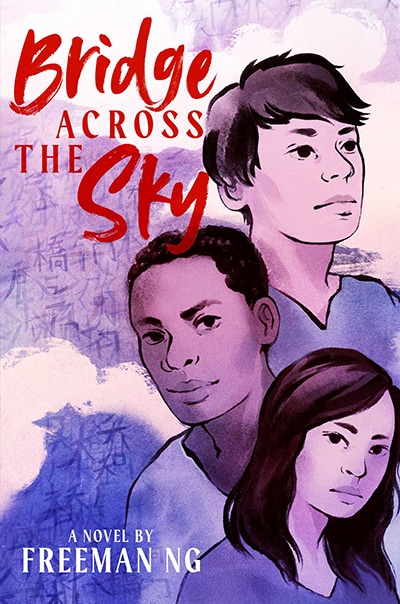
Bridge Across the Sky
Freeman Ng
(Atheneum Books for Young Readers)
(Atheneum Books for Young Readers)
- Fiction
Key words: Historical fiction, immigration, identity, perseverance
Tai Go and his family have crossed an ocean wider than a thousand rivers, joining countless other Chinese immigrants in search of a better life in the United States. Instead, they’re met with hostility and racism. Empowered by the Chinese Exclusion Act, the government detains the immigrants on Angel Island in the San Francisco Bay while evaluating their claims.
Held there indefinitely, Tai Go experiences the prison-like conditions, humiliating medical exams, and interrogations designed to trick detainees into failure. Yet amid the anger and sorrow, Tai Go also finds hope—in the poems carved into the walls of the barracks by others who have been detained there, in the actions of a group of fellow detainees who are ready to fight for their rights, in the friends he makes, and in a perceived enemy whose otherness he must come to terms with.
Unhappy at first with his father’s decision to come to the United States, Tai Go must overcome the racism he discovers in both others and himself and forge his own version of the American Dream.
Bridge Across the Sky is a novel written in free verse by Freedom Ng to portray one young Chinese immigrant’s experiences at the U.S. Immigration Station on Angel Island in San Francisco Bay. This station was built to resemble the contemporaneous Ellis Island in New York Harbor; however, its focus was on the detention of certain categories of immigrants, notably from China, rather than on their routine inspection and processing.
While the story takes place over a period of half a year during 1924, the station on Angel Island remained in operation from 1910 to 1940. The protagonist—Soo Tai Go—and others like him were held in prison-like conditions at the station. The novel effectively portrays the claustrophobic atmosphere that prevailed.
Most of the Chinese immigrants had untrue “paper stories” about themselves and their relationships to particular ethnic Chinese individuals in the United States. The historical reasons for this are slightly complex, involving three special circumstances. First, in the mid-nineteenth century, thousands of Chinese had emigrated from a region of Southeast China to take part in the California Gold Rush (1850s) and the construction of the Transcontinental Railroad (later 1860s). As Chinese continued to immigrate, a powerful movement arose against them on the U.S. West Coast, leading to the passage in Congress of the Chinese Exclusion Act in 1882. This unprecedented law, which remained in force until 1943, prohibited the immigration of additional Chinese laborers to the United States.
Second, prior to the Exclusion Act, Chinese immigrants, as non-whites, were already prohibited from becoming U.S. citizens. However, the Fourteenth Amendment to the U.S. Constitution (1868) mandated birthright citizenship, meaning that the children of immigrants of any ethnic background were automatically citizens if born within the United States. This led the U.S. government to collect detailed information regarding the circumstances of Chinese immigrants, including when and where their children were born.
However, many of these records—like other vital statistics for area citizens—were destroyed during the San Francisco earthquake of 1906. Accordingly, the third circumstance is that certain immigrants from Southeast China began to claim that they were the children of Chinese couples residing in the United States. Since the government lacked records to prove or disprove these claims, the Bureau of Immigration (a forerunner to today’s U.S. Citizenship and Immigration Services) conducted detailed interrogations of these “paper sons” and their claimed relatives to ensure that their stories were consistent. These prospective immigrants were detained on Angel Island while they and their alleged relatives were interrogated. Most immigrants were eventually “landed”—permitted to enter the United States.
In sum, Chinese Exclusion, birthright citizenship, and the San Francisco earthquake jointly prepared the stage for this tale set on Angel Island. Soo Tai Go (paper name “Lee Yip Jing”) arrives with his father and grandfather in early 1924. His mother had insisted on teaching him English, which means that he can communicate with an African American kitchen worker. This figure—John Brown Boucher—agrees to transmit notes to a half-Chinese, half-Japanese young woman in the women’s quarters.
The story is complex and dramatic, with the positive ending that Soo Tai Go and his father will be “landed”—permitted entry. It presents the harsh U.S. immigration policies of the time as part of a larger racism that had also impacted other ethnicities such as African Americans and Native Americans. At the same time, the United States also comes across as an appealing “bigger world” (p. 78) relative to the districts of Southeast China—a rural area near the mouth of the Pearl River that abutted Hong Kong and Macao—from which the detainees emigrated.
The author of Bridge Across the Sky is a poet, and poetry is central to this book, even the source of its title. The text features poems by detainees (historically, over 200 Chinese poems have been found on the walls of the detention barracks), by Tai Go, by Yukiko (the half-Japanese woman), and by Boucher. The quoted poems by detainees are authentic, while those by Tai Go, Yukiko, and Boucher—all fictional characters—help to drive the story forward.
Collectively, the detainees’ poems are now famous as the earliest literary expressions of Chinese immigrants to the United States. Although the immigrants usually had only an elementary school education, they wrote their poems in classical form. This form featured four or eight lines per poem and five or seven characters per line. Typically, the ends of even-numbered lines would rhyme. Some poems that were scratched onto the walls included historical or literary allusions that further displayed the knowledge level of their authors.
As noted, Yukiko, Tai Go’s prospective love interest, included poems in her letters. While not identified as such in the text, these poems are haiku: short Japanese poems that subtly express emotions while overtly concentrating on natural phenomena. Traditionally, a haiku poem has five syllables in their first line, seven in its second, and five in its third and final line. Haiku in English, such as the examples in the book, don’t always conform strictly to this pattern. However, they too are short and display a sensitivity to nature.
Tai Go’s grandfather had two obsessions: the wall poems and the game Go (weiqi in Chinese) originating in ancient China. Grandfather and grandson play the game frequently. Tai Go’s changing approach to it becomes a metaphor for his increasing assertiveness in the face of challenges. The game itself involves a grid-covered board on which two players face off, one with white chips and one with black. Each player places a single chip on the board each time it is their turn. The objective is to surround the opponent’s chips with one’s own, step-by-step, thus controlling ever greater territory on the board and earning more points. As a message about both the game and life at large, Tai Go’s grandfather reminds him to attack relentlessly, but always from positions of strength: “only / surrounded groups / can be killed” (p. 295).
Part of the screening process for prospective Chinese immigrants featured intensive medical exams that they found quite humiliating. Tai Go contrasts these exams—which included nudity before others, needle injections, and stool samples—with the gentler approach of Traditional Chinese Medicine (often called TCM in English writing). The latter would measure a patient’s heartbeat through a touch on the wrist, drawing many diagnostic conclusions from this single act. TCM would also pay substantial attention to the patient’s eating habits and defecation patterns (tactfully). Here, as elsewhere, the protagonist highlights the contrasting approaches of East Asia and the modern West.
Note that while the text does not focus on introducing elements for their shock value, it includes swear words and references to the protagonist’s erections in bed. There is also focused discussion of one detainee’s suicide, reflecting the fact that a few detainees rejected for entry into the United States ended their own lives at the immigration station.
Regarding pronunciation: The author’s family name is “Ng,” pronounced like the diphthong that ends English words like “shopping” and “hiking.” This sound appears in the Cantonese dialect of Chinese, spoken in Guangdong Province in Southeast China. It does not form a part of the standard (Mandarin) Chinese dialect.
While published in 2024, Bridge Across the Sky already has heightened relevance today in the light of changes imposed to U.S. immigration policies in 2025.
Author: Prof. David B. Gordon, Shepherd University
2025
There’s always / one guy / who doesn’t realize / that this place / is a prison.
—Bridge Across the Sky (p. 19)
Appropriate for Grades: 6–12
Best for Grades: 8–12
Introduction to the Book
Narrative poetry is an immensely inviting genre for a spectrum of readers; struggling readers are drawn to its brevity while stronger readers are afforded more time to delve into the specificity of language. Freeman Ng’s Bridge Across the Sky is a superlative example of the art form. The protagonist, Soo Tai Go (aka Lee Yip Jing), narrates in verse the story of his incarceration on Angel Island in San Francisco Bay during the 1920s. This book can be read purely for its narrative elements (potentially in a Social Studies classroom) to shed light on the 1920s Chinese immigrant perspective, yet the poetry is so well-crafted that it, too, could be used as an anchor text for deep language-analysis studies in an English classroom.
Note: Though the book has some swearing and a little of the crudeness to be expected in a men’s incarceration unit, two poems—titled “both bigger” (pp. 42–44) and “I take” (pp. 254–256)—involve intense descriptions of the protagonist’s erections. If necessary, those passages could be excised for a specific group of students so that the remainder of the novel might still be used in a curriculum.
Best Matched Curricular Units
- Social (In)justice
- Racial Relations in America
- Immigration
- Separation
Essential Questions
- When should truth be withheld, and when should it be told?
- How much should someone be willing to pay for a chance to better his family’s position in life?
- At what point does treating a stranger humanely become too expensive?
- Is connection to your past more important than your attention on the future?
Cultural Clarification Vocabulary
- Gold Mountain: This is a direct translation of the name the Chinese use for San Francisco. It derives from the California Gold Rush which spurred the need for the Transcontinental Railroad, resulting in the first major influx of Chinese immigrants into the U.S. to build that railroad.
- White ghosts: In its original Chinese, this term has derogatory connotations.
- Black ghost: Also derogatory in its Chinese use, but to this day, it carries a much uglier, pejorative sense than even “white ghost.”
- Sè-less ones (p. 31): This is a clever play on the Mandarin Chinese word “死” (pronounced: sì) and the English “soulless.”
Suggested Activities
Pre-search. Prior to reading the novel, explore information regarding the following topics:
- Angel Island Barracks living conditions and photographs
- Chinese Exclusion Act and the Johnson-Reed (Immigration) Act of 1924
- Warlord Era in China
- Sino-Japanese Relations from 1895 onward
- Chinese Famine of 1920–1921
Trace the Metaphors. Three major metaphors are woven throughout the novel: 1) The Go game board; 2) Jab the awl; and 3) The bridge (across the sky). Prior to reading the novel, select one of the metaphors to pay close attention to, noting its explicit appearances in the novel as well as its implicit and figurative presence.
Weight of Words. In English-language poetry, typically the final word of any line carries the greatest weight in that particular line of poetry, and the final line of any poem carries the greatest weight of meaning for that particular poem. Select a poem to practice analyzing theme with this method. Highlight or circle the final word of each line as well as the final line of the poem. Using only the marked words, develop an argument around how these specific words illuminate a major theme in the poem. Extension: Look for various poetic devices and examine how they support or refute the argued theme.
Two Letters. After reading Part I (“arrival”), from the perspective of an Angel Island “prisoner,” write a letter home to a loved one or close friend in China, advising whether to embark on the journey to America or stay in China. Be sure to explain why you are for or against his embarkation. After reading the entire novel, write a second letter (from the same perspective) advising the same person once more, using new evidence gathered from the rest of the novel to support your advice.
Complete the Story. In the poem “a story” (pp. 72–75), the protagonist tells of a Japanese traveler who tried to leave his village with a Chinese girl, but of their story, the protagonist says, “No one / would ever tell me / how it ended.” Finish their story (as a poem) from the Chinese girl’s perspective.
Yukiko’s Poems. Yukiko writes several short haiku poems that are dense with meaning. Select one to analyze and present to a (small or large) group:
“Falling petals / the words inscribed on the walls / of my heart” (p. 222)
“Just as bright / on this side of the sky, the moon / through barred windows” (p. 236)
“Is that the face of a god / among the clouds? Only the light / of what will be” (p. 244)
“In darkest night, / the uncountable stars / like so many friends” (p. 271)
Poetry Analysis. Several poems of note are provided below, as well as a suggested line, plot element, or thematic concept worth exploring:
“except” (p. 152). “my bridge across the sky was broken.” What does this mean?
“too many eyes” (pp. 211–214). In this poem, Soo Tai Go witnesses Boucher being beaten by four men for possibly being a spy. Soo Tai Go seems to recognize that Yen Yi’s flaws may now undo the strength of his virtues. Are Yen Yi’s flaws too great? Can all virtues be undone by someone’s flaws? Are any virtues durable?
“reach” (p. 233). In this poem, the protagonist confirms that both he and Yukiko are communicating through poetry, and he even offers some analysis of hers. How does writing poetry rather than prose change communication in letters? Extension: Write a poem to a partner, imparting the story of an event in your life, and have the partner respond in poetry.
“so many more” (p. 240). “I picture her spending / her strength beside me / in the fields—for what? / A house? A job? / to be the girl / of someone else’s / life?” What is the role of women in this book? Consider the mothers, the sister (Kow Loon), and the girl (Yukiko).
“a damn” (p. 284). Yen Yi says, “We owe / no truth to men / who will consign us / to despair.”
“the verdict” (p. 328). The protagonist writes, “I was not / the hero of my own story. / I was the villain / of another’s.”
Debate/Socratic Seminar. After reading the novel, hold either a debate or a Socratic seminar centered on immigration. During the debate, speakers must use evidence from the novel to support their assertions in order for their arguments to be considered. Possible guiding discourses: What are the benefits of more/fewer restrictions for opportunities to apply for immigration to America? How many barriers should stand at the border between a prospective immigrant and their opportunity to begin a new life in America? Where does racism land in the immigration equation? Is it possible to have immigration controls without racism?
Learn Go. In the “Resources” section of the Endnotes, the author provides websites for learning to play Go. The game could be learned before reading the novel to influence the reading experience, or it could be learned afterward once the novel has sparked an interest.
Suggested Discussion/Writing Prompts
Themes to Explore. Secrets and trust. Identity—real or fabricated. Loss of family history/identity. Realms of inequality. Forgetting and memory. Knowledge—gift and burden. Tribes and kin.
Power in Poetry. The protagonist writes, “There are poems / on the walls!” (p. 26) and “For the first time, I am struck / by the poetry of the poems” (p. 153). He notes that the pale powers paint over the poems or sand them off the walls (p. 61). Yukiko also notes that the walls of the women’s side have poems all over them (p. 221). Why poetry? What advantages does poetry have compared to prose? Why is poetry chosen as a way to maintain memory for all of the prisoners? Is writing your own story a human necessity?
Victims and Villains. Soo Tai Go writes, “My / ‘fuck you’ was a fuck you / to the Association” (p. 61); the Association comprises imprisoned Chinese men. We also learn that the guards are not unkind to Yukiko, but the Chinese women who are imprisoned along with her, however, are terrible to her. Why are the imprisoned so unkind to one another? Who is worse: the prisoners or the prison keepers?
Final Considerations. Consider these three important questions after reading the novel:
- By the end, were you rooting for the family to be “landed” in America or returned home to China? Where are they better off? Was splitting up best for all of them?
- This story is entirely from Soo Tai Go’s perspective, and after his admission of guilt, we never hear from Yukiko again. Consider her perspective: How much did she lose through Sow Fong’s and Soo Tai Go’s actions?
- In the poem, an ardor (257), Boucher writes, “At night we dream / the moon through bars.” What do you make of this line in light of Yukiko’s second poem written to Soo Tai Go in which she uses the same imagery?
Author: Josh Foster, Educator and Learner
2025
2025 Notable Social Studies Trade Book Award presented by the National Council for Social Studies (NCSS) and the Children’s Book Council (CBC).
Lesson on Angel Island Immigration Station from The Digital Inquiry Group.
© 2024 NCTAsia