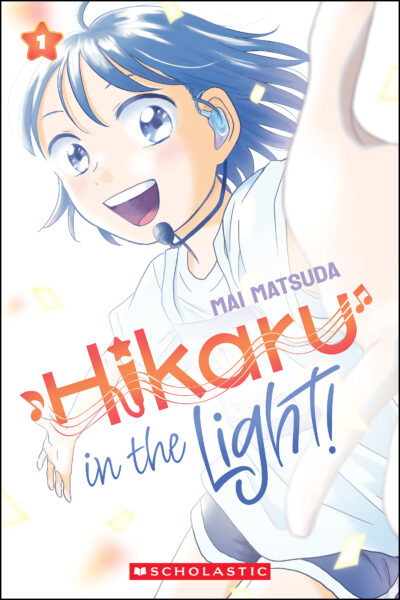
Hikaru in the Light! (Volume 1)
Mai Matsuda
(Graphix, an imprint of Scholastic Inc.)
(Graphix, an imprint of Scholastic Inc.)
- Fiction
- Set in Japan
Key words: Middle school, friendship, identity, relationships
Middle-school student Hikaru Ogino is known as the songbird of her family’s bathhouse in Tokyo. Her beautiful singing echoes from room to room as she cleans up after school, but she dreams of holding a microphone, not a mop! When her best friend, Ran — a former girl group idol — invites her to try out for a pop star survival camp together, it’s the chance of a lifetime to put her talents to the test. Can Hikaru outshine the competition and make her stage debut, or will she fall flat?
Text Overview
The manga series Hikaru in the Light! is written and illustrated by Mai Matsuda. This four-volume series follows Hikaru through her journey as a participant in the Girls in the Light pop idol competition. With its engaging narrative, bright illustrations, and themes that may lend themselves to a variety of content areas, Hikaru in the Light! is best suited to grades 4–8.
Volume 1 introduces the reader to the world of idol competitions. Hikaru loves to sing; but this is typically in the confines of her grandfather’s bathhouse. Though she often has an audience, Hikaru faces a gamut of emotions as she pursues her spot in an idol competition. As she makes her way through several rounds of auditions, with some highs and lows along the way, Hikaru begins to experience self-doubt and some level of imposter syndrome. She struggles with feeling special, even though she has moved forward in an elite competition. As new characters, and competitors, are introduced, it becomes apparent that despite their talents many experience the same feelings of doubt. Although most students will not have participated in this type of competition, they will be able to relate to Hikaru’s emotions and challenges.
Appropriate Student Grade Levels
This book is suited to elementary and middle school students. The text is accessible and engaging. It has the potential to work well for early-advanced readers, though younger ages may face some challenges with the need to read a book of manga right to left. This would also work well as a supplemental text for high school students; it would be a very quick, enjoyable read for most older students. The novel provides many relatable themes that would work perfectly in an English Language Arts setting, as well as lending itself to some interesting cross-curricular options.
Cross-Curricular Suggestions
A history class can easily use this text as an entry point for research on contemporary Japanese culture. Pending grade level and prior knowledge, students can be led through a variety of inquiry-based activities that encourage a better understanding of idol culture and competition in Japan, school life for those their age, and what Japan would be like for a present-day visitor. Moreover, there is an opportunity to compare Japanese idol competitions to K-pop, Broadway, American Idol, and Eurovision (among others that may be familiar to a specific classroom). Comparing and contrasting these competitions, students can focus on the audition process and how they may vary, what fan culture is like from a global perspective, what type of training is involved, and the challenges that all competitors experience.
In music class, students can learn more about Japanese music and culture. They could listen to and analyze a variety of J-pop music. They could be asked to try to make a connection between the music they are listening to and the girls in the novel, especially Hikaru. Students could also be encouraged to write their own lyrics on a theme discussed in the book: friendship, identity, comparison with others, dealing with critiques (positive and negative feedback), and life pressures.
Art class can also serve as a creative outlet to reveal a deeper understanding of this text. Students may be asked to select a character and create a tour poster or album cover that best represents that competitor. Encourage students to reference the text to explain why they made certain artistic choices for a specific character.
Each of these ideas can be a standalone lesson or an extension to a unit taught in an ELA classroom. In ELA, students could consider the similarities they have with Hikaru and her friends—the everyday pressures of being a certain age, plus the added pressures of competition. Considering the importance of music in this series, students may be asked to create a playlist to demonstrate their understanding of either a character or the plot and theme of the book. Students will have the opportunity to select songs and connect them to a character or the general idea of the text. Students at a more advanced level can be asked to provide textual evidence to support their creative decisions and further explain their understanding of the character or text. Furthermore, students may be introduced to the term imposter syndrome. This may be a new concept for this age group, however, reading an educational publication and discussing would lead to a strong connecting point to the text. Edutopia provides some interesting ideas of how to incorporate the understanding of imposter syndrome into the classroom.
Context & Resources Provided by Author
Mai Matsuda does an excellent job of setting her readers up for success. She provides context and resource guides for better understanding of the story. At the opening of the book, readers will find a “how to read manga” guide. This provides an explanation and illustration on how to read this style of writing. Some students, and teachers, might find the new pattern of reading manga challenging. This reference guide is helpful when starting, or if a refresh is needed.
The author then moves on to an explanation of “honorifics.” This details how specific endings are added to names to signify types of relationships. Not only is this an interested cultural lesson, but it also provides a clue for readers looking to see if relationships among characters change throughout the series.
Throughout the text, the author uses footnotes to assist the reader with understanding specific words, cultural references, and music.
Lastly, at the end of the book, readers are met with an explanation of some terms used throughout the text. There is also some background provided on idol competitions and that popularity of bathhouses in Japan.
Select Common Core ELA Standards:
- RL.4.1 / RL.5.1 / RL.6.1 / RL.7.1 / RL.8.1– Refer to details and examples (Grades 4–5) or cite textual evidence (Grades 6–8) to support analysis of what the text says explicitly and inferences drawn from the text.
- RL.4.2 / RL.5.2 / RL.6.2 / RL.7.2 / RL.8.2– Determine a theme or central idea of a text and summarize or analyze its development.
- RL.4.3 / RL.5.3 / RL.6.3 / RL.7.3 / RL.8.3– Describe or analyze characters, settings, and events, including how characters respond to challenges or change over time.
- W.4.9 / W.5.9 / W.6.9 / W.7.9 / W.8.9– Draw evidence from literary texts to support analysis, reflection, and research.
- W.4.4 / W.5.4 / W.6.4 / W.7.4 / W.8.4– Produce clear and coherent writing appropriate to task, purpose, and audience.
- SL.4.1 / SL.5.1 / SL.6.1 / SL.7.1 / SL.8.1– Engage effectively in collaborative discussions with diverse partners.
- SL.4.4 / SL.5.4 / SL.6.4 / SL.7.4 / SL.8.4– Report on a topic or present claims and findings using appropriate facts and descriptive details.
Reference
Jose, Clementina. “Supporting the Mental Health Needs of High-Achieving Students.” Edutopia, April 21, 2025. https://www.edutopia.org/article/addressing-imposter-syndrome-high-achieving-students.
Author: Jennifer Schmidt, English Teacher, North Allegheny School District
2026
Discussion questions from publisher’s A Guide to Reading MANGA with Children and Teens
© 2024 NCTAsia