
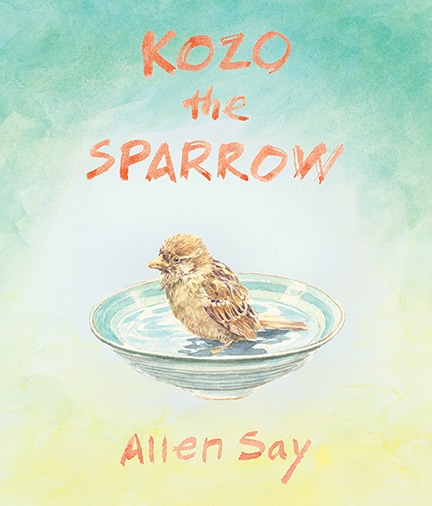
Kozo the Sparrow
Allen Say
(Clarion Books)
(Clarion Books)
- Fiction
- Set in Japan
Key words: Bullying, school, relationships, birds
A young boy sees a baby bird quivering in the hands of a neighborhood bully. Suddenly, he wants the orphan sparrow more than anything. He trades all his treasures for the bird and calls it Kozo, Little Boy.
But how will he keep Kozo alive?
In this painted album of memory, eight-year-old Allen Say talks about the best friend he made in his childhood.
Setting: This story is set in Sasebo, Nagasaki prefecture, in 1946, in the immediate postwar period in Japan.
Historical background: Given its protected deep-water harbor, Sasebo became the site of a major Japanese Imperial Navy base in the late 1800s. The fishing village grew in area and population and flourished through shipbuilding and related industry alongside the Imperial Navy Base. On June 28,1945, after a firebombing raid, nearly half the city burned down. Food shortages and homelessness quickly followed, with some residents fleeing to the countryside.
Japan surrendered on August 15, 1945; the surrender of the Sasebo naval base to Allied Occupation forces occurred in September 14–22, 1945. By June 1946, some of the base’s facilities were re-established under the U.S. Navy’s U.S. Fleet Activities Sasebo, which remains in Sasebo to this day.
Allen Say’s story, Kozo the Sparrow, occurs in this moment when the defeated Japanese people’s wartime enemy became their local occupiers and sometimes benefactors. Like Japanese all over the archipelago, people in Sasebo faced poverty, lack of shelter, food scarcity, unemployment, inflation, and economic stagnation. Psychologically, it was a demoralizing and disorienting time. According to John Dower’s compelling account of the postwar period, Embracing Defeat, teachers and students had to quickly switch from a nationalist school curriculum to a new curriculum that focused on peace and democracy. Students were directed to blacken out nationalistic and militaristic passages in textbooks, using a brush and ink.
During the war, firebombs had destroyed many school facilities, and children had been evacuated to the countryside. When school resumed in Japan in September or October 1945, classes were held outside. (See“An empty classroom in an elementary school that no longer has a school building” taken in Sasebo in October 1945). Nevertheless, for Japanese children, school provided some measure of continuity in their lives.
Say’s background: Allen Say was born in 1937 in Yokohama and navigated a multicultural upbringing. His mother was a Japanese American born in Oakland, California, who returned to Japan as an adult. His father was a Korean orphan adopted by a British family and raised in Shanghai. His parents spoke Japanese to him but their shared language was English. As a young child he experienced the discrimination that Koreans in Japan faced, fear of U.S. bombings of Japanese cities, and displacement in the evacuation of Japanese children to the countryside. After multiple moves and new schools he felt uncomfortable, ostracized, and withdrawn.
Allen Say turned eight years old thirteen days after the end of World War II. With their home in Yokohama destroyed in firebombing, and because he spoke English, his father secured a job with the American military and moved the family to Sasebo.
In Sasebo, Say entered a local elementary school as a first grader. This school is the wooden school in Kozo the Sparrow as well as the setting for Say’s picturebook memoir, The Bicycle Man. Say’s encouraging teacher, Morita-sensei, is a character in each of these books. See Say’s “Author’s Note” and “Caldecott Medal Acceptance Speech” in which he discusses the awkward class reunion at which his classmates remembered Kozo but not the American servicemen who joined the school’s sports festival. Their selective memory reflects the enduring trauma of the immediate postwar period for the Japanese.
School life: Kozo the Sparrow addresses several distinct aspects of school life in Japan past and present.
Bullying: At this age, Say was a victim of bullying, or ijime in Japanese. Bullying takes place in multiple forms (verbal, physical, and social; direct and indirect) in many societies. According to the psychologist Tomoyuki Kanetsuna’s comparison of British and Japanese bullying, in Japanese schools and workplaces, ijime is also used to describe social and indirect aggression towards a victim who does not appear to conform to the majority’s goals, values, attitudes, interests, backgrounds, etc. Cohesiveness, Confucian values, and living in close proximity are social, cultural, and geographic conditions of interpersonal relationships in Japan that factor into ijime. British anthropologist Peter Cave reports that oral history interviewees who attended school in Japan in the twenty years prior to 1945 told of bullying due to economic status, dialect, or hair texture. In the last four decades, awareness about ijime has increased in Japan through media and research attention, but it is an ongoing social problem.
Uniforms: Say’s illustrations of bullies and students in military jackets and caps resemble the gakuranuniforms for higher elementary and junior and senior high school boys or the standardized clothing in wartime for civilians (kokumin fuku). Japan did not require uniforms for lower-level elementary students. The children at Say’s elementary school in 1946 Sasebo were most likely simply wearing what was available. Today, elementary students at public schools have uniforms only for physical education.
Home visitation (katei hōmon): Mrs. Morita’s visit to Say’s home reflects common practice for elementary and junior high teachers in Japan; these home visits were meant to develop parent-school partnerships. A student’s homeroom teacher would visit once a year or more if necessary. Recently this practice is being phased out in some school districts.
Benkei (full name, Saitō Musashibō Benkei; 1155–1189): Benkei was a warrior monk in the years leading up to the Kamakura period (1192–1333). He served Minamoto Yoshitsune (1159–1189), the younger brother of the first Kamakura shogun, Minamoto Yoritomo (1147–1199). While Benkei is mentioned in a few Kamakura-era sources dating a century after his death, after the fifteenth century he grew to be a legend memorialized in numerous Noh and Kabuki plays and woodblock prints. He is known as a smart strategist with exceptional martial skills and strength, as well as for his loyalty and courage. Most famously, he is remembered for helping Minamoto Yoshitsune flee when Yoritomo ordered him killed. Benkei fought to his own death, allowing time for his master to commit seppuku honorably.
Significant toys (pages 8–9):
The sasebo koma (Sasebo spinning top) is a wooden top designated as a traditional craft of Nagasaki prefecture and dates to the later nineteenth century. Tops are an ancient form of entertainment in northeast Asia that were introduced to Japan before the eighth century. Koma can be flat, curved, and even triangular. The sasebo koma are round (rakkyō-gata) with a metal tip in the shape of a diamond for spinning. (https://www.jtco.or.jp/en/japanese-crafts/?act=detail&id=206&p=42&c=29) Traditionally, they are decorated in black, red, green, yellow, and white, the colors of the five elements of Daoism (water, fire, wood, earth, and metal, respectively). For spinning-top fights using the sasebo koma, the top is released with a rope.
Glass marbles became a popular toy in Japan by the 1920s. In addition to the sphere-shaped marbles, flat marbles called ohajiki were popular with Japanese children. During the U.S. Occupation (1945–1952) the American government supported the development of the glass marbles industry to aid Japan’s economic recovery. Manufacturers in Japan developed a new design called “cat’s eye” that has a twist of colored glass inside a clear glass sphere. Because they were less costly to produce in Japan, when the “cat’s eye” marbles became popular in the U.S., many U.S. marble companies couldn’t compete.
The Japanese began playing baseball during the Meiji period (1868–1912) and its popularity grew in the early 1900s. Only in the few years of the Pacific War did the game become victim to anti-American rhetoric, loss of players to the military, and Allied bombings. A popular sport in both Japan and the U.S., during the Occupation, friendly games were held as early as November 1945, and the Japanese professional league started up again nine months into the Occupation. Baseball was an essential bond in U.S.-Japan relations in the twentieth century.
Boxes (pages 5 and 10): The wooden boxes with slanted lids in front of the urban homes were for trash collection.
References:
Arrn, Barbara L. “Benkei.” Kodansha Encyclopedia of Japan, Volume 1. Kodansha,1983.
Cave, Peter. “Elementary Education, 1900–1945.” Childhood, Education and Youth in Modern Japan. The University of Manchester, 2024. [https://sites.manchester.ac.uk/japanese-childhood/home/home-en/topics-2/elementary-education/; accessed July 13, 2026].
Dower, John W. Embracing Defeat: Japan in the Wake of World War II. New York: W. W. Norton / The New Press, 1999.
Eakins, Philip D. “East Meets West – the Occupation of Sasebo.” Sasebo Soundings. US Fleet Activities. September 12, 1998. Republished by Bill Anderson, no date. https://santafe.paintrock.net/Docs/occupation.htm
Gregorio, Paul. “Allen Say (1937).” Oregon Encyclopedia. May 18, 2023. https://www.oregonencyclopedia.org/articles/say_allen/
Kanetsuna, Tomoyuki. “Comparisons between English bullying and Japanese ijime.” School Bullying in Different Cultures: Eastern and Western Perspectives. Cambridge University Press. 2016.
Miller, Kater. “Diamond Diplomacy: Marines, Baseball and the Occupation of Japan.” Leatherneck Magazine, December 2021. Republished by National Museum of the Marine Corps, March 29, 2022. https://www.usmcmuseum.com/blog/diamond-diplomacy-marines-baseball-and-the-occupation-of-japan
Sasebo Koma Honpo. “Sasebo Koma (Sasebo Spinning Top).” Japanese Traditional Culture Promotion & Development Organization. Yoshiko Nagao, trans. Hiroko Okamura, ed. 2026. https://www.jtco.or.jp/en/japanese-crafts/?act=detail&id=206&p=42&c=29
Suzuki, Aiko. “Japan as a Leading Marble-Producing Nation: An Industrial History Behind Its Modernization.” The Nikkei. August 28, 2025. Self-translated and republished by The Marble Connection. January 2, 2026. https://marbleconnection.com/topic/43308-2025-08-28-japan-as-a-leading-marble-producing-nation-an-industrial-history-behind-its-modernization/
Author: Catherine Higbee Ishida, Assistant Director for Japan and Korea Projects, Program for Teaching East Asia, University of Colorado Boulder
2026
© 2024 NCTAsia