
Masked Hero: How Wu Lien-Teh Invented the Mask That Ended an Epidemic
Shan Woo Liu and Kaili Liu Gormley; illustrated by Lisa Wee
(MIT Kids Press)
(MIT Kids Press)
- Non-fiction
- Set in Malaysia and China
Key words: Biography, inventions, pandemic, discrimination
More than a hundred years before Covid, a deadly pneumonic plague threatened to sweep through Northeast China. Medical experts were summoned to help contain it—among them Wu Lien-teh, who had overcome hurdles to be a doctor since his boyhood in Malaysia. Unlike others, Dr. Wu deduced the disease was spread through airborne bacteria and advocated for quarantines and other measures familiar to readers today, including the use of a face covering he designed from layers of cloth and gauze: the first version of the N95 mask.
Wu Lien-teh faced ridicule and discrimination, but his trailblazing methods prevailed: the 1910 Manchurian plague was vanquished in four months, and his invention continues to keep us safe now. Masked Hero, written by Dr. Wu Lien-teh’s great-granddaughter Shan Woo Liu and charmingly illustrated by Lisa Wee, celebrates the little-known history of the N95 mask and the hero who first devised it. Back matter, including an author’s note and a time line, sheds further light on the ever-relevant past, encouraging budding scientists to think bravely—and remember the small acts we all can perform to keep our communities safe.
Masked Hero: How Wu Lien-teh Invented the Mask That Ended an Epidemic is a biographical picture book for young readers. It is crafted by Wu Lien-teh’s great-granddaughter Dr. Shan Woo Liu alongside co-writer Kaili Liu Gormley, with illustrations by Peranakan artist Lisa Wee. Rooted in direct family oral history, Wu’s autobiography Plague Fighter, and firsthand site visits to the Wu Lien-teh Institute in Harbin, the book tells the little-known story of the first Nobel Prize nominee of Chinese descent and creator of the precursor to the N95 mask we use today.
1. Historical and Cultural Background
Three interconnected cultural-historical threads underpin the story: British colonial Straits Settlements society, early twentieth-century Sino-Russian border geopolitics, and systemic anti-Asian racial discrimination within global medical systems.
Late 1800s British Malaya (Modern Penang, Malaysia): Peranakan Multicultural Colonial Life
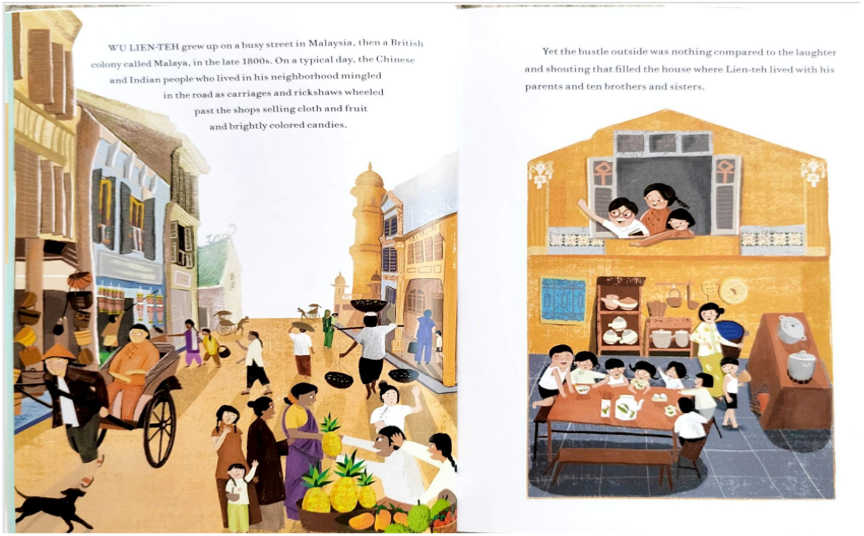
Wu Lien-teh was born in Penang, part of the British Straits Settlements, which included Singapore and Malacca. Penang was a port colony built on overlapping Malay, Indian migrant, and Chinese Peranakan communities, captured in the book’s bustling market street illustration (Fig. 1). The term Peranakan describes Straits Chinese families like Wu’s, who merged Chinese ancestral customs, Malay daily rural and market traditions, and British colonial schooling structures. Wu’s crowded household with ten siblings, late-night studying by the light of a coconut oil lantern, and makeshift homemade sports equipment all reflect working-class Peranakan domestic life; elite white colonial families had electricity and segregated schooling.
A critical unstated detail: Penang Free School, Wu’s alma mater, offered a liberal education for non-European students in the empire, yet systemic racism excluded its graduates from government professional jobs. This formative contradiction shaped Wu’s lifelong mission to build equitable medical care across Asia.
1910–1911 Northeast Pneumonic Plague: Late Qing Cross-Border Public Health Crisis
The Harbin plague storyline relies on dual geopolitical and cultural contexts:
Sino-Russian contested border territory: Harbin sat under overlapping Russian railway authority and weak late Qing-dynasty imperial governance. Russian, French, and Japanese foreign doctors arrived to manage the outbreak and dismissed local Chinese medical expertise outright, mirroring the rejection Wu faced back in Malaya.
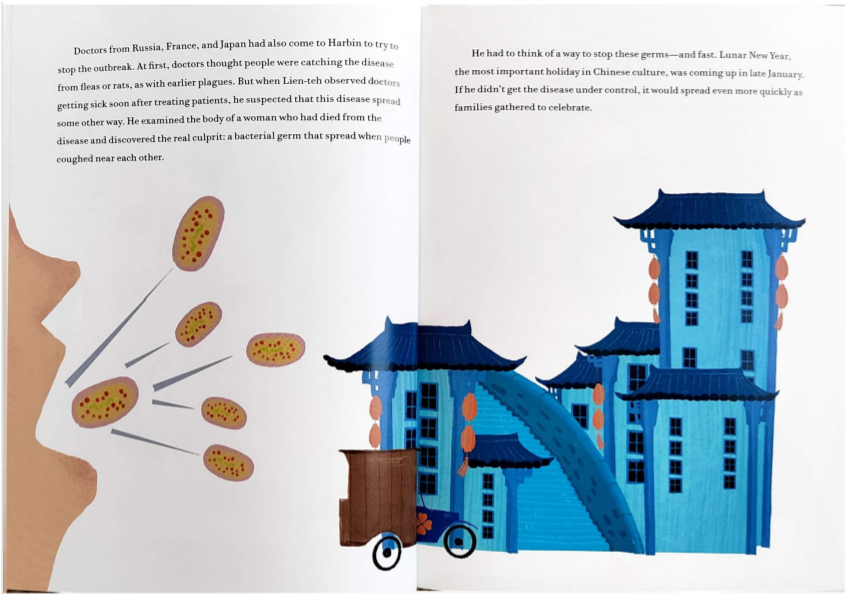
Lunar New Year public health urgency: The text stresses Wu’s rush to contain the spread of the illness before the mass holiday travel associated with Lunar New Year (Fig. 2). Lunar New Year (Chinese Spring Festival) is the most important annual family reunion tradition; millions of rural and urban Chinese travel by train across Manchuria, creating catastrophic airborne transmission risk. Most Western educators lack context for the mandatory long-distance family travel tied to ancestral duty that amplified the epidemic threat.
Collapsed pre-revolutionary Chinese medical infrastructure: In 1910, China had no national network of modern hospitals or trained epidemiologists. Wu’s work required balancing disease containment, cross-imperial diplomatic negotiation with Russian officials, and grassroots germ-theory education for populations with zero formal modern medical schooling.
Colonial and Global Anti-Asian Racial Discrimination in Early Twentieth-Century Medicine
Encounters with racial prejudice run throughout the narrative, with two distinct pivotal moments:
- After graduating from Cambridge University, Wu applied for government medical service in British Malaya and was rejected solely because of his Chinese ancestry; colonial law reserved civil service medical roles exclusively for white European British citizens. This rejection pushed him to relocate his family to Harbin in Northeast China, where he hoped to build medical institutions free from colonial racial barriers.
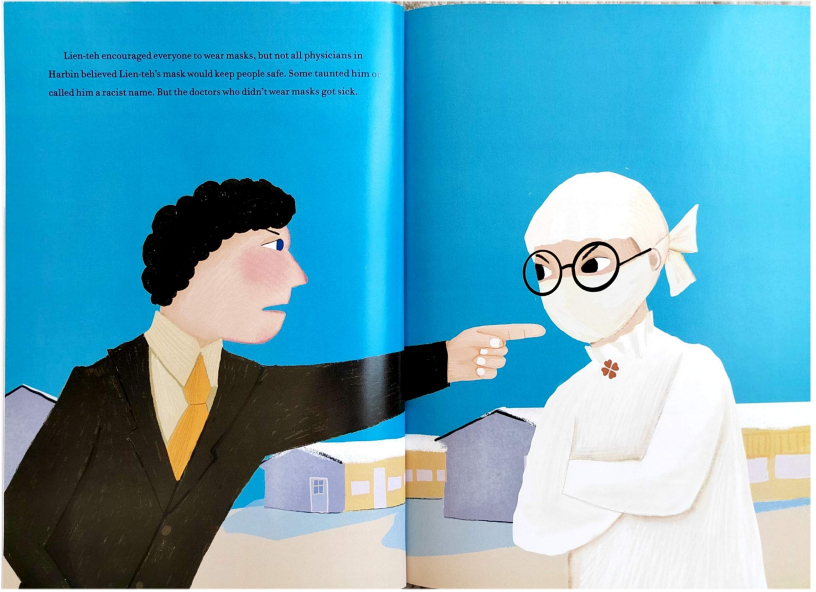
- But in China he continued to face prejudice. In Harbin, European physicians mocked Wu’s layered cotton mask design, used racist slurs to discredit his airborne transmission theory, and refused to wear protective coverings—many of these skeptical doctors contracted the fatal pneumonic plague as a result (Fig. 3).
2. Authenticity Analysis
Masked Hero balances biographical accuracy with simplified age-appropriate storytelling for young readers, with clear instructional strengths and only minor contextual limitations educators must address.
Primary source intergenerational framing:
Author Dr. Shan Woo Liu is Wu Lien-teh’s great-granddaughter. In her research for the book, she drew on family oral history, Wu’s published autobiography Plague Fighter, and personal travel to the Wu Lien-teh Institute in Harbin. Unlike most Western children’s biographies about Asian figures written by outside authors, this text centers Asian diasporic lived experience and fills a major gap in K–12 STEAM literature highlighting Asian innovators.
Dual cultural-visual fidelity:
Illustrator Lisa Wee, a Peranakan artist, accurately renders both Penang’s multiethnic colonial market culture and early 1900s Northern Chinese architectural, medical, and holiday traditions, with subtle visual cues distinguishing Southeast Asian and Northeast Chinese cultural spaces.
Contemporary anti-racism bridge:
The author’s afterword explicitly connects Wu’s experiences to the surge of anti-Asian hate crimes during the global COVID-19 pandemic, creating an immediate, relatable cultural link for student discussions on racial equity within science and healthcare.
3. Cultural and Historical Terms
- Peranakan describes Straits Chinese families like Wu’s, who merged Chinese ancestral customs, Malay daily rural and market traditions, and the British colonial school system.
- The Straits Settlements was a group of British territories in Southeast Asia established in 1826. Originally formed as trading ports by the British East India Company, the Crown colony included Penang, Singapore, and Malacca. The colony was dissolved in 1946 following World War II.
This picture book fills a critical gap in multicultural STEAM curricula by centering a little-known Asian diasporic scientific hero whose invention reshaped global epidemic prevention. Its overlapping cultural layers—colonial Southeast Asian multiethnic community life, a late-Qing Chinese public health emergency, cross-continental racial discrimination, and intergenerational Asian family heritage—offer rich discussion prompts that extend far beyond basic science lessons.
Author: Huan Li, Chinese children’s literature specialist, writer and teacher of children’s literature
2026
NCTA webinar with author Shan Woo Liu
2024 Notable Social Studies Trade Book Award presented by the National Council for Social Studies (NCSS) and the Children’s Book Council (CBC).
© 2024 NCTAsia