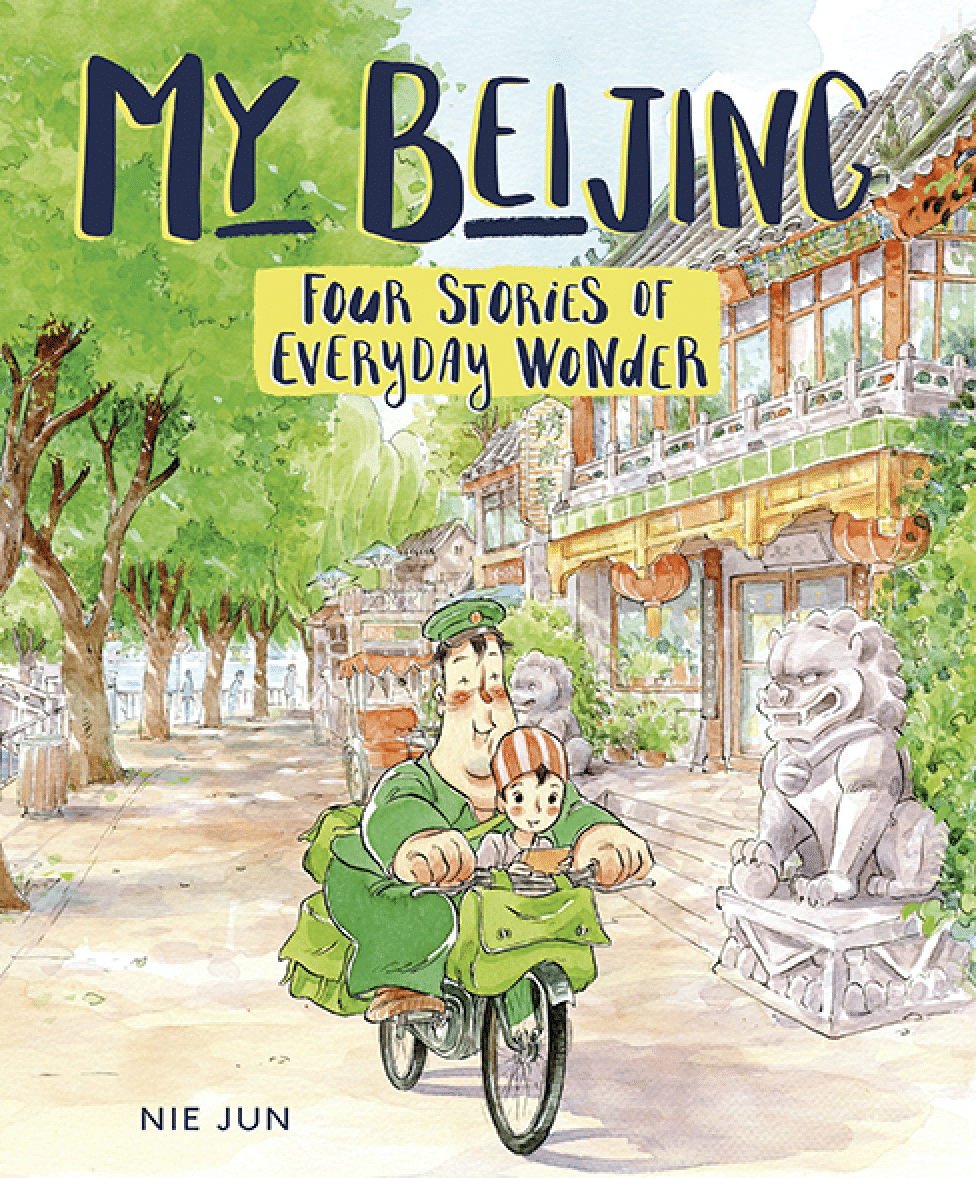
My Beijing: Four Stories of Everyday Wonder
By Nie Jun, Translated by Edward Gauvin (Lerner Books)
- Fiction
- Set in China
Keywords: graphic novel, translation, grandparents, disability, sports
Yu’er and her grandpa live in a small neighborhood in Beijing—and it’s full of big personalities. There’s a story around every corner, and each day has a hint of magic.
In one tale, Yu’er wants to swim in the Special Olympics, a sports competition for people with disabilities. But she and her grandpa don’t have a pool! Their trick to help Yu’er practice wows the whole neighborhood. In another story, a friend takes Yu’er to a wild place full of musical insects. Later, Yu’er hears a special story about her grandparents. And in the final story, Yu’er and her grandpa show a cranky painter the sweet side of life.
Introduction
My Beijing is a graphic novel by Chinese artist Nie Jun that vividly captures life in Beijing’s hutongs in the twenty-first century. Drawing from the artist’s own experiences sketching in these historic lanes and engaging with local residents, the book weaves together heartfelt stories of family, community, and dreams—all set against a backdrop of centuries-old cultural heritage.
Hutongs: The Heart of Traditional Beijing
Hutongs—(pronounced who-TONG) narrow lanes formed by the outer walls of courtyard houses called siheyuan(四合院)—are the defining feature of Beijing’s urban landscape, with a history spanning over 700 years. Their origins date back to China’s Yuan dynasty (1271–1368), with significant expansion during the Ming (1368–1644) and Qing (1644–1912) dynasties. For centuries, hutongs have been far more than just thoroughfares; they embody a tight-knit community structure where neighbors live in close proximity, sharing daily routines, celebrations, and hardships that foster deep, lasting bonds.
Beijing’s hutong network reflects the city’s long legacy as China’s capital (a role it has held for most periods since 1420, with a brief interlude from 1912 to 1949). In recent decades, rapid urbanization has led to the demolition of many hutongs to make way for modern skyscrapers and infrastructure. Fortunately, some—including those near the White Pagoda (Baita) featured prominently in the book—have been designated protected cultural areas. These surviving hutongs serve as living bridges between the past and present, offering students a rare window into traditional Beijing life amid the city’s modern transformation.
The White Pagoda and siheyuan (四合院)
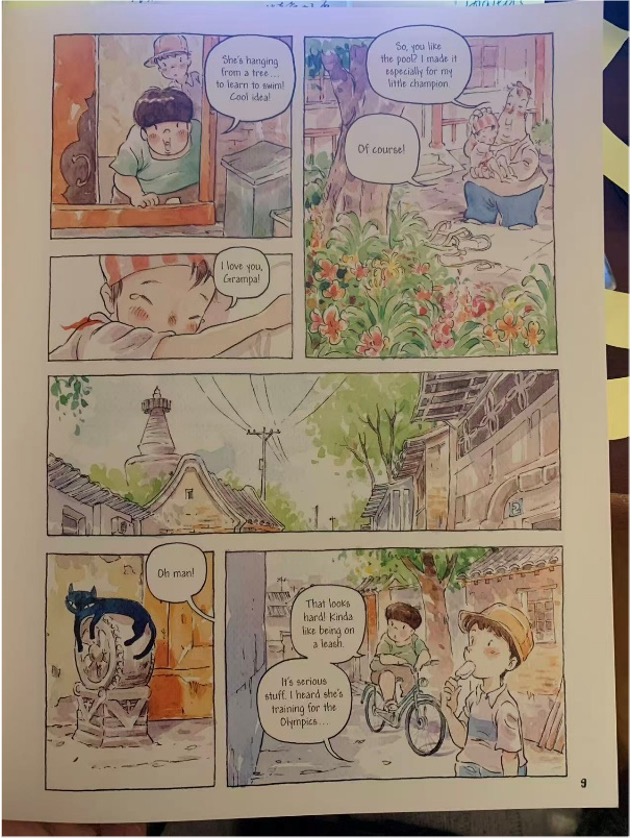
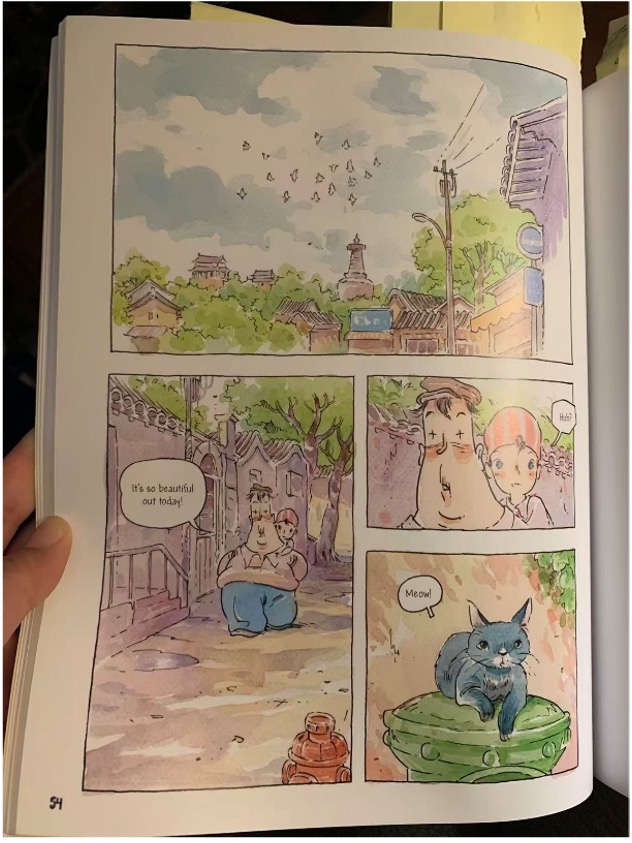
The White Pagoda (Baita) appeared many times in the book.
A key geographic reference in My Beijing is the White Pagoda (Baita), located in the vicinity of the hutongs where the characters reside. First built during the Yuan dynasty (1271–1368), the White Pagoda Temple and its surrounding hutong area gradually took shape over the Ming and Qing dynasties (1368–1912), evolving into a distinctive urban landscape. Unlike the grand, symmetrical siheyuan once occupied by nobility, the courtyard houses here are smaller, irregular in shape, and tightly packed, reflecting the daily lives and practical needs of ordinary people.
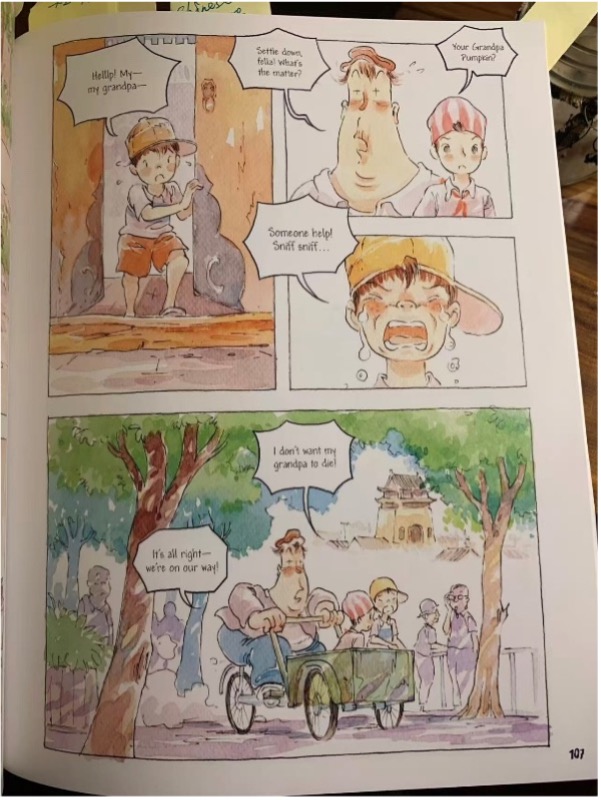
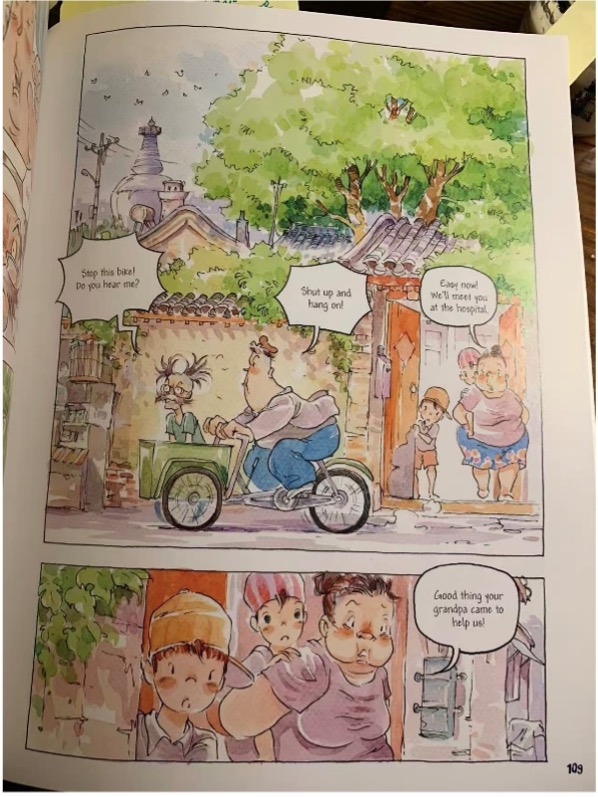
Reversed tricycles stand as vivid, culturally authentic details of hutong life
Due to the limited living space in siheyuan, residents often hang their laundry by the sides of hutong lanes or in the alleys between two siheyuan courtyards. This detail is depicted multiple times in the book—for instance, the first double-page spread of the second story features scenes of clothes hanging outdoors. Cars are rare in hutongs; instead, residents commonly use tricycles or bicycles. As Nie Jun mentioned in a lecture at Xi’an Academy of Fine Arts, the reversed tricycles appearing in the second and fourth stories of this work are derived from his sketches done in Beijing’s old hutongs. He also pointed out that French readers related to this small scene since they also use a reverse tricycle in France for mail delivery.
The Panoramic Finale: Jingshan as a Symbol of Cultural Continuity
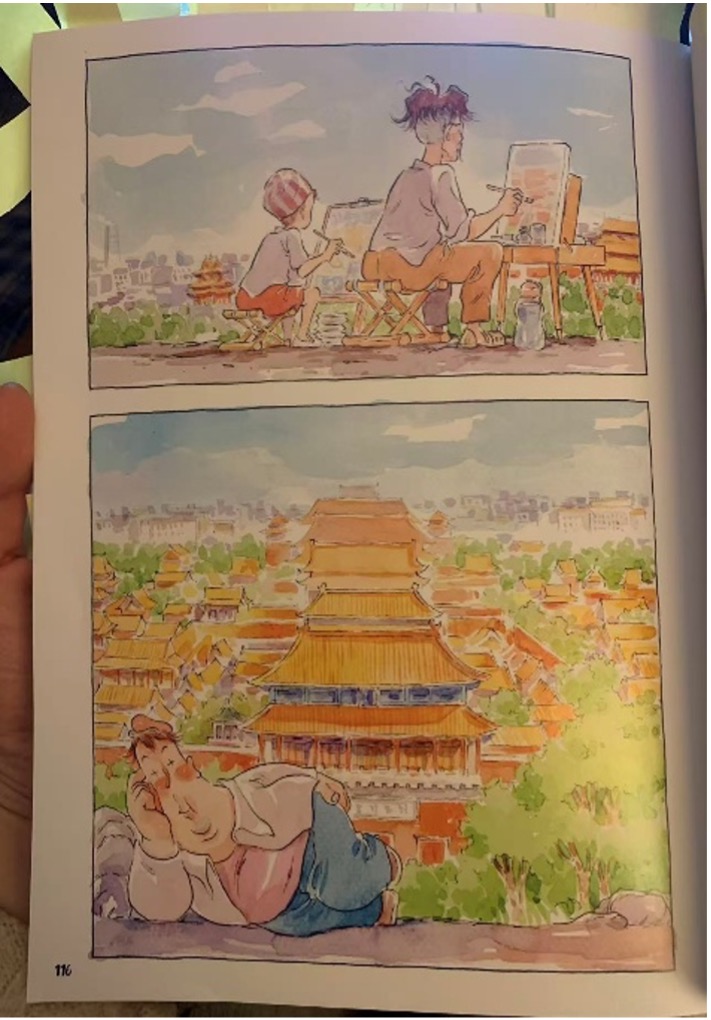 In the final story of the book, the painter Hu Xizi takes Yu’er outdoors to sketch. Their destination is Jingshan, an iconic landmark on Beijing’s central axis. Standing 42.6 meters tall and 88.35 meters above sea level, Jingshan is the highest point in Beijing. From its summit, one can overlook the entire city—where the resplendent ancient Forbidden City and the gleaming new skyline of modern Beijing unfold side by side.
Though Beijing’s urban layout has undergone numerous transformations over time, its fundamental essence remains unchanged: a symmetrical and balanced architectural pattern centered on the city’s axis. By framing this panoramic view as the book’s conclusion, the author allows readers to take in not just the grandeur of the city, but also the joys, sorrows, and everyday lives of the people who reside in the narrow hutongs below.
Key Terms and Cultural Definitions
To help your students navigate the book’s cultural references, here are explanations of core terms and concepts:
- Hutong (胡同): Narrow, winding lanes formed by the outer walls of siheyuan (courtyard houses), unique to Beijing’s urban fabric. Hutongs are centers of community life, characterized by intimacy—where residents know one another by name, share resources, and participate in each other’s daily lives. They are not just physical spaces but cultural symbols of Beijing’s collective memory.
- Siheyuan (四合院): Traditional Chinese courtyard residences, named for their four-sided structure: a main house (zhengfang正房) facing south, a reverse house (daozuo倒座房) facing north, and east and west wing houses (xiangfang厢房), all enclosing a central courtyard. Historically, siheyuan were often home to multiple generations of a single family, but today, many are occupied by unrelated families, resulting in limited living space that shapes daily routines—such as sharing common areas.
- Jingshan (景山): A hill in central Beijing, 42.6 meters tall (88.35 meters above sea level) and the highest point in the city. Located on Beijing’s historic central axis, Jingshan offers panoramic views of the Forbidden City (China’s ancient imperial palace) and the modern skyline beyond.
Author: Huan Li, Chinese children’s literature specialist, writer and teacher of children’s literature
2025
A 2019 Batchelder Honor Book