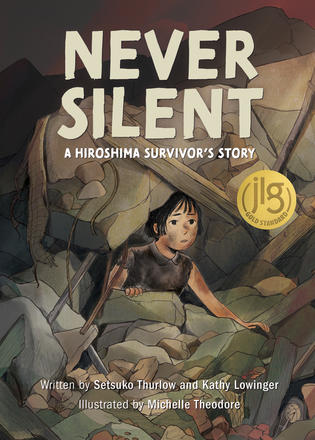
Never Silent: A Hiroshima Survivor’s Story
Setsuko Thurlow and Kathy Lowinger; Illustrated by Michelle Theodore
(Annick Press)
(Annick Press)
- Non-fiction
- Set in Japan
Key words: War, atom bomb, courage, resilience
When Setsuko Thurlow was thirteen, she witnessed one of history’s most horrific events. She experienced—and survived—the atomic bombing of Hiroshima in 1945. Since then, she has worked tirelessly to educate people about the catastrophe and to ensure that it never happens again. As a leading member of the International Campaign to Abolish Nuclear Weapons (ICAN), she gave the acceptance speech when the organization won the 2017 Nobel Peace Prize.
Never Silent recounts Setsuko’s earliest memories of her happy life in Hiroshima, followed by the devastating firsthand impact she witnesses after the dropping of the atomic bomb, and finally traces the steps she takes to rebuild a life in the aftermath of her experiences. With informational text scattered throughout the book to give historical context for the places and events, readers are given a full and profoundly affecting picture of what it was like after the bomb dropped, the struggle to return to normalcy, and the plea for activism to ban nuclear weapons.
2025 EUREKA! Nonfiction Children’s Book Award
2025 New York Public Library’s Best Books, Joint winner
Reading Level: 940L
Recommended Grade Level: 6–8
Summary
Setsuko Thurlow’s memoir begins with her happy childhood in Hiroshima, followed by her firsthand account of survival after the devastation of the atomic bomb. Her account ends with the steps she takes to rebuild her life in the aftermath of the war. With informational text scattered throughout the book to give historical context for the places and events, readers are given a full and profoundly affecting picture of what it was like after the bomb dropped, the struggle to return to normalcy, and the plea for activism to ban nuclear weapons.
Universal Themes
Loss of innocence – The book begins when Setsuko is an innocent thirteen-year-old, but her entire reality is suddenly transformed by the bombing of Hiroshima on August 6, 1945.
Survivor’s guilt and the burden of memory — Setsuko loses 351 of her classmates in the bombing of Hiroshima. Much of the book discusses her struggle to move forward while also carrying the memory of her friends.
Silence versus voice — The title illustrates this tension between being a witness who chooses to speak and those who remain silent.
The individual against a vast, impersonal system — Setsuko’s memories of her life in Hiroshima before the bombing demonstrate the constant presence of the Japanese government through its use of propaganda, illustrating the theme of Setsuko and her classmates versus the interests of the nation-state.
The unreliability of “victory” narratives — As with many books on the atomic bombings of Hiroshima and Nagasaki in the final days of World War II, Setsuko’s memories complicate the reductive narrative of winner and loser.
Possible Curricular Unit Connections
- WWII and Pacific Theater units — Never Silent offers a perspective from a Japanese civilian that balances the American perspective on the war.
- Nuclear age and Cold War units — Sets up the hibakusha (bombing survivor) experience, the arms race, and nuclear policy debates that follow.
- Human rights and international law units — Setsuko Thurlow became a committed activist with ICAN (International Campaign to Abolish Nuclear Weapons); she delivered the organization’s acceptance speech after receiving the 2017 Nobel Peace Prize.
- Memoir/personal narrative writing units — As a mentor text for memoir writing, Never Silenthighlights scene-setting, pacing, and sensory detail.
- Rhetoric and persuasive writing units — Thurlow’s Nobel speech could be considered a case study in argumentation.
- Media literacy and primary source analysis — Compare survivor testimonies to textbook or official historical accounts.
Suggested Lesson Activities
- Pair with a primary source— U.S. government statements about the bombing decision could be studied alongside Never Silent to teach perspective and source bias.
- End the unit on agency — Structure discussion questions and assessments around Setsuko’s activism rather than closing on the bombing itself, so students leave with a model of peace advocacy as a response to violence.
- Use the Nobel address as a mentor text for a culminating persuasive writing task — Students draft their own call to action modeled on testimony-based rhetoric.
- Text-to-text comparison circles — Small groups each read a different survivor testimony and report back on shared structural/thematic patterns.
- Perspective-taking debate — Students research and voice different historical viewpoints on the bombing decision (the Truman administration, U.S. military planners, Japanese civilians, postwar historians), then place Setsuko’s account in conversation with those views.
- Found-poem exercise — Students pull lines directly from the book’s most powerful passages to build an original found poem, then reflect on which images or phrases carried the most weight and why.
- Timeline project — Build a class timeline connecting Setsuko’s personal life events to global historical events.
- “Silent flash” sensory map — Students create a sensory web (sight, sound, touch, etc.) for the bombing scene, then use it as a scaffold for writing their own high-stakes narrative moment.
- Reflection panel and gallery walk — Students post one line from the book alongside their own written response, then do a silent gallery walk before a full-class debrief.
- Watch and compare — Pair the book with Setsuko’s actual Nobel acceptance speech footage; ask students to note what the speech does that the book’s prose can’t and vice versa.
Author: Stephanie Rizas, IB History and East Asian History
2026
Winner, EUREKA! Nonfiction Children’s Book Award 2025
Joint winner, New York Public Library’s Best Books 2025
© 2024 NCTAsia