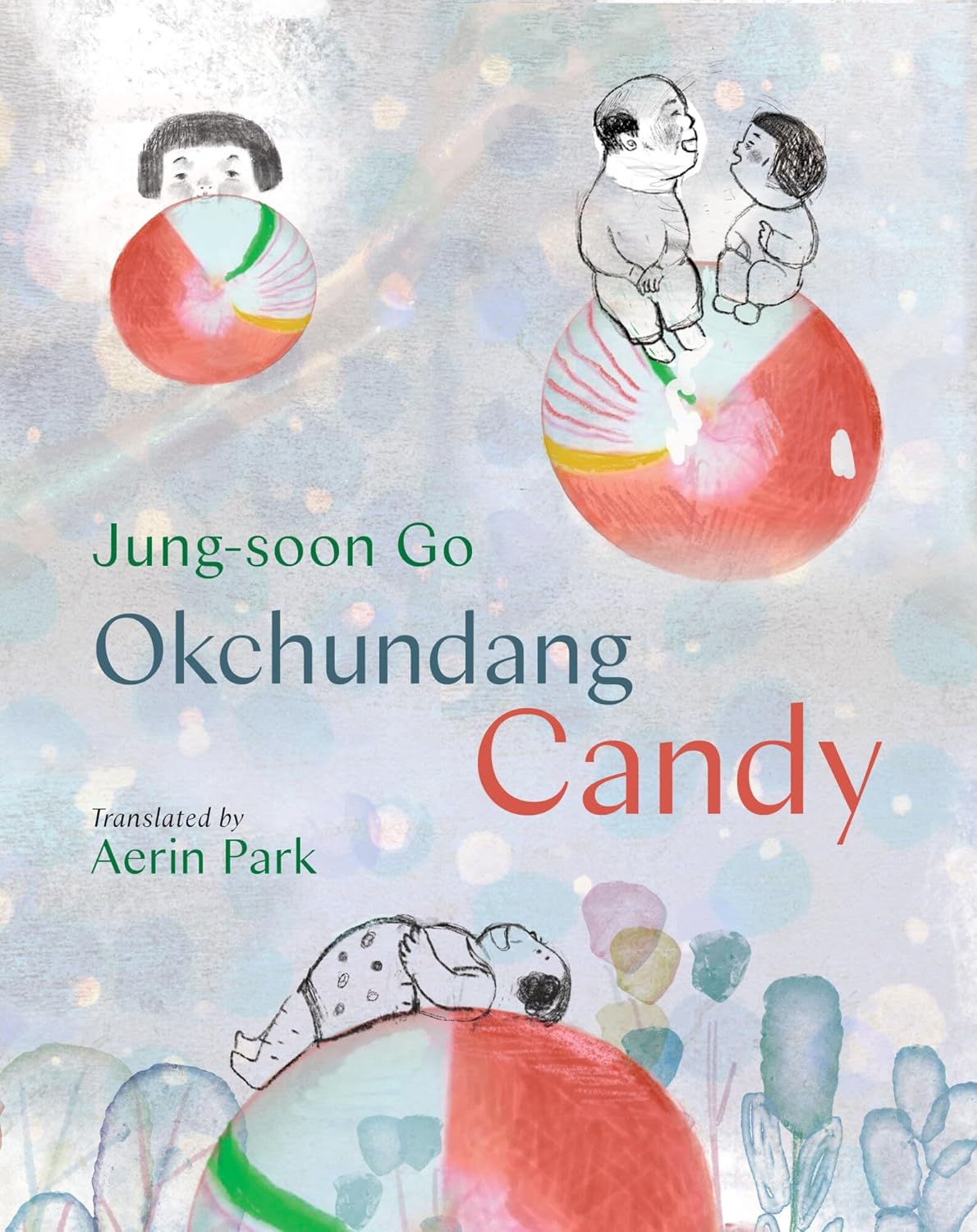
Okchundang Candy
Jung-soon Go; Translated by Aerin Park
(Levine Querido )
(Levine Querido )
- Fiction
- Set in Korea
Key words: Family, grandparents, aging, relationships
I still remember that house filled with summer…
Growing up, Jung-soon spent every moment she could at her grandparents’ house. Dressing up and watching cartoons. Dyeing each other’s fingernails with crushed balsam petals. Getting the whole neighborhood together to sweep their streets. Falling asleep together…just the three of them, happy.
Grandfather was Grandmother’s best and only friend. On every Jesa day, during the ancestral ritual, he would gently place the okchundang candy in her mouth, a big smile spreading across her face as it melted on her tongue.
But nothing ever stays the same, and as Jung-soon got older, so did her grandparents. With breathtaking colored pencil and watercolor art, she presents an achingly beautiful graphic novel about the little joys and sharp sorrows that make up a life together as a family.
Overview
Okchundang Candy is a graphic novel by Jung-soon Go, originally published in South Korea in 2023; it was translated by Aerin Park, 2025. Described as fiction by the Freeman Book Awards, the book is in part a memoir, detailing the author’s childhood memories of summers with her grandparents. Okchundang Candy is classified as appropriate for young adult readers, ages 10–14. At 122 total pages in three chapters, a simple sentence structure, and few pages with more than 20 words, this is a quick, yet profoundly emotional, read. The images are predominantly minimalistic pencil sketches, with more elaborate watercolor and colored pencil drawings every few pages to emphasize key points in the narrative.
Select Common Core Standards
- CCSS.ELA-LITERACY.RL.6.1 / RL.7.1 / RL.8.1 / RL.9-10.1: Cite textual and visual evidence to support analysis of what the text says explicitly as well as inferences drawn from the text.
- CCSS.ELA-LITERACY.RL.7.2 / RL.8.2 / RL.9-10.2: Determine a theme or central idea of a text and analyze its development over the course of the text.
- CCSS.ELA-LITERACY.RL.7.7 / RI.8.7: Analyze the effects of techniques unique to multimedia and the graphic novel form.
- CCSS.ELA-LITERACY.RH 6-8.7 / SS.9-10.7: Integrate visual information from diverse sources, both primary and secondary, into a coherent understanding of an idea or event.
- CCSS.ELA-LITERACY.RH 9 – 10.3: Analyze in detail a series of events described in a text; determine whether earlier events caused later ones or simply preceded them.
Appropriate Student Population and Application
When I first read this book, I was surprised to find myself getting emotional, a sentiment echoed in the Booklist review, which states: “Although Go’s English-language debut—thoughtfully translated by Park—is officially recommended for readers ages 10 to 14 years old, this sweet, poignant tale deserves to be appreciated by all audiences, particularly adults with aging parents.”[i]
While the narrative is simple and direct, the book deals with loss and death; teachers should be mindful of their student population’s maturity level and lived experiences. I think students in high school would also find this book engaging and would likely have more maturity and life experience to draw upon in discussion.
Okchundang could work in a Literature/English classroom, or to facilitate a cross-disciplinary collaboration between English and Social Studies. If cross-curricular collaborations aren’t possible, I would recommend using Okchundang in Social Studies classes as an entry point for discussing traditional East Asian religions and philosophies or as an opportunity for Korean cultural enrichment.
I finished the book in an hour; if I had spent less time examining the pictures and reflecting, I estimate it could be read in 30 minutes. The short page length makes it assignable over the course of a week, or readable in class over a week for younger readers.
Entry Points and Suggestions for Social Studies and English Classrooms
While Okchundang Candy is not intended to explain Korean culture, there are a few opportunities that might connect to content typically covered in Social Studies classrooms:
- Jesa (and Okchundang Candy): As the author explains in the preface, “Okchundang, or Okchun, is a traditional Korean sweet made from rice flour and Korean molasses. Its vibrant colors and taste make it a staple of rituals. Until the 1980s, when candy became less scarce in Korea, Okchundang was a special treat for children after honoring their ancestors.” The treat makes an appearance at the end of Chapter One, when grandfather puts a piece in grandmother’s mouth “on Jesa day.” The book ends similarly, with a series of pictures of grandfather giving a piece of Okchundang to grandmother as she is dying. Since grandfather is deceased by this point, it is unclear whether he is a spirit visiting grandma, a dream grandma is having, what the narrator is imagining took place at grandma’s death, or all three. Most students will be left wondering what the book’s mention of “Jesa day” means, offering an opportunity for some outside research. Joseph Han, writing in the New York Times, describes jesa as “ancestral rites honoring loved ones who’ve passed”[ii] Thus, while an uninformed reader might interpret the author’s mention of “Jesa day” as a specific holiday, Han’s article clarifies that it isn’t a one-off event but is “performed as a ceremony on specific occasions, [and] it can be practiced as a daily mode of being.” Still widely observed in South Korea, jesa most commonly occurs on the anniversary of a loved one’s death or during holidays like Lunar New Year. While jesa is becoming an increasingly less common practice in modern South Korea, the tradition is still preserved by many Buddhists, non-religious people who seek to honor cultural traditions, and even some Christians.
- Confucianism (Filial Piety): Confucianism isn’t discussed in the book, but its presence is made known through jesa. While aspects of jesa predate the adoption of Confucianism in Korea, its emphasis on showing respect for deceased elders exhibits strong ties to Confucianism. Few teacher resources appear to exist on jesa in the context of Confucianism, but the Yonsei Annals (the English-language student journal of Yonsei University in Seoul) has a 2025 article on the strong connection between Confucianism and jesa. [iii]
- The Korean War (1950–53): This is much more peripheral than jesa or Confucianism, but the narrator does mention that her grandparents were both Korean War orphans and that the war profoundly influenced how they treated others.
In the context of an ELA classroom, the main themes are listed below:
- Memory & Loss: The intertwined themes of memory and loss are central to this book. In the final pages, the author includes a note that the book is based in large part on real events, explaining, “with my whole heart, I send my love in this book to my grandfather and grandmother, who left me with childhood memories I will never forget.” At the start of the first chapter, we are told both the grandparents were orphaned during the Korean War. Later, we learn that grandfather rents rooms to local bar workers, whom the other neighbors shun as undesirable, because of his own memory of being a war orphan and “not having a home to go back to.” The chapter ends during a ritual in remembrance of the dead during a jesa ceremony, when grandfather puts a piece of Okchundang candy in grandmother’s mouth during a ceremony to honor ancestors. In Chapter Two, the narrator’s grandfather passes away due to lung cancer, leaving the grandmother having lost “her husband and her only friend.” Subsequently, throughout the rest of Chapter Two and all of Chapter Three, grandmother suffers the effects of Alzheimer’s and loses almost all her memories, except of her deceased husband. At grandma’s death, Grandpa returns as a spirit or vision to place another piece of Okchundang candy in grandma’s mouth.
- Impermanence/Change: Loss–of life, memory, a family member, and more—is deeply tied to change. Because this book focuses on growing up and aging, impermanence is central to the narrative. Throughout the three chapters, we see the grandparents and the narrator grow older, reacting to the various life situations that aging brings. Grandpa develops lung cancer and chooses to die at home to maintain some normalcy. Grandma develops Alzheimer’s and slowly reverts to behaviors the narrator describes as childlike. In a complete role-reversal, the narrator and her parents become increasingly active in caring for the grandmother. The story also takes place within the historical context of a modernizing South Korea: grandma and grandpa live in an “old-fashioned” multi-family dwelling in a quickly developing neighborhood.
- Family Love: Much of this can be deduced from the thematic summaries above. Additionally, in the first chapter we learn that the narrator enjoys staying with her grandparents because they are so kind to each other, unlike her parents, who are “busy fighting back home.”
- Regret: At the end of the second chapter, the narrator gives her grandmother a haircut. She says, “When I think of this moment later, will I have as many regrets as the number of hairs cut today?” In Chapter Three, the narrator explains that she visited her grandmother in the nursing home less and less, hiding behind “excuses of being busy.”
Suggested Learning Activities and Discussion Prompts
It would be great to pair the reading with a taste-test of some Okchundang candy, but it may be difficult to source since it is a ritual item rather than a commercially available candy. If you live in a place with a Korean immigrant community, you might be able to find a local source for this traditional sweet.
Pair a reading of the book with articles on jesa and Confucianism.
- How does your faith and/or cultural traditions honor the dead? Compare and contrast it with the jesa ritual.
- How does food help you to remember loved ones? What are some foods you associate with loved ones?
- The author wrote this book as an act of love for her grandparents. How do you show members of your family that you love them?
- What symbolism does Okchundang candy hold within the story? We learn that the candy is popular among children. Why are two elderly people feeding it to each other? How does its appearance in Chapter One differ from its later appearance in Chapter Three? Is the second appearance part of a dream, a supernatural encounter, or neither?
- Okchundang candy developed at a time when sugar was scarce and was intended to be savored for a long time. Does the candy symbolize anything about the grandparents’ relationship?
- On page 97, the narrator says, “When I think of this moment later, will I have as many regrets as the number of hairs cut today?” What does she mean by this?
- Compare the grandparents’ life to historical primary sources regarding Korean War orphans. What did the author alter or emphasize? What was minimized? Why? Perhaps start with a historical text about the war and then use Okchundang Candy as an extension or a way to gain insights into the grandparents’ behaviors.
Author: Matthew David Williams, Social Studies Teacher, Oakland Catholic High School 2026
[i] Terry Hong, review of Okchundang Candy by Jung-soon Go, Booklist, 1 February 2025, https://www.booklistonline.com/products/9802083.
[iii] Jung Sea-young, “The Haunted Ritual: How Jesa Reflects Korea’s Dual Faith in Confucianism and Shamanism.” Yonsei Annals, 10 November 2025, https://annals.yonsei.ac.kr/news/articleView.html?idxno=11667.
© 2024 NCTAsia