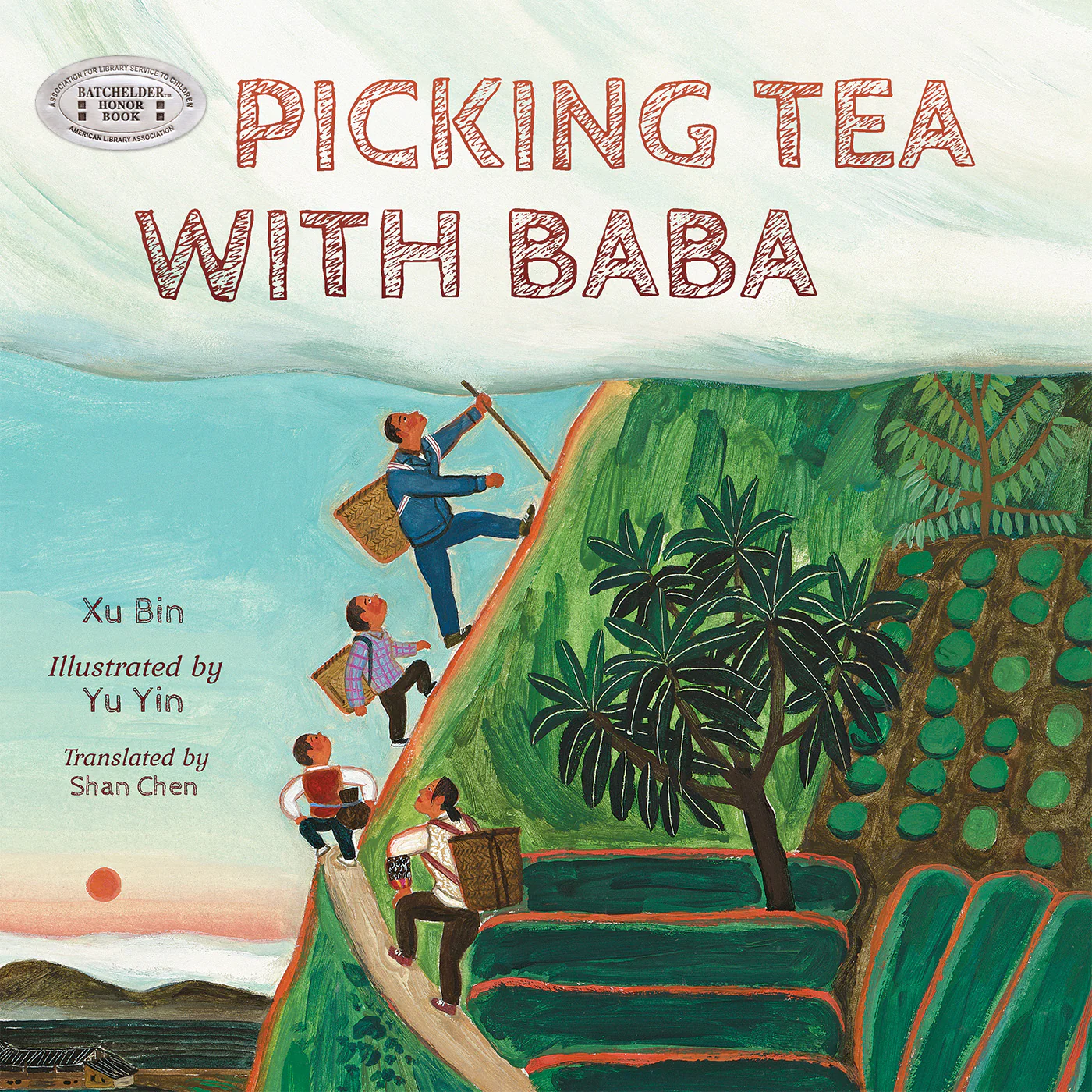
Picking Tea with Baba
Xu Bin; Illustrated by Yu Yin; Translated by Shan Chen
(Charlesbridge)
(Charlesbridge)
- Fiction
- Set in China
Key words: Food, family, farming, countryside
A young boy and his brother travel with their parents up the mountainside to their tea garden for a day of work. They delight in the animals they see, compete to see who can pick the most tea leaves, take a lunch break, and weather an unexpected rainstorm. At the end of the day, they trek back down the mountain to sell the leaves before going home.
“Working in a Chinese tea garden is hard work… It is also joyful, especially when I do it with my family.”
—from Picking Tea with Baba
1. Family Working Together
Picking Tea with Baba is about a young boy and his brother who travel with their parents up the mountainside to their tea garden for a day of work. They are happy with the animals they see while picking tea leaves. After taking a lunch break, they experience an unexpected rainstorm. At the end of the day, they go down the mountain to sell the tea leaves before going home.
This picture book introduces readers to rural life on a Chinese tea farm through the eyes of a child who helps family members with the work of picking tea leaves. While the story celebrates family working together in nature, it also serves as an excellent introduction to one of China’s oldest cultural traditions, which is tea culture.
2. Tea in Chinese Culture
Chinese tradition credits a divine farmer named Shen Nong with introducing agricultural practices and herbal medicine to the people of China more than 5,000 years ago. The legend recounts that when Shen Nong drank water boiled with tea leaves that had fallen into his cup, he noticed that it refreshed him. Originally valued as a medicinal herb, tea eventually became one of China’s Seven Necessities of Daily Life and continues to symbolize hospitality and community.
The earliest scientific evidence of tea use in China was discovered in 2016 in the second century BCE mausoleum of Emperor Jing (d. 141 BCE) of the Han dynasty in Xi’an. Researchers from the Chinese Academy of Sciences announced the discovery of the oldest known tea leaves.
Over the centuries, China innovated and mastered the production of six tea categories (white, yellow, green, oolong, black, and pu’er), and tea’s cultural significance expanded. The Tang dynasty (618–907 CE) marked the birth of formal tea culture. The scholar Lu Yu, revered as the Sage of Tea, wrote The Classic of Teabetween 760 and 762 CE. This foundational text elevated tea drinking to a highly refined cultural and spiritual art form.
Chinese tea culture is deeply intertwined with Daoist and Buddhist philosophies. Preparation of tea embodies the Five Elements: Wood in the plant, Fire/Metal in firing, Water for brewing, Earth in the ceramics. Tea consumption evolved into an art form and cultural pillar, shaping East Asian traditions, spirituality, and trade.
3. About the Author, Illustrator and Reviews
Author Xu Bin is a Chinese author, editor, farmer, and reading educator whose work draws on rural life and agricultural traditions. His firsthand knowledge gives the story authenticity and warmth. Illustrator Yu Yin, a graduate of the China Academy of Art, creates richly textured artwork inspired by Chinese landscapes and nature. Her illustrations immerse readers in the mountain tea gardens through changing weather, native plants, insects, and family life.
Reviewers praise the book for its authentic portrayal of rural Chinese life, vivid sensory writing, and beautiful illustrations. The story provides an engaging window into contemporary Chinese culture, while emphasizing universal themes of family and perseverance. The book is a beautiful story about a family working together and being proud of the work.
Unlike many books that discuss tea only as a beverage, Picking Tea with Baba emphasizes the people behind every cup of tea. Students witness the careful labor of tea harvesting while gaining insight into Chinese family life, agriculture, environmental stewardship, and cultural heritage. The book supports inquiry across geography, science, social studies, art, economics, environmental studies, and language arts with intercultural understanding.
4. Connection to Classroom
“Delicious tea leaves come from the tea garden.”
“Delicious tea is made from the tea leaves.” —from Picking Tea with Baba
Picking Tea with Baba provides natural connections to social studies, geography, science, art, environmental studies, and language arts. Students can investigate tea agriculture, Chinese geography, plant biology, processing methods, cultural traditions, and global trade while developing cross-cultural understanding. Students learn that every cup of tea represents careful work performed by families over generations. They will learn respect for labor, cultural heritage, and gratitude for everyday products.
Tea as Agriculture
The story highlights the labor behind tea production. All traditional teas come from tea gardens. Different types of tea—green, black, oolong, white, yellow, and pu’er teas—go through different processing and fermentation. Tea cultivation depends on mountain environments, particularly rainfall, and the timing and methods of picking, reflecting generations of agricultural knowledge.
From Tea Garden to Teacup
Picking tea leaves is only the beginning of production. Green, black, and oolong teas undergo different combinations of withering, rolling, oxidation, firing, roasting, and drying. These processes provide excellent connections to science lessons on physical and chemical change.
Chinese Tea Ceremony
Traditional tea ceremonies such as the Tie Guanyin ceremony emphasize mindfulness, hospitality, respect, and appreciation of nature. Warming the tea set, measuring the tea leaves, brewing the tea with care, enjoying the aroma, tasting slowly, and sharing tea with others reinforce values of patience and community. In modern times, tea lovers continue to celebrate China’s vibrant influence on global tea culture.
Author: Haixia Wang, Senior Lecturer, Carnegie Mellon University & Curriculum Specialist, University of Pittsburgh
2026
“Delicious tea leaves come from the tea garden.”
“Delicious tea is made from the tea leaves.” —from Picking Tea with Baba
Appropriate for Grades 3–12
Best for Grades 5–10
1. Introduction to the Book
Picking Tea with Baba is about a young boy and his brother who travel with their parents up the mountainside to their tea garden for a day of work. They are happy with the animals they see while picking tea leaves. After taking a lunch break, they experience an unexpected rainstorm. At the end of the day, they go down the mountain to sell the tea leaves before going home.
Picking Tea with Baba provides natural connections to social studies, geography, science, art, environmental studies, and language arts. Students learn that every cup of tea represents careful work performed by families over generations. They will learn respect for labor, cultural heritage, and gratitude for everyday products.
2. Best Matched Curricular Units
- Chinese Culture: Students explore how tea has shaped Chinese daily life, family traditions, hospitality, and celebrations for thousands of years. The book provides an example of contemporary rural China to demonstrate how everyday activities preserve cultural heritage.
- East Asian Geography: The story offers opportunities to examine how mountains, climate, rainfall, and elevation influence agricultural production. Students can compare China’s tea farms with tea production in other parts of the world (for example, India and Japan).
- Environmental Science: Tea farms provide excellent case studies for discussing ecosystems, soil conservation, biodiversity, pollinators, and climate change. Students can explore how environment affects agricultural production.
- Family and Community: The story emphasizes cooperation, responsibility, and shared work among family members. Students can compare family roles and traditions across cultures while recognizing universal values such as helping one another and taking pride in family work.
- Global Trade: Tea is one of the world’s oldest internationally traded agricultural products. Students examine how tea connects farmers, processors, exporters, retailers, and consumers across continents through global supply chains.
3. Essential Questions
Why has tea been important in Chinese culture for thousands of years?
- Students investigate how tea has served as both a daily necessity and an important symbol of hospitality, family, health, and cultural identity throughout Chinese history.
How does geography influence what people grow and eat?
- By researching tea producing regions, students learn how climate, rainfall, and soil affect agricultural products and regional food traditions.
How do family traditions preserve cultural heritage?
- The story demonstrates how cultural knowledge is passed from one generation to the next through hard work, family, and community traditions.
How are local traditions connected to global trade?
- Tea is a good example of a food product that is grown in one part of the world becoming important to the international market. At the same time, tea continues to have cultural significance in China.
4. Suggested Activities
Tea Garden Mapping
- Students locate China’s major tea-producing provinces, including Fujian, Zhejiang, Anhui, and Yunnan. Discuss why mountain environments and humid climates are ideal for tea production. Students could compare tea traditions from their own cultural backgrounds.
The Tea Horse Road
- Students research the trade routes that connected tea-producing regions of southwestern China with other parts of Asia. Students examine the geography and how it affected trade and cultural exchange.
Chinese Tea Ceremonies
- Students investigate the history and purpose of traditional tea ceremonies, including the Tie Guanyin ceremony. Students compare Chinese tea customs with ceremonies from Japan (Chadō, the Way of Tea) and other cultures.
Rural Life in Contemporary China
- Students discuss how rural communities maintain traditional practices in the modern era. Students compare rural lifestyles in China with those in their own communities.
5. Note to Teachers
The story offers an authentic portrayal of contemporary rural China. Teachers are encouraged to help students recognize that China is geographically and culturally diverse, with different climates, languages, agricultural products, and customs.
- Possible Common Core and National Standards Alignment
Framework for Social Studies
East Asian Geography
Global Trade, Framework (Economics & Geography)
Author: Haixia Wang, Senior Lecturer, Carnegie Mellon University & Curriculum Specialist, University of Pittsburgh
2026
© 2024 NCTAsia