
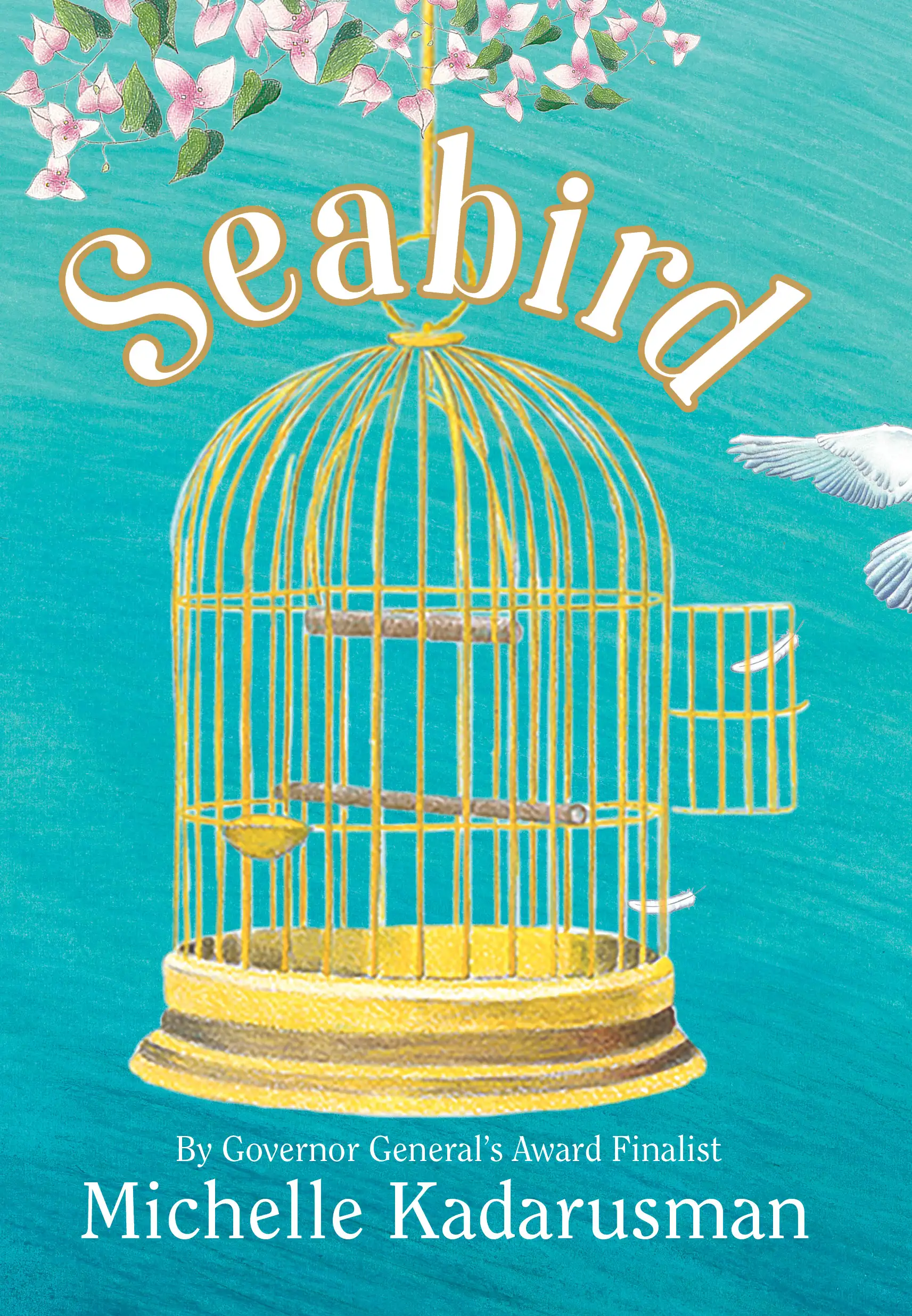
Seabird
Michelle Kadarusman
(Pajama Press)
(Pajama Press)
- Fiction
- Set in Indonesia
Key words: Activism, colonization, patriarchy, courage
Inspired by a true story, Seabird follows the early teen years of Kartini, whose forced isolation ignites her desire for freedom and the right to have a say in the decisions that shape her life. Kartini was born in 1879 during Dutch-colonized Indonesia, then known as the Dutch East Indies. Due to her high-born status, Kartini is forced to enter home seclusion just before her twelfth birthday with the intention that she will remain home until she is married. During seclusion, Kartini, who is fluent in the Dutch language, begins a self-directed education and writes letters to a former schoolmate named Lesty. This period of isolation sparks her interest in feminist thinking and ignites her desire to improve education opportunities for all Javanese girls and women.
I can’t understand why they cling so strongly to customs that have caused pain for them both. —Seabird (page 13)
Appropriate for Grades: 6–8
Best for Grades: 6–7
Introduction to the Book
Michelle Kadarusman’s Seabird does not have wild adventures or shocking turns. Probably the future-lover of Jane Austen’s work is most going to be thrilled by the emotional swings and the relational entanglements of the characters. It is the kind of book that is well suited to book clubs with book choice in the classroom rather than being assigned to the whole class.
Best Matched Curricular Units
- Traditions and Change
- Southeast Asia Trade and Commerce
- Colonialism (in the Dutch Indies)
- Gender Roles
Essential Questions
- What is lost and what is gained when traditions are held onto, abandoned, or changed?
- Can one in power ever empathize with those out of power?
- How do the dispossessed reclaim power?
Note to Teacher: The back matter is essential reading for the teacher (before reading the novel) and for the student (after reading).
Suggested Activities
Pre-search Geography. Before reading the novel, explore the following geographical locations (climate, culture, topography, colonial naming conventions, etc.):
- Dutch East Indies (Sumatra, Jepara, Java, Medura Island)
- Netherlands
Pre-search Dutch Colonialism. Before the novel, build background knowledge on Dutch colonialism in Africa and East Asia as well as the role of the Dutch in the slave trade.
Raden Ayu. Beginning on page 10, we are introduced to Raden Ayu, the traditional title for a married Javanese noblewoman. Throughout the book, track the expectations—clothing, daily habits, activities, behaviors, living conditions, etc.—for women with this status in Javanese society.
Nineteenth-Century Travel. On page 16, we are told that Lesty’s return trip from Jepara to Amsterdam in the Netherlands would have taken months. Research what such a travel experience would have been like for a girl of Lesty’s status (or maybe someone of lesser status). To take this further, Lesty describes her own journey beginning on page 38. Compare and contrast Lesty’s description to that described in the research.
Birds as Symbols. The title of the novel is Seabird, and bird imagery appears again and again throughout the novel. Track each instance of birds (e.g., on pages 31, 35, 39, 45) as well as the context in which the bird imagery is used. At the end of the novel, review your notes in order to come to a conclusion regarding their symbolic meaning for this particular story.
Traditional Javanese Formal Dress. Before a visit from Marie Ovink-Soer, Kartini describes the process of getting dressed and what she is wearing. Research how a high-born Javanese woman might traditionally dress in the late nineteenth century. Illustrate an outfit (patterns, layers, materials, etc.) and the accompanying hairdo. If only limited information can be found online, illustrate the outfit as Kartini described it.
Allusions. Marie Ovink-Soer gives Kartini a book: Verbonden Schakels by Hélène Mercier. Research what this book is about and discuss why it might be an important text for Kartini, Marie, or anyone else. Why would the author mention this book in Seabird?
Lesty provides a lengthy account of the Pirate Queen, who becomes something of a hero to Kartini, Yanti, and Uka. Hong Kong, China, and Singapura (Singapore) are all mentioned in the account. Encourage students to research these locations, the Red Fleet, and the Pirate Queen herself. Grace Lin’s short story “The Difficult Path” is an excellent companion piece, as it, too, tells part of the Pirate Queen’s story at a middle school level; it can be found in the anthology Flying Lessons and Other Stories, edited by Ellen Oh.
In her letter beginning on page 145, Lesty recounts the experience of seeing a mock Javanese village at the International Colonial and Export Exhibition. A powerful companion text (or perhaps an alternative book club selection) is Candy Gourlay’s Wild Song, which tells the story of the people who filled a mock village from the Philippines at the 1904 World’s Fair in St. Louis. (Note: Wild Song also won a Freeman Book Award: https://www.nctasia.org/award/wild-song/)
Javanese Home. Research traditional Javanese homes (design, building materials, decorations, layout, etc.). Provide a tour to classmates of such a home, or else draw a home based on Kartini’s description (see pages 98–99).
Suggested Discussion/Writing Prompts
Traditions & Change. The greatest tension in the novel is that between maintaining and abandoning (or revising) traditional practices. Assign a stance to each student to debate:
Stance 1: We should hold tightly to our traditions, no matter what.
Stance 2: We should revise or let go of traditions that seem outdated.
Not Equals. Kartini writes to Lesty, “But we are not equals in many ways. If you think about it, you will understand what I mean” (page 70). What does Kartini mean? Kartini comes from a high-born family with a home, food, clothing, high status in society, opportunities to learn English, and so on. What makes the Kartini and Lesty unequal? Are there similar ways in which people continue to be unequal today in our society?
Ironic Ignorance. Kartini says, “I toy with the latch [of a caged bird], but don’t open it. I know that if I were to let it out, it would not survive” (page 105). How are Kartini’s words full of irony?
Answer Kartini. On page 120, Kartini laments,
“The fever put me to bed, but the melancholy keeps me here. What is the point of getting up if I can’t leave this house? To wander paths that always end in a stone wall? Reading books about places I will never go? Writing essays that will never be published? Keeping correspondence with a friend I will never see again?
“What is the point of a life where your voice is silenced at every turn? A life where you must whisper. Where you are not even allowed to show emotion?”
Assign a different question to each student and ask them to write a short letter to Kartini in response.
Striving. The Pirate Queen says, “A person should strive to be the best at what they do, no matter how ordinary the work may seem” (page 133). What is such an ordinary task for you? How could you strive to do it better? How could you keep striving, despite its ordinariness?
Kartini’s “Rejection” of Tante. Tante Marie Ovink-Soer and Kartini have an exchange on page 194 after Tante offers her the opportunity to “be like a real Dutch girl” (page 193):
“I cannot stay mad at Tante. How can I? I know her intentions are good. But my heart breaks to know that I am not seen by her in the way I thought I was.
‘Of course,’ I say. ‘Please do not worry on it.’
But we both understand this moment cannot be undone.”
Unpack why this moment cannot be undone.
Socratic Seminar Questions. The following might be used in a teacher-guided Socratic Seminar:
A. “Great power comes with great tragedy” (page 50). How so?
B. “Who has the right to give or take away dreams?” (page 164)
C. Kartini is thrilled when she becomes a published writer (page 173): Why does being published matter for any writer?
D. “But we as a people who are colonized, we must also look to the customs and traditions of those who govern. Striking a balance between the two is not easy” (pages 178–179). Should we look to the customs and traditions of those who govern, even when we are colonized?
E. “It is sometimes hard for children to see their parents completely” (page 183). What does this mean?
Author: Josh Foster, Writer, Educator, Learner
2026
© 2024 NCTAsia