
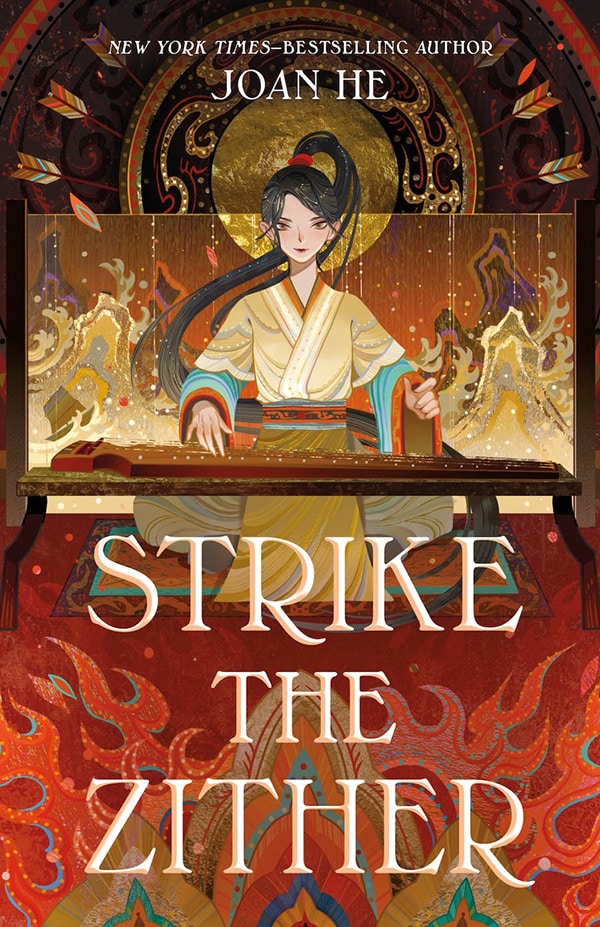
Strike the Zither
Joan He (Roaring Brook Press)
- Fiction
- Set in China
Keywords: Fantasy, retellings, adventure, women
The year is 414 of the Xin Dynasty, and chaos abounds. A puppet empress is on the throne. The realm has fractured into three factions and three warlordesses hoping to claim the continent for themselves.
But Zephyr knows it’s no contest.
Orphaned at a young age, Zephyr took control of her fate by becoming the best strategist of the land and serving under Xin Ren, a warlordess whose loyalty to the empress is double-edged—while Ren’s honor draws Zephyr to her cause, it also jeopardizes their survival in a war where one must betray or be betrayed. When Zephyr is forced to infiltrate an enemy camp to keep Ren’s followers from being slaughtered, she encounters the enigmatic Crow, an opposing strategist who is finally her match. But there are more enemies than one—and not all of them are human.
Zephyr, the protagonist who plays the zither in Joan He’s historical fantasy, is inspired by Zhuge Liang, a strategist from the Three Kingdoms period, when there were three warring states in China: Wei in the north, Shu-Han in the southwest, and Wu in the south.
Strike the Zither is Book One of Joan He’s two-part fantasy series. The second is Sound the Gong. These two books are Joan He’s reimagining of Romance of the Three Kingdoms, a fourteenth-century historical novel. It focuses on the period from the decline of the Eastern Han dynasty to the reunification of China in 280. Romance of the Three Kingdoms is attributed to the novelist Luo Ben, who was probably better known as Luo Guanzhong. He combined historical knowledge with fiction, legends, dramatic embellishment, and popular storytelling traditions. Today, Romance of the Three Kingdoms is regarded as one of the four great classic novels in Chinese literature. Notably, Luo Guanzhong was so talented that he also helped to revise Water Margin, another of the four classics.
Romance of the Three Kingdoms is widely read not only in China but also in East and Southeast Asia. Some characters from this novel—such as Liu Bei, Guan Yu, Zhuge Liang, Cao Cao, Sun Quan and Zhou Yu—are household names and cultural icons. For example, Liu Bei is widely recognized as a benevolent statesman. Zhuge Liang, Liu Bei’s trusted advisor, is famous for his military stratagems and loyalty. Guan Yu, a tragic hero, represents honor and bravery. He is revered to such an extent that today you can find both Daoist and Buddhist temples and shrines dedicated to him across China. Although Romance of the Three Kingdoms was not the only factor in elevating Guan Yu, his appealing image in this widely read novel helped to make him a folk hero.
In Strike the Zither, Joan He borrows heavily from Romance of the Three Kingdoms. For example, Zephyr asks Lotus to employ the “empty fortress” stratagem to rid herself of the north’s pursuit, just as Zhuge Liang did in Romance of the Three Kingdoms. Zephyr serves Xin Ren faithfully out of her respect for her morals and benevolence towards her subjects. In Romance of the Three Kingdoms, Luo Guanzhong idealizes Liu Bei as a moral ruler who protects his subjects even during military retreats. Nonetheless, Strike the Zither is clearly Joan He’s reimagining of the story. For example, most of the leaders of these three rival states are female. Thus, Joan He has succeeded in taking a must-read for boys growing up in China and re-creating it as a must-read for girls.
Author: Sophia Geng, Professor, James and Margaret Tseng Loe Chair for China Studies, Saint Vincent College, Latrobe, PA
2026
© 2024 NCTAsia