
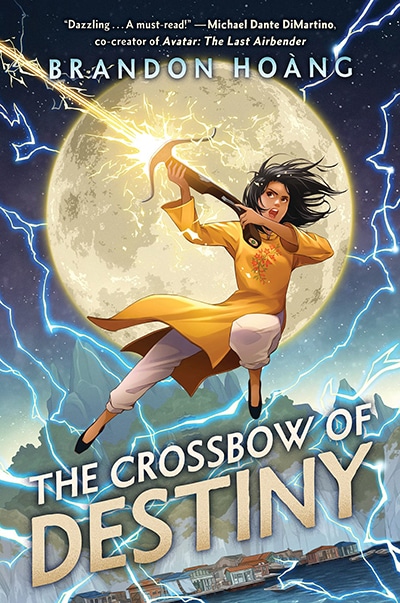
The Crossbow of Destiny
Brandon Hoang
(Scholastic Press)
(Scholastic Press)
- Fiction
- Set in Vietnam
Key words: Fantasy, mythology, adventure, grandparents
When Vietnamese American Freddie Lo finds herself in Vietnam for the first time since she was little, she’s not quite sure how to feel. The memories of her extended family are more like distant echoes; she has a tough time speaking Vietnamese; and she can’t help but feel like she just isn’t Vietnamese enough. Still, this is her chance to reconnect with her family, especially her Ong ngoai — or grandfather — who is receiving a big award.
That’s when Ong ngoai reveals his secret: He knows the location of an ancient legendary crossbow, one with the power to decimate armies — and he’s hidden it away from those who intend to use its magic for evil. But when Ong ngoai is kidnapped, it’s up to Freddie, her cousin Lien, and a mysterious boy named Duy to get to the crossbow before it ends up in the wrong hands.
In this Indiana Jones-style adventure, readers will travel through Vietnam — from its seaside villages, to the swamps of the Mekong Delta, to the majestic Marble Mountains of Da Nang — as Freddie learns what it takes to be a hero.
Guess these mountains are used to keeping secrets.
—The Crossbow of Destiny (page 203)
Appropriate for Grades: 5–7
Best for Grades: 5–6
Introduction to the Book
Brandon Hoang’s The Crossbow of Destiny is pure adventure fun for young readers. Though hints of serious underlying themes abound, Hoang is not heavy-handed. In fact, most young and many adult readers may miss the oblique references to more complicated cultural matters. When adding this novel to a curriculum, it’s best to focus on the plot-driven reading experience it offers.
Best Matched Curricular Units
- Destiny
- Compassion
- Identity (through language)
- Heritage
Essential Questions
- How does language affect relationships?
- What makes a hero?
- How do legends (folktales, myths, etc.) define us?
Note to Teacher: A useful glossary is available in the back matter of the book. The Vietnamese con, bác, bà ngoai, ông ngoai and con hổ should be introduced before students read the book. Vietnamese is used frequently throughout, and some young readers may find it overwhelming without some preparation.
Suggested Activities
Pre-search. Before reading the novel, explore information regarding the following topics:
- Mangosteen fruit
- Saigon / Ho Chi Minh City (Why does this city have two names?)
- Da Nang (geography and tourist landmarks)
So Close, Yet So Far. Freddie constantly finds herself at the very edge of reconnecting to her Vietnamese home and family, but the haziness of her memories and her fading language abilities prevent her from fully reclaiming her place in Vietnamese society. Find a passage that illustrates this frustrating challenge for her. (Page 19 has one such passage.)
Food Stall Day. Vietnamese food appears frequently—fish, noodles, desserts—at home, at the market, in the city, and during special occasions. Choose a dish. Make a copy of a photo or create a drawing to illustrate the dish, list its ingredients, and describe how it would be served. Students set up “food stalls” with their dishes and offer them to the other students in the class who roam the stalls and vote for which dishes look like something they would want to try. (Page 55 is a good place to start.)
Language Challenge. Throughout the book are passages such as:
“Xin lỗi,” Freddie mumbled, searching for the words to convey that she didn’t understand him. “Con không… hiếu.”
How does the author use language to create empathy for Freddie’s experience?
Mangosteen Symbolism. The mangosteen appears several times throughout the story (See pages 47, 62–63, 82, 97, and 240.) Search for the passages and then decide who or what the fruit symbolizes. (This is explicitly stated on the final page of the story.) Find evidence that shows how Freddie’s characteristics align with the description of the mangosteen. Draw a picture that illustrates their symbolic connection. Extension question: If the fruit is Freddie, then who or what would the mangosteen tree itself symbolize?
Fairy Tale Endings. “Fairy tales always ended the same way—with more questions than answers” (p. 52). What does Freddie mean? Think of a fairy tale from your own cultural heritage. What answers does it provide at the end? And what questions does it raise? Are some fairy tale endings more complex than others?
Ao Dai Decorating (Page 84). Share pictures of various áo dài so that students can get an idea of the different designs and colors used as well as how they might vary based on the different occasions when they are worn. Provide an áo dài coloring outline, and have students decorate the áo dài for an important occasion in their own culture while still using Vietnamese color and design language.
Forgotten Land Mines. Nhất quips at the children, “Or, heaven forbid, you uncovered an old forgotten land mine” (p. 173). Have students research why he might say such a thing. Encourage the students to look into some of the current methods the Vietnamese use to prevent landmine deaths.
Suggested Discussion/Writing Prompts
Themes to Explore. Finding Identity. Family Culture. Home. Destiny versus Luck.
Vietnamese-ness. What makes someone more Vietnamese than another? Can Freddie ever be as Vietnamese as Liên?
Legends and Folklore. Ông Ngoai says, “The thing about these old stories is that they shift after being passed down from generation to generation. They evolve. You could say that these legends are a reflection of our own lives” (p. 52). What is Ông Ngoai trying to tell Freddie and Liên? This question could be examined during the reading and/or after the book is finished.
Legends and Folklore Extension: Later Ông Ngoai continues in a similar vein during his speech when he argues, “…folklore says more about us as a people than history books filled with facts. They hold our dreams. They hold our ideals.” What does he mean? How is this true of folklore from your own culture?
Characterization of Nhat. Early on before we know Nhất is “the bad guy,” he is characterized in a manner that foreshadows his future misdeeds. Once his ill intentions are finally revealed, have students go back and look for the clues they may have missed (or caught) prior to the reveal. Example: “Nhất took the podium, a brilliant smile plastered on his face” (p. 88).
Character Development of Freddie. Characterize Freddie when she arrives in Vietnam at the start of the novel. Characterize her again during her experience in the jungle. Characterize her once more after the confrontation in the caves beneath the Marble Mountains. What is the key to her growth at each step in the journey?
Home. Why does it hurt Freddie so deeply when Liên says to her, “This is my home—and it hasn’t been yours for a long time” (p. 170)? Is Liên right?
Final Questions. Were Freddie’s good choices along the way “just luck” (her words) or “destiny” (Ông Ngoai’s words)? Will Freddie be satisfied with life when she returns to her home in the U.S.?
Author: Josh Foster
Writer, Educator, Learner
2026
NCTA webinar with author Brandon Hoang
© 2024 NCTAsia