
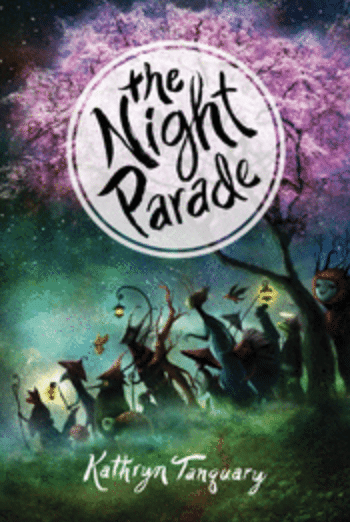
The Night Parade
By Kathryn Tanquary (Sourcebooks Jabberwocky)
- Fiction
- Set in Japan
Keywords: fantasy, folklore, adventure, friendship
A fantasy story that will appeal to many middle school students, The Night Parade bridges past and present Japanese cultural customs. It is filled with wonder and imagination, as well as respect and admiration for cultural tradition, and provides a window into Japanese mythology.
The Night Parade is a fantasy set in Japan. Its primary themes are bullying and learning to see bullies for who they truly are, learning to overcome challenges, learning courage, and perhaps most importantly, learning to be true to oneself. The author draws on her lived experience in Japan to integrate these themes with Japanese folklore. Although this is a fantasy, students can be engaged to learn more about Japan’s history of the “strange and mysterious” through this book, as well as Japanese customs and traditions. At the same time, students should understand that the story is a creative mixture of folklore and the author’s imagination. Much that is based on Japanese culture and folklore becomes pure fantasy in this book.
The Japanese people have long been fascinated by the strange and mysterious. There has always been an acceptance of the existence of things that could not be easily explained, such as bakemono (changing things; shape-shifters), yōkai (a broader category of mysterious phenomena and manifestations), tricksters such as kitsune (fox) and tanuki (raccoon-dog), and yūrei (human ghosts). A parade of yōkai known as “Night Parade of One Hundred Demons” (Hyakki yagyō) dates at least as far back as the Muromachi period (1392–1573) and serves as the inspiration for the night parade in this story.
The story begins with thirteen-year-old Saki’s family driving from Tokyo to their ancestral village to spend time with Saki’s grandmother during the August festival of Obon. This is a festival to welcome the ancestors back to their home. Typically, Obon starts by welcoming spirits of the deceased back from the local cemetery to the family home, using fire to draw them back. In Nagano, my Japanese family would have a Buddhist altar set up in the living room, with food, flowers and incense. A Buddhist priest would visit and offer prayers to the ancestors. Cleaning up the tombs in the cemetery is also part of the ritual. The three-day celebration also involves bonodori, dances in the village squares, with food, games and entertainment part of modern practices. The typical dress for the dances is the yukata, a lightweight summer kimono with either thin or thick belts or sashes (obi). Yukata are also worn in Japanese onsen (hot springs) and hotels when guests are resting or going to and from the communal bathing facilities. Saki’s grandmother’s use of yukata as daily wear outside of the house is unusual in Japan today.
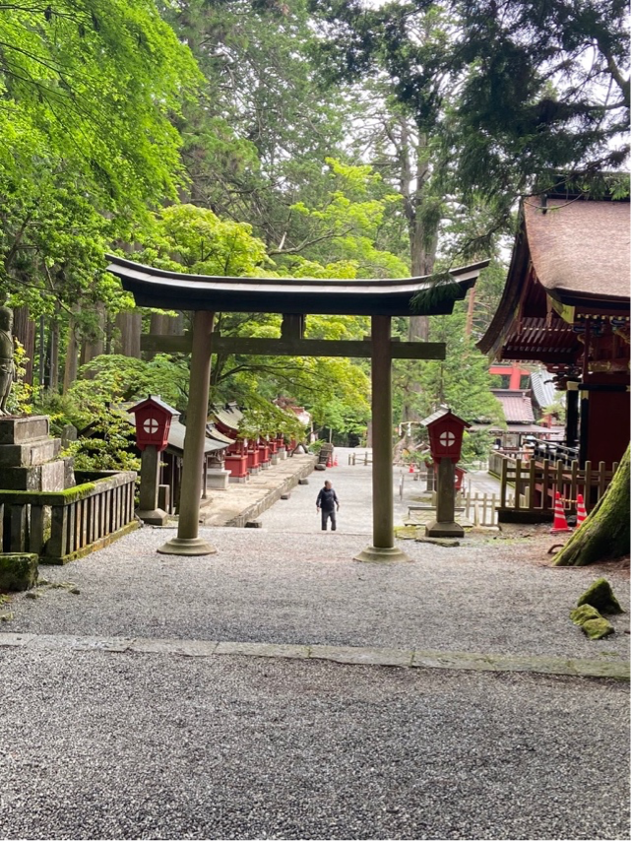
Author’s photo, 2023
Japan has a long history of combining native Shinto practice with Buddhist practice. In the late 1800s, the two religions were officially separated by the state, but they continue to be intertwined to some extent. The story reflects this history of intermingling, sometimes to great confusion. A “shrine” in Japan is a Shinto site, which can be a single building or a complex. A “temple” always refers to a Buddhist site. A torii is a gate that marks the entrance into sacred space and is associated with Shinto even though torii will appear at temple sites as shown below.
Likewise, a common practice when entering a Shinto shrine or Buddhist temple complex is to stop just inside the entrance to purify oneself by rinsing your hands and mouth with clean water, a Shinto practice. Sakaki trees (Cleyera japonica), mentioned often in the story, are sacred trees associated with Shinto.
Depopulation is a serious problem in rural Japan, with fewer and fewer resources available for rural families. Buddhist temples and cemeteries as well as Shinto shrines in the countryside have become neglected, as older Japanese like Saki’s grandfather pass away and younger family members who often live in the large urban areas like Tokyo rarely visit their ancestral villages.
The author frequently uses the English word “shrine” loosely; sometimes it means a Shinto shrine, sometimes it seems to mean a fantasized mixed temple/shrine/castle site. She also integrates Shinto kami (spirits) and denizens of the strange and mysterious into the story. The following is a list:
Sakaki tree spirits (p. 109): part of Shinto belief is the existence of nature spirits or kami. The anime My Neighbor Totoro features tree spirits in the form of Totoro and his companions.
Yōkai in the story include the umbrella, biwa, sandals, lanterns, and other daily use items, which embody spirits and are often featured in the “Night Parade of the One Hundred Ghosts and Demons.”
Shape-shifters are common among the bakemono, as are tricksters. The fox guide is one such trickster (Chapter 5). Foxes are said to love udon (a type of thick noodle), and enjoy fooling humans, including shape-shifting into human form for either good or evil purposes. A fox with more than one tail is thought to be older, wiser, and more powerful. Foxes are also the messengers of Inari, the Shinto deity of rice, and in that role often appear with a granary key in their mouth (p. 169). The tanuki (Chapter 15) is also a trickster and shape-shifter; the teapot that turns into a tanuki is based on traditional folklore.[i] Both foxes and tanuki are real animals in Japan. Other bakemono are part of the strange and mysterious world of the imagination. Tengu, the long-nosed yōkai appearing first on page 144 has been characterized both as a martial spirit as well as having connections with Buddhist practice. Tengu could transform into Buddhist priests and nuns to delude people but eventually were seen as spirits that could transfer their powers to humans who worshipped them.
Other yōkai include the long-necked lady on p. 167 who is a rokurokukubi and often appears in literature and the arts. What the author refers to as ogres are almost certainly oni, demonic spirits that cause trouble for humans and may be manifestations of the inherent dark side of humankind. Oni can manifest as Buddhist monks, as in this story. Kappa (p. 79) are small green creatures with a turtle-like shell on their backs. They dwell in rivers and ponds, love cucumbers, and were traditionally blamed for drownings. To weaken them, one tricks them into bowing, thus spilling the water in the dish-like depression on its head—the source of their strength. Finally, the animals and insects dressed like humans, including like soldiers, appear in Japanese paintings and prints dating back centuries.
Other manifestations include Yamauba (also known as Yamamba), the mountain woman, who can be either benevolent or malicious (p. 91). The Daruma doll (p. 72) is based on the legend of the founder of Chan (Zen) Buddhism, who meditated in a cave in China for nine years until his arms and legs atrophied (but he achieved enlightenment!). The Daruma doll typically has a round shape and unpainted eyes. People paint in one eye and make a wish, such as to pass an exam, and on achieving success, they paint in the other eye. The faceless man appearing on p. 100 recalls a scene from the 1994 anime Pom Poko (Heisei Tanuki Gassen Pom Poko) by Studio Ghibli. This film is highly recommended since the tanuki main characters are surrounded by a multitude of yōkai and there is a long scene of a Night Parade. Teachers should preview the film before showing it however, and it is much better in Japanese with subtitles than the dubbed version.
All of the above are creatures that feature in both ancient Japanese literature and paintings and prints as well as in modern and contemporary Japanese films, anime, and videogames. In addition, the Shinto idea of purity and cleanliness appears more than once in the story, particularly when Saki is forced to clean out a fifthly bathroom (p. 175). Another example of this is the repeated pollution and filth in the anime Spirited Away, where another young Japanese girl, Chihiro, is trapped along with her parents in a spirit-filled town during a trip to their new home.
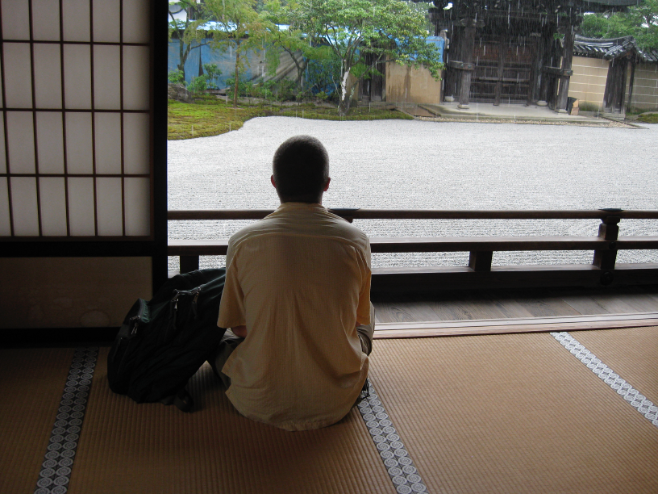
Finally, there are a few things to note that don’t resonate with Japanese culture. Although perhaps a minor point, the use of the word “chamber” for a Buddhist main worship hall (kondō) seems very odd as is the arrangement of the interior. The “walkway” of Grandma’s house is most likely referring to a veranda (engawa). The description of it as a covered outside area where one sits or walks is correct. Engawa run alongside a traditional style house, can be accessed directly from rooms in the house, and are an architectural feature that dates back centuries.
One of the most puzzling aspects is the consistent use of Tomo Maeda’s family name when referring to her while all other Japanese girls in the book are referred to by their given name. In Japan, one always refers to those outside their close group of friends or family by their family name, followed by the honorific –san (as in Maeda-san). “Inside group” friends, such as Saki’s friends in Tokyo, might be referred to by their first name, depending on the closeness of the relationship. But new acquaintances such as the group of bullies that Saki encounters in her grandmother’s village would always be referred to by their family name + -san, in accordance with the correct use of Maeda for Tomo—as none of these village teenagers are close friends of Saki’s.
Author: Brenda G. Jordan, former University of Pittsburgh NCTA Director
2025
[i] For more on tricksters, see Brenda G. Jordan, “The Tricksters in Japanese Art,” Education About Asia, Vol 18, No. 1 (Spring 2013), pp. 26-31. https://www.asianstudies.org/publications/eaa/archives/the-trickster-in-japanese-art/
Archived Book Group (Once you have created a login for yourself at asiaforeducators.org, you are able to view and access all current and archived offerings from the main page. One (free) login suffices for all)
© 2024 NCTAsia