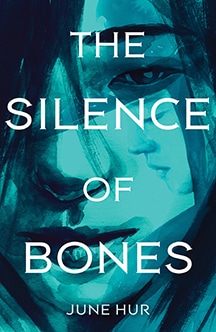
The Silence of Bones
By June Hur (Macmillan)
- Fiction
- Set in Korea
Keywords: mystery, women, family, perseverance
1800, Joseon (Korea). Homesick and orphaned sixteen-year-old Seol is living out the ancient curse: “May you live in interesting times.” Indentured to the police bureau, she’s been tasked with assisting a well-respected young inspector with the investigation into the politically charged murder of a noblewoman.
As they delve deeper into the dead woman’s secrets, Seol forms an unlikely bond of friendship with the inspector. But her loyalty is tested when he becomes the prime suspect, and Seol may be the only one capable of discovering what truly happened on the night of the murder.
But in a land where silence and obedience are valued above all else, curiosity can be deadly.
June Hur’s The Silence of Bones is a richly detailed murder mystery set in early 1800s Joseon Korea (1392–1910). Hur’s exquisite attention to detail brings the Joseon period to life for the reader. In order to better understand the context of the novel, here is a brief overview of the Joseon period.
The Joseon Dynasty: Society, Ideology, and Persecution
Confucianism as State Ideology
The Joseon period lasted over 500 years, from 1392 to 1910. It started when the military leader Yi Seonggye (also rendered Yi Seung-Gye) overthrew the Goryeo dynasty (918–1392) and moved the capital at Hanyang (modern-day Seoul). The new dynasty embraced Neo-Confucianism as its guiding philosophy. It completely reshaped how Korea was governed, how people were educated, and how they lived their daily lives.
Power in Joseon Korea belonged to the yangban, the scholar-official class. They had to prove themselves by mastering the Confucian classics and passing incredibly difficult civil service exams modeled after the Chinese system. Their days were filled with scholarly pursuits, running the government bureaucracy, performing elaborate ancestral rituals, and setting a moral example for the rest of society.
Neo-Confucianism brought a whole system of rules for how people should behave, interact with family and organize society. At the heart of this system were the Five Relationships: between ruler and subject, father and son, husband and wife, elder brother and younger brother, and friend and friend. These relationships defined how Koreans interacted with each other in daily life. Rituals, ancestor worship, and filial piety became the essential fabric of everyday life. Confucian academies called seowons emerged all over the kingdom, serving as both schools and sites where scholars honored important Confucian thinkers. Meanwhile, the government actively worked to marginalize Buddhism by seizing temple lands and limiting its influence. Through all these efforts, Joseon Korea was deliberately shaping itself into a model Confucian society.
Stratified Society and Social Rigidity
Joseon society had a rigid hereditary class system that made social mobility nearly impossible.
At the top were the yangban aristocrats: about 10 percent of the population, they controlled political power and land. The yangban monopolized education and the civil service exams, keeping their privileged status across generations. Despite professing Confucian ideals, many yangban men enjoyed spending time at kisaenghouses (female entertainers), gambling, and engaging in political intrigue.
Below them were the jungin (“middle people”): educated professionals like doctors, interpreters, and astronomers, they were essential to government but couldn’t advance beyond their rank.
The sangmin (commoners) formed the majority: farmers, artisans, and merchants. Farmers were theoretically respected as producers but faced heavy taxes and forced labor. Merchants, though economically important, ranked lowest among “honorable” occupations because Confucians saw them as parasites profiting from others’ work.
At the very bottom were the cheonmin (“base people”): slaves (nobi), butchers, entertainers, and outcasts. Slavery was hereditary and widespread, at its height accounting for a third of the population. Unlike other slave systems, some Joseon slaves owned property and lived semi-independently, but they still faced severe discrimination and were subject to their masters’ control. Slavery was abolished in the late nineteenth century.
Women in Joseon Society
Confucian ideology created a deeply patriarchal society that severely restricted women. The principle of male superiority shaped everything from family structure to legal rights. Women were expected to follow the “Three Obediences,” obeying their father before marriage, their husband after marriage, and their son in widowhood. The ideal woman was chaste, obedient, and self-sacrificing.
Women’s rights declined gradually during the early Joseon period. Initially, women could inherit property and widows could remarry, but by the seventeenth century, both became heavily restricted or banned. The state even built commemorative gates honoring widows who stayed faithful to dead husbands or committed suicide after their husband’s death. Upper-class women were confined to the inner quarters of the home and had to wear face-covering veils outside.
Female education focused on domestic skills and moral instruction, not classical learning. While some yangbanwomen learned to read, they were completely excluded from civil service exams and politics. Women couldn’t own property, and marriage meant joining the husband’s family, often losing contact with their birth families. Despite these restrictions, women found ways to exercise influence within the home. The invention of Hangeul was particularly important because it allowed more women to become literate.
The Persecution of Korean Catholics
Christianity came to Korea in an unusual way, through books rather than missionaries. In the late eighteenth century, a scholar named Yi Seung-hun discovered Catholic texts during a diplomatic trip to China and became curious about the faith. He was baptized by a Jesuit missionary and returned to establish Korea’s first Catholic community in the 1780s, all without any foreign missionaries. This makes Korean Catholicism’s origin story unique.
The Joseon government saw Catholicism as a serious threat to the Confucian social order. Catholic teachings about equality before God directly contradicted Neo-Confucianism’s hierarchical principles. Even more problematic, Catholics refused to participate in ancestor worship ceremonies, which the government interpreted as rejecting family, society, and even the state itself.
Persecution began in 1791 and continued through major purges in 1801, 1839, 1846, and 1866. The government targeted both Korean believers and foreign missionaries who had secretly entered the country, executing thousands. Despite this brutal suppression, the faith survived underground as believers met in secret at enormous personal risk.
Catholics finally gained the freedom to practice openly in the 1880s. The Korean Catholic Church reorganized in 1962, and by the early twenty-first century, South Korea had about 4.5 million Catholics.
Legacy
The Joseon dynasty’s 500-year reign left a profound mark on Korean identity that persists today. The Confucian emphasis on education created a culture that still prioritizes academic achievement and respect for teachers. The civil service examination system laid the groundwork for modern Korea’s highly competitive education system and meritocratic ideals. The invention of Hangeul democratized literacy and became a source of national pride. The dynasty’s hierarchical social structures influenced modern Korean concepts of age-based respect and proper social relationships. While many Joseon-period restrictions have been dismantled, the dynasty’s cultural and philosophical influence remains woven into the fabric of Korean life.
Author: Lori A. Snyder, History Teacher, Longmeadow High School
2026
Bibliography
Cawley, David N. “Dangerous Women in the Early Catholic Church in Korea.” In David W. Kim, Religious Transformation in Modern Asia: A Transnational Movement, Numen Book Series, vol. 148. Leiden: Brill, 2015. Accessed December 15, 2025.
Han, Hee-sook. “Women’s Life during the Choson Dynasty.” International Journal of Korean History 6 (December 2004): 113–53. Accessed December 1, 2025.
Seth, Michael J. “Choson Society.” In A Concise History of Korea: From Antiquity to the Present, 3rd ed. New York: Rowman & Littlefield, 2020.
——. “Confucian Korea: The Joseon Dynasty (1392–1910).” In A Brief History of Korea : Isolation, War, Despotism and Revival: The Fascinating Story of a Resilient but Divided People. North Clarendon, VT: Tuttle Publishing, 2019.
Wall Street Journal. “A Brief History of the Catholic Church in Korea.” August 14, 2014. Accessed December 2, 2025.
June Hur’s The Silence of Bones is a richly detailed murder mystery set in early 1800s Joseon Korea. It follows Seol, a damo or young female police servant, as she assists the reserved Inspector Han in the investigation of the murder of a noblewoman who had been brutally disfigured. In the process of the investigation, she uncovers connections to forbidden love, to dangerous religious ideas and even to her own painful past.
Hur’s intricate mystery of the death of Lady O mirrors the intricacy of the Joseon period itself. Hur includes details of the inner workings of Joseon society from the emperor at the very top to butchers and executioners at the very bottom. Seol’s character has a unique role in the story. A woman of low rank, she is regularly overlooked by more powerful players. Her relative “invisibility” allows her opportunities to uncover hidden clues as people around her speak freely in her presence. Her innate inquisitiveness and skepticism result in a relentless quest for truth and justice for the deceased. Increasingly, she finds herself navigating dangerous situations, but she refuses to give up until justice is served. Additionally, Seol’s partnership with Inspector Han demonstrates that uncovering truth requires determination, the courage to challenge those in power, and close collaboration. Through these narrative choices, the book raises important questions about who controls information, whose voices are heard, and how systems of power can obstruct justice.
Silence and Voice
Hur uses silence and voice as major themes that connect with bigger ideas about power, truth, and identity. The book begins with the murder of Lady O, who is silenced forever. Silence is the expected norm for all women, from the low-ranking damo to the highest-ranking noblewomen. As the story progresses, many characters choose silence because it keeps them alive. Seol tries to live by the motto, “I have a mouth, but I mustn’t speak; ears, but I mustn’t hear; eyes, but I mustn’t see.” Fortunately for the investigation, she fails to keep quiet about what she observes (p. 11). Seol learns when it’s smart to speak up and when keeping quiet is the better option. As she investigates the murder, she’s also discovering her own voice and agency. The more she uncovers about the crime, the more she realizes she has the power to speak up, even when it’s risky. Her partnership with Inspector Han matters because he’s someone who actually listens to her and values what she has to say. In the end, refusing to stay silent becomes a form of resistance. When Seol and others decide to voice dangerous truths, they’re challenging the social order that relies on their silence. There’s even some irony in the title: the bones might be silent, but they force the people examining them to speak up.
Identity and Belonging
Another powerful theme in the book is identity and belonging. As an orphan and low-ranking damo, Seol struggles to find her place in such a rigid society. Her childhood memories allude to her family’s loss of privilege and status among the aristocracy. The mystery of her older brother’s disappearance and abandonment also plays a prominent role in the story as Seol’s investigation of the murder leads to her discovering and confronting secrets from her past. This theme of identity will resonate particularly well with older adolescents navigating their own understanding of who they are in relationship with their family.
Common Core ELA Standards for Reading Literature
Here are some key ELA Common Core standards that would apply to reading The Silence of Bones:
- RL.9-10.1 or RL.11-12.1: Cite strong textual evidence to support analysis of what the text says explicitly as well as inferences drawn from the text.
- RL.9-10.2 or RL.11-12.2: Determine themes and analyze their development over the course of the text.
- RL.9-10.3 or RL.11-12.3: Analyze how complex characters develop, interact with others, and advance the plot or develop the theme.
- RL.9-10.6 or RL.11-12.6: Analyze a particular point of view or cultural experience reflected in a work of literature from outside the United States.
This book is best used in a high school ELA classroom. The historical fiction murder mystery plotline is set against rich details of Joseon Korea (1392–1920). The plot is intricate. It’s strongly recommended that students be familiar with the basic tenets of Confucianism and understand the term patriarchy before reading the book (see Culture Notes for this book). Hur introduces a myriad of Joseon terms but is careful to provide definitions or an understanding from context. How and why Catholicism was forbidden during this time would also be helpful to the reader as this plays an important role in the development of the story and of Seol, herself. Beyond ELA, The Silence of Bones also works well in a premodern World History or Asian Studies classroom as enrichment reading. Korean history is often overlooked in World History courses as the “shrimp between the two whales” of China and Japan. This book provides a fascinating glimpse of Joseon society that would allow students to compare and contrast their study of premodern China and Japan with Korea. Students will gain a deep understanding of the rigid social hierarchy and patriarchy of Joseon Korea.
Suggestions for Using The Silence of Bones
Before Reading
Historical Context Stations: Set up learning stations around the room covering Joseon-period Korea: historical overview, Confucianism basics, social stratification, the role of women, Catholicism in Joseon Korea. Students rotate through stations taking notes to build background knowledge.
During Reading
Vocabulary Journal: Have students create an ongoing vocabulary journal for Korean terms used in the novel (damo, yangban, norigae, etc.). They can add illustrations, definitions, and examples as they read.
Scene Illustration: Students choose a pivotal scene and create an illustration with a written explanation of their artistic choices and the scene’s significance.
Evidence Board: Set up a class “murder board” like detectives use. Students add clues, suspects, and theories as they read, updating it after each section. This makes the investigation process visible and collaborative.
Post Reading
Podcast Episode: Groups create a true-crime style podcast episode analyzing the case, incorporating textual evidence and discussing the social context.
One-Pager Activity: Students create a one-page summary of the book that includes elements determined by the classroom teachers such as scene illustration, student-generated discussion questions, a rating, plot summary, character development, and so on.
Author: Lori A. Snyder, History Teacher, Longmeadow High School
2026
Fill out the online form to access the NCTA webinar with author June Hur
Publisher’s Reader’s Guide
ABA Indies Introduce Selection
© 2024 NCTAsia