The Waiting
By Keum Suk Gendry-Kim, Translated by Janet Hong (Drawn and Quarterly)
- Fiction
- Set in Korea
Keywords: graphic novel, translation, war, family, women
Keum Suk Gendry-Kim was an adult when her mother revealed a family secret: She had been separated from her sister during the Korean War. It’s not an uncommon story—the peninsula was split across the 38th parallel, dividing one country into two. As many fled violence in the north, not everyone was able to make it south. Her mother’s story inspired Gendry-Kim to begin interviewing her and other Koreans separated by the war; that research fueled a deeply resonant graphic novel.
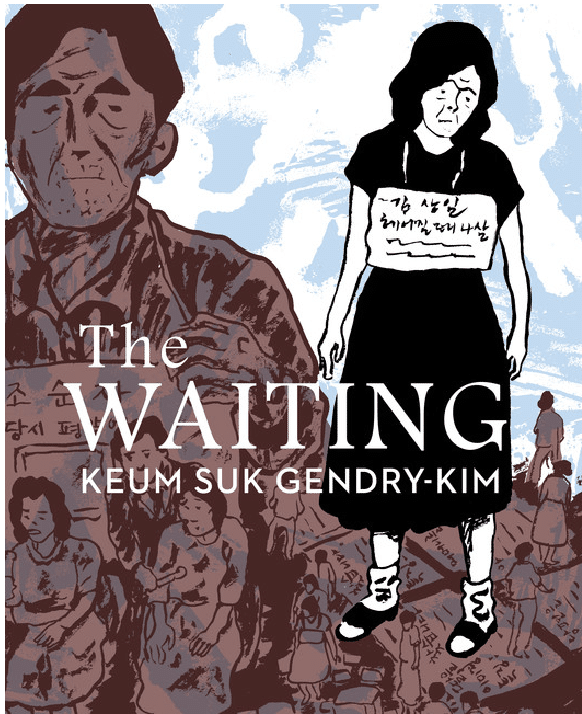
The Waiting is the fictional story of Gwija, told by her novelist daughter Jina. When Gwija was 17 years old, after hearing that the Japanese were seizing unmarried girls, her family married her in a hurry to a man she didn’t know. Japan fell, Korea gained its independence, and the couple started a family. But peace didn’t come. The young family of four fled south. On the road, while breastfeeding and changing her daughter, Gwija was separated from her husband and son.
Then seventy years passed. Seventy years of waiting. Gwija is now an elderly woman and Jina can’t stop thinking about the promise she made to help find her brother.
Korea’s modern history is a story of colonization, war, division, and extraordinary endurance—from Japan’s colonialization of the Korean peninsula (1910–1945) to the devastation of the Korean War (1950–1953) and the division into North and South Korea that followed. The Waiting, a graphic novel by Keum Suk Gendry-Kim, brings that history to life through one family’s experience. Based on memories from the author’s mother, the story captures the emotional cost of separation and the quiet persistence of hope that defines much of modern Korean identity.
Following Japan’s annexation of Korea in 1910, colonial authorities sought to reshape Korean society in Japan’s image. Japanese became the language of administration and education; Koreans were pressured to take Japanese names and adopt Japanese customs. Infrastructure projects, such as railways and ports, supported Japan’s industrial goals but benefited few ordinary Koreans.[i] Beneath the surface, cultural resistance continued, and the dream of independence survived in art, religion, and underground schools.
The end of World War II ended Japan’s rule but brought new tensions. Korea was divided at the 38th parallel, with Soviet forces occupying the North and American troops in the South. Within five years, ideological conflict erupted into the Korean War (1950–1953). The fighting displaced millions and left families scattered on both sides of the border. Some, like Gendry-Kim’s mother, fled south during the chaos and never saw their loved ones again. The Waiting focuses this historical reality into a personal story, centered on a woman named Gwija who carries her longing across decades.
During and after the war, both Koreas endured hardship. In the North, reconstruction followed a communist model tied to Soviet aid; in the South, U.S. support fueled rebuilding and a democratic model of government but also political instability. Authoritarian governments in Seoul during the 1960s and 1970s emphasized rapid economic growth while restricting political freedoms. Many older South Koreans remained haunted by the loss of relatives in the North, a grief that found little public expression during this era of silence and censorship.
That silence is central to the narrative. Gwija’s daughter, Jina, a novelist, records her mother’s memories as they resurface late in life. Their exchanges reveal the emotional inheritance of a generation shaped by displacement. In Korean cultural tradition, such longing is often described through the concept of han (한; pronounced HAAN)—a feeling of deep sorrow, resentment, and unresolved yearning. The Waiting translates han into visual form, portraying absence and endurance through stark imagery rather than explicit sentiment.
The graphic novel’s black-and-white artwork gives emotional weight to the story, using light, shadow, and silence to express what the characters themselves cannot say. Gendry-Kim’s deliberate pacing and recurring motifs—roads, waves, empty rooms—mirror the emotional distance between past and present. Her work shows how visual storytelling can carry the emotional truth of history as powerfully as text.
The Waiting also speaks to South Korea’s broader transformation. From the 1960s to the 1980s, the nation’s industrialization—the “Miracle on the Han River”—lifted millions from poverty but often muted conversation about the personal costs of war. By the late 1980s, as democratization movements gained strength, stories of wartime separation and political repression began to surface. Artists, writers, and filmmakers used memory as a tool for national reflection, connecting private loss to collective healing.
Today, reunion programs occasionally allow elderly relatives from the North and South to meet briefly, often for the first time in seventy years. These encounters, heavily mediated by politics, remind readers that the war’s consequences are not confined to history books. The Waiting gives shape to that ongoing separation and asks readers to consider what it means to live with unfinished history.
Through its blend of memory, art, and restraint, The Waiting introduces readers to a Korea still negotiating the line between past and present. It reflects the strength of ordinary people who endured upheaval and the persistence of love across borders both physical and emotional. Gendry-Kim’s story, like many told by survivors of division, turns silence into remembrance and remembrance into a quiet form of reconciliation.
Author: Ron Sivillo, Social Studies Teacher, Upper St. Clair High School (Pittsburgh, PA)
2025
[i] Bruce Cumings, Korea’s Place in the Sun: A Modern History (New York: W. W. Norton, 1997), 169–175.
Keum Suk Gendry-Kim’s graphic novel tells the story of her mother, who was separated from her sister during the Korean War. Inspired by her mother’s tragic story, Gendry-Kim interviewed other Koreans whose families were separated by the war, and drew from their life stories to write The Waiting. With this work, teachers and librarians have the opportunity to add a personal dimension to the Korean War.
The Waiting is told from the perspective of a fictional mother and daughter, Gwija and Jina (pronounced: Jeh-nah), as Gwija (pronounced: QUEE-jah [“quee” as in “queen”]) shares the story of the loss of her brother seventy years earlier, and her daughter promises to find him. The book describes how families were separated during the forced migration, and the anguish it created.
Connections to Literature
Teachers of literature may choose to use this graphic novel in conjunction with other texts about war or family relationships. It may also be used in history classes to explore the effects of war on the people of Korea. Other texts that might be used with this graphic novel include Year of Impossible Goodbyes by Sook Nyul Choi and Beyond the Border by Tae-hyok Kim and Nicole Kim Rogers. Year of Impossible Goodbyes is the narrative of a ten-year-old boy in Korea who lives under Japanese rule during World War II; it highlights his experience with the colonial regime and the cruelties of war. Beyond the Border shares Tae-hyok Kim’s experience of being captured at the 38th parallel and joining the South Korean Army’s fight to end Communist rule in his country.
Displacement
During the Korean War, many people in North Korea tried to escape to South Korea. Many Koreans were forced to flee their homes, seeking safety. In The Waiting, Gwija steps aside to nurse her child while marching south with other refugees; in the process, she loses track of her husband and her young son, whom she never sees again. Author Julie Lee also explores this idea in her book In the Tunnel, about a young refugee who loses her father when he is taken by the secret police, and who becomes trapped in an enemy tunnel during the war.
Forced Migration
This text explores the hardships that can result from leaving home in search of survival and safety. The decision to stay or to go, determining which alternative will be safer, is a battle faced by all during a forced migration. The book also deals with the struggles of having to make these decisions as a teen or young adult. Another Freeman Award Winner, Brother’s Keeper (2020), explores a sister and brother’s plight to escape North Korea on their own and would be an ideal companion to The Waiting.
Bias
Students should understand that many of the books they read have an inherent bias. Sometimes it is deliberate, and sometimes it is an unconscious bias. Exploring the concept of bias with students will help to make them more conscientious and empathetic readers. It could inspire them to use more primary sources and explore different viewpoints on historical events. The Library of Congress has a wonderful collection of oral histories available through the Veteran History Project, as does the Korean War Legacy Foundation, which features the viewpoints of Koreans, Japanese, Chinese, and British, as well as American military and government officials stationed in Korea.
Grade Levels
This book is recommended for use with high school students (grades 9–12), in humanities courses, world history, U.S. history, and Asian studies. The subject matter highlights the extreme violence and turmoil of war along with the loss of family; these topics might be too intense for younger students.
Suggestions for History, Social Studies, and Humanities
This text explores the kinds of life-or-death decisions many are forced to make during wartime or under dictatorship. The use of violence to create fear can be seen throughout history—for example, in the violence leveled against millions of newly freed African Americans during Reconstruction (1861–1900). Detailed images in the graphic novel allow the reader to visualize the struggles experienced by many refugees and those trapped in war. Exploring artifacts of survivors and items left behind can help students deepen their understanding, and this activity also connects to the National Social Studies Standards. Such materials can be found in the National Archives. Students can also use state or Common Core research standards to delve deeper into why the Korean War is referred to as the “Forgotten War.” They can look at a timeline to see what was happening ten years before and after the war. They could also research present-day Seoul and its economy to see the progress that South Korea has made since the Korean War. Students might research a World Heritage Site in Korea and share with their classmates what they learn about Korean culture. Here are two websites that may be helpful:
- https://www.koreanculture.org/korea-information-culture-and-the-arts
- https://www.cia.gov/the-world-factbook/countries/korea-south/
Racism and Xenophobia
When living under an occupation, people may struggle to determine where they belong. The division of a country can lead to mistreatment and racism by those of the same nationality, as well as by those in control. The Waiting explores what is lost from family, daily life, and personal identity during a war. The fear that continues to plague a survivor long after their war experience may explain why some secrets are kept forever and why some are revealed only when the person finally feels safe, as Gendry-Kim’s mother did when she was older. Losing what one knows and struggling to find oneself are relatable challenges for teens, and will also connect to the National Social Studies Standards of Individual Development and Identity and Culture.
Experiential Learning Activities
This book began when Gendry-Kim’s mother shared a family secret that led the author to conduct other interviews with Koreans who were separated from family by the war. Inspired by this, students could interview an older family member who is willing to share a story about growing up. By using research skills found in the National Social Studies Standards of Global Connections and Individual Development and Identity, students will explore their own family while seeing themselves as part of history.
American Ancestors gives suggestions for planning and conducting a family interview:
https://www.americanancestors.org/conducting-family-history-interview
Students can listen to Korean War histories on the Korean War Legacy Site: https://koreanwarlegacy.org/interactive-library/
Exploring Primary Documents and Artifacts
- https://artsandculture.google.com/story/life-of-korean-war-refugees-national-archives-of-korea/tgVB5KsC_5i-EQ?hl=en
- https://artsandculture.google.com/story/life-of-korean-war-refugees-national-archives-of-korea/tgVB5KsC_5i-EQ?hl=en
Readings and Resources
- Choi, Sook Nyul. Year of Impossible Goodbyes. Boston: Houghton Mifflin, 1991.
- com Editors. “Korean War.” Updated May 11, 2022. https://www.history.com/topics/asian-history/korean-war
- Kim, Tae-hyuk, and Rogers, Nicole Kim. Beyond the Border. Independently Published, 2023.
- Lee, Julie. Brother’s Keeper. New York: Holiday House, 2020.
- Lee, Julie. In the Tunnel. New York: Holiday House, 2023.
- Lesney, Meredith. “Brother’s Keeper.” National Consortium for Teaching about Asia, n.d. https://www.nctasia.org/award/brothers-keeper/
- Library of Congress. “Korean War (1950–1953).” Veteran History Project Collection, n.d. https://www.loc.gov/collections/veterans-history-project-collection/serving-our-voices/korean-war/
- PBS Learning Media. “Let’s Talk Bias.” Ethics in the Classroom, n.d. https://lpb.pbslearningmedia.org/resource/cb19-ss-letstalkbias/lets-talk-bias/
Accommodations
Background information for emerging readers: https://kids.nationalgeographic.com/geography/countries/article/south-korea
Author: Mandy Perret, Gifted Teacher
2024
© 2024 NCTAsia