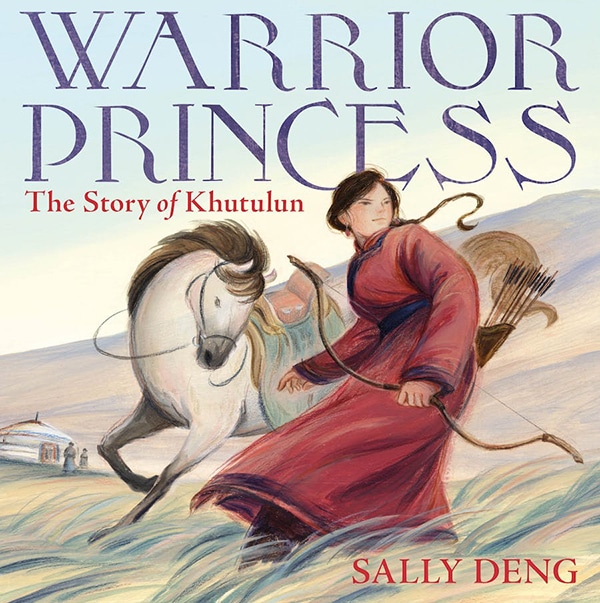
Warrior Princess: The Story of Khutulun
Sally Deng (Farrar, Straus and Giroux)
- Non-fiction
- Biography
- Set in China and Mongolia
Keywords: Romance, women, identity, war
An empowering and informative picture book biography about Khutulun, the great-great granddaughter of Genghis Khan, and how she defied the expectations of her time to become commander of the Khan’s army.
Just like the fourteen brothers that came before her, Khutulun, princess of her tribe, learned from an early age how to ride horseback, shoot arrows at full gallop and, most importantly, to wrestle. But as she grew older, her people wondered why their beloved princess had not yet married. So Khutulun vowed to marry any man that could defeat her at wrestling. Though she remained undefeated, Khutulun felt duty bound to throw a match to end the rumors and restore honor to her family. But when the day arrives, Khutulun’s heart is torn. In the heat of battle, would she–could she–make the decision to become a wife and not a warrior?
A story based on the life and legend of Khutulun, Warrior Princess is an inspiring tale of a princess who realizes that sometimes the best way to serve one’s community is to stay true to oneself and defy their expectations, brought to life by Sally Deng’s lush, sweeping paintings and additional backmatter about Khutlun’s life.
Sally Deng’s picture book Warrior Princess: The Story of Khutulun brings to life one of Mongolia’s most legendary figures, blending vivid imagery with tales of strength and independence. At the heart of the narrative is Khutulun, a figure whose reputation as a fearsome wrestler has captivated audiences for centuries. Yet, separating myth from historical reality reveals layers of cultural significance tied to Mongolian wrestling traditions, gender roles, and sartorial heritage.
Khutulun’s portrayal as a divine wrestler traces its roots to The Travels of Marco Polo, where she appears under the Tartar name “Aigiarm” and is described as a warrior princess so formidable that no man in her kingdom could defeat her. Suitors forfeited a hundred horses each time they lost to her in combat, and since no one was able to defeat her, she amassed ten thousand horses.
However, scholarly research casts doubt on the historical veracity of Khutulun’s mythic wrestling prowess. A study of Mongolian wrestling during the twelfth to fourteenth centuries concluded that while Marco Polo’s account mentions a royal princess as a successful wrestler, there is no evidence of women participating in traditional Mongolian wrestling (Batmunkha and Boldbaatar 996). Wrestling, part of the “Eriin Gurvan Naadam” (Three Manly Games: wrestling, archery, and horse racing), was historically a male domain. Khutulun’s story, as recounted by Marco Polo, is most likely based on legend rather than factual record.
Wrestling, or “bukh,” occupies a sacred place in Mongolian culture, symbolizing strength, nobility, and tribal identity. Batmunkha and Boldbaatar emphasize that wrestlers were revered as “symbols representing ancient ideas of strength, outstanding sportsmanship, and nobility,” and wrestling became integral to state ceremonies during the Mongol Empire” (988). During Khutulun’s era (13th century), two distinct wrestling costumes prevailed. One, similar to the long-sleeved top and shorts depicted in Deng’s book, featured a “zodog” (chest garment) with an open front and “shuudag” (short pants)—though Deng’s artistic rendering of a feminine top deviates from historical reality, as male wrestlers’ zodogs were designed for functionality, with exposed chests to facilitate grappling (Batmunkha and Boldbaatar 997). The other wrestling costume consisted of wide, long pants called “banjil,” worn in some regions for wrestling (Batmunkha and Boldbaatar 993). These garments reflected the sport’s masculine origins, with no specialized female versions existing at the time.
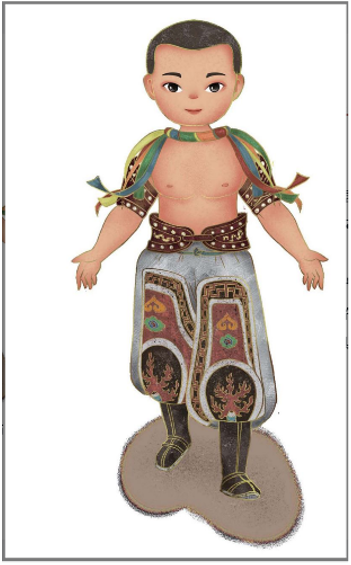
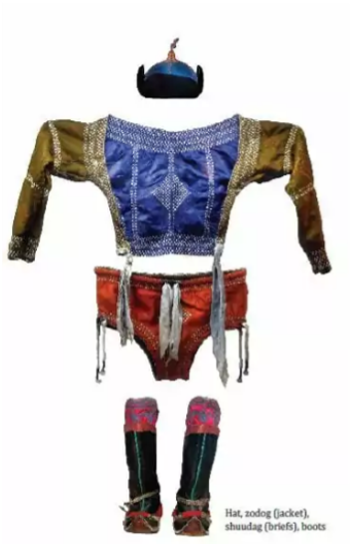
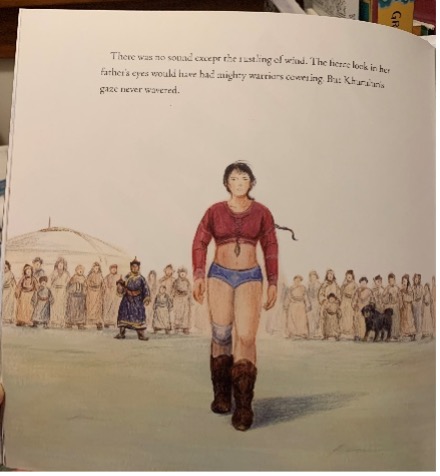
Mongolian everyday and ceremonial attire further enriches the cultural context of Deng’s book. As described inthe Chinese children’s book 《了不起的中华服饰:蒙古族》 [The Magnificent Costumes of China: Mongolian Ethnic Group], Mongolian clothing is characterized by “wide robes, broad sashes, and elaborate decorations, embodying the nomadic people’s bold spirit” (Yang 2019, author’s translation). Daily wear typically included fur robes and hats, as depicted in Deng’s illustrations of Khutulun’s family. Notably, Khutulun’s mother’s headdress bears a striking resemblance to the Barhu Mongol noblewomen’s headdress— “silver ornaments inlaid with corals, shaped like ox horns, which served as tribal emblems and symbols of royal status” (Yang 2019,author’s translation). This attention to detail aligns with historical records, where a king’s wife’s attire and accessories signified their clan’s identity and prestige.


In Warrior Princess, Sally Deng weaves myth and culture to celebrate Khutulun’s legacy, while grounding the narrative in authentic Mongolian traditions. Although Khutulun’s wrestling feats may be a product of legend, the book illuminates the central role of wrestling in Mongolian identity and the richness of the Mongolian nobility’s clothes and wresting attire.
While Warrior Princess: The Story of Khutulun shines with its vivid storytelling and thoughtful portrayal of Mongolian culture, it would have benefited from a list of the resources that the author consulted during her creative process. For readers and educators eager to dig deeper—whether to investigate the roots of Khutulun’s legend beyond Marco Polo’s account, verify details about Mongolian wrestling attire, or connect the book’s imagery to authentic cultural traditions—a resources list would have encouraged further exploration of the rich cultural context that shapes Khutulun’s story.
Author: Huan Li, Chinese children’s literature specialist, writer and teacher of children’s literature
2026
Bibliography
Batmunkha, Buyandelger, and Dalanbayar Boldbaatar. “Mongolian Wrestling (Bukh) during the Twelfth–Fourteenth Centuries.” The International Journal of the History of Sport 38, no. 9 (2021), pp. 988–1007.
Deng, Sally. Warrior Princess: The Story of Khutulun. New York: Farrar Straus Giroux, 2022.
Otgonbaatar, Altaibaatar. “What is Mongolian Wrestling?” Mongulai website, 6 June 2024.
Polo, Marco. The Travels of Marco Polo, translated by Robert Latham. New York: Penguin Classics, 1958.
Yang Yuan (杨 源). 《了不起的中华服饰:蒙古族》 [The Magnificent Costumes of China: Mongolian Ethnic Group]. Beijing: CITIC Press Group, 2019.
© 2024 NCTAsia