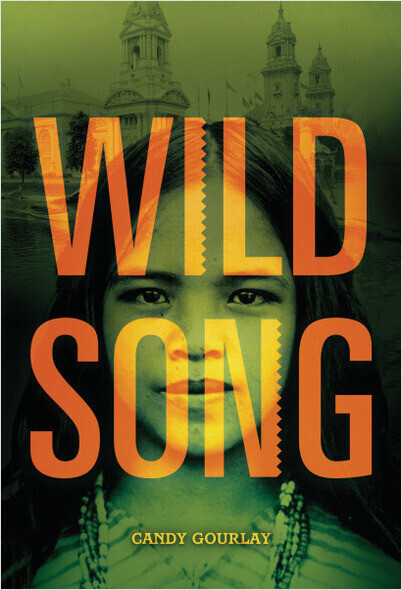
Wild Song
Candy Gourlay
(Lerner Publishing Group)
(Lerner Publishing Group)
- Fiction
- Set in The Philippines and America
Key words: Colonization, patriarchy, identity, persistence
Sixteen-year-old Luki is the best hunter in her village, but she has to keep it a secret. Hunting is a man’s skill. She’s expected to marry and raise a family instead. Chafing against these restrictions, she impulsively accepts an offer from the local American authorities: they’re looking for volunteers to travel to the United States for the World’s Fair, where Indigenous peoples from around the world will be represented.
Luki and others make the long journey to Saint Louis, Missouri, for the fair, where they’re “exhibited” in a replica village. But even as Luki makes friends and discovers a wider world that intrigues her, she learns dangerous secrets and difficult truths. Facing pressures from all sides, she must decide what kind of future she wants after the fair.
Filipino author and former journalist Candy Gourlay’s young adult novel Wild Song is set in the Philippines and the U.S. at the beginning of the twentieth century. It is a dramatic, overtly political book about an era in which Filipinos and Americans were taking each other’s measure, just after the U.S. had conquered the Philippines and begun its largest-ever experiment in colonial rule.
Gourlay had previously written another young adult novel, Bone Talk, featuring the same two primary characters as Wild Song’s when they were six years younger. In the newer book, our two principals—Luki (female) and Samkad (male)—are sixteen years old and have an unstable but persistent romance going. They are Bontok, a minority ethnicity living far up in the mountains of Luzon, the main island in the Philippines. Luki and “Sam” reside in a village—never named—that cherishes its traditions of attunement to nature, respect for ancestral spirits, and, on occasion, headhunting as a recognized form of retribution for the murder of a relative. The “wild song” of the title refers to the melodies that natural forms can, in Luki’s estimation, express under special circumstances.
The book starts with Luki sitting in a tree to hunt a boar—a major violation of Bontok gender expectations. Her boyfriend tries to help out but is narrowly saved from the boar’s charge by Luki leaping out of the tree and spearing it—an achievement that both of them would publicly attribute to Sam. Unknown to them at the time, an American administrator named Truman Hunt was watching. At a later meeting with the “ancients”—the village’s elders—Hunt relays an invitation from U.S. President Theodore Roosevelt to the youth of the village to travel to the city of St. Louis to display their customs at a major fair (the 1904 Louisiana Purchase Exposition). Hunt notices Luki in the audience and loudly announces that it was she who had killed the boar. This blows Luki’s and Sam’s cover, leading to a situation in which Luki and Sam separately volunteer—along with two peers and additional Bontok from other villages—for the long voyage across the Pacific Ocean to St. Louis.
The narrative that ensues traces a coming-of-age journey from the safety of a Bontok mountain village to the dangers that lurk in the capital city, Manila, and far beyond, on the journey to the U.S.
Most of the storyline is straightforward. It is helpful, however, to understand a certain amount about the history of the Philippines to grasp the context in which the story’s events take place. First, the Bontok are one of a group of indigenous mountain peoples along the Cordillera (Spanish for mountain range) of the northwestern part of Luzon. In Tagalog, the foremost language of the Philippines, these peoples have been collectively known as Igorot (literally, “mountain people”). The original users of the term were lowlanders—a group outside of the Igorot themselves—and Spaniards. The mountain peoples themselves have often preferred to use more specific terms, like Bontok, to refer to themselves, particularly when lowlanders employed Igorot as a slur. This helps clarify Luki’s irritation with the term when she hears outsiders use it. (She will be similarly unhappy to hear Native Americans lumped together as a single group when it is clear to her even at a glance that they are diverse.)
Before Spanish colonization in the sixteenth century, the archipelago that is the Philippines consisted of numerous distinct peoples with no particular need for political unity. The Spanish conquered the islands and incorporated them into their empire, ruling them loosely for more than three hundred years. They were governed as an extension of the Spanish territory of New Spain—today’s Mexico, Central America, and parts of what is now the U.S., including the present-day southwestern states and California, Louisiana, and Florida. New Spain relied heavily on the galleon trade that transported luxury goods from Acapulco on Mexico’s west coast across the Pacific.
In the later 1890s, the Spanish-American War broke out over control of the island of Cuba in the Caribbean. It spilled over into Southeast Asia when the U.S. sent an armada from a location near Hong Kong on China’s southeast coast to Manila Bay, quickly destroying the Spanish fleet stationed there. This was ostensibly done to help Filipino forces fighting for their independence. However, under President McKinley, the U.S. shifted its focus to bringing the Philippines under its own control. The Treaty of Paris, signed between Spain and the U.S. in 1898, transferred control over the Philippines to the U.S. in exchange for twenty million U.S. dollars.
Once the U.S. Congress ratified the treaty, war began between U.S. troops and pro-independence Filipinos. Although the U.S. expected to win quickly, a pattern of guerilla warfare took shape—America’s first such experience in Asia. To hasten victory, the U.S. military established concentration camps (called “reconcentration zones”) with the aim of isolating local populations from the anti-American guerillas. Estimates of the number of Filipinos killed in the fighting range from a quarter of a million to one million. The higher figure, if correct, would equal one-tenth of the total Filipino population at the time.
The pro-independence side was forced to surrender in 1902 when the U.S. general in charge threatened to cut off food to 300,000 Filipinos in the camps. Subsequently, the Philippines became a territory of the U.S., a status it would keep in some form for the next forty-four years (aside from a three-year period during World War II when Imperial Japan occupied the islands). For the Philippines, territorial status could be compared to twentieth-century Puerto Rico’s status, including non-voting resident commissioners in the U.S. Congress, an anti-independence sedition act, and a prohibition on display of the national flag (in Puerto Rico, this is the “Gag Law” of 1948, lifted in 1957).
The events described in Wild Song take place during the immediate aftermath of the Philippine-American War. Luki and Sam travel with a fellow villager, Tilin, her younger sister Sidong, and dozens of other Bontok by steamship to Tacoma, Washington. They arrive in the winter. Despite being given overcoats, they travel in freezing conditions during their rail trip to St. Louis (in an heated compartment) because the conductor refuses to turn on the heat for them. Two people die along the way, and Tilin catches pneumonia. As believers in ancestral spirits, the entire group is very concerned about whether the two dead men can find any final peace in a foreign land. Hunt promises that they will receive a proper burial in St. Louis.
Crowds in Tacoma, at the rail station in St. Louis, and subsequently at the Fair itself consistently treat the Bontok as a sort of freak show. They are small and dark-skinned, appear to Victorians as half-naked, display tattoos, and, in certain cases like Luki, have their earlobes are extended through the use of ear stretchers. Hunt capitalizes on this primitive image to create more interest in the Bontok and raise ticket sales for himself. Following the main text of the book, see “What Happened Next,” clarifies that there really was a Truman Hunt who profited greatly off the display of Bontok during and after the Fair.
The Bontok themselves will tend, increasingly, to participate in their own objectification in order to earn more money. This angers Sam, especially when his compatriots agree to hold a sacred event, called a chaw–es(“dog sacrifice” in the book), as a form of entertainment. Sam calls to mind Okonkwo, the young protagonist of Chinua Achebe’s famous Things Fall Apart, who intemperately tried to resist pressure for Westernization that his fellow villagers in colonial Nigeria were increasingly willing to accept.
Luki will eventually learn that the brains of the two dead Bontok were harvested and placed in fluid at the Fair’s Anthropology Building rather than receiving burial. She learns, too, that her friend, Tilin, died without proper care for her pneumonia and had her brain harvested as well. Addressing her own deceased mother, Luki asks, “Who were the headhunters now?”
With this, the text leads into President Roosevelt’s visit to the Fair. Luki had once fantasized about offering Roosevelt a drink of tapuy, Filipino rice wine, but she has come to see him, and the country he represents, as all power and no heart. And indeed, that is how Gourlay will depict him when he appears at the Fair. Luki’s friend and member of the Philippine Constabulary Band revealed to her his plan to assassinate Roosevelt (the friend’s father and brothers were killed in the war). In the end, he loses his nerve and Luki prefers this outcome. Luki herself, however, confronts Roosevelt when a fellow Bontok tries to humbly offer him his axe. She intervenes, shouting: “You cannot have this axe. . . . You cannot have us!” This face-off with Roosevelt is the climax of the book. Afterward, Luki, Sam, and Sidong will be sent home to the Philippines early, leading to a gratifying reunion with their village as the novel’s conclusion.
In sum, despite a smooth, engaging writing style, this is at heart an angry tale about the cruelties and manipulations that the U.S. committed in its conquest and early rule over the Philippines. Its points about racism strike deep, as they should. In its eagerness to show us the interior logic of the Bontok point of view, however, it at times comes close to creating an image of the “noble savage”—people who consistently adhere to a path of goodness and inner balance. The author’s treatment of the potential assassination of a U.S. president is likewise open to question. Despite these issues, the book succeeds in its ambitions—successively revealing the worlds of the Bontok, the Philippines, and early twentieth-century U.S.—making it an attractive addition to classes related to Asia, modern American/world history, and world geography.
Author: Prof. David B. Gordon, Shepherd University
2026
© 2024 NCTAsia