Yukie’s Island: My Family’s World War II Story
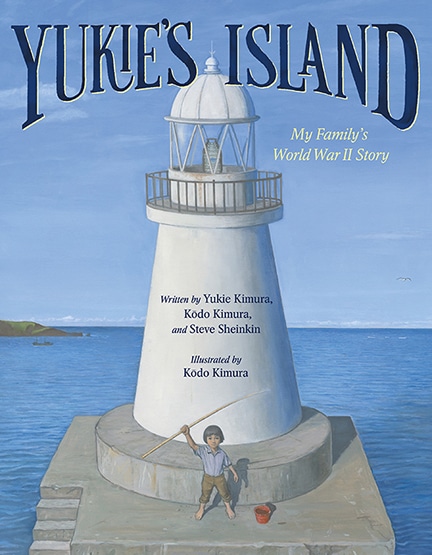
Yukie Kimura, Kōdo Kimura and Steve Sheinkin; illustrated by Kōdo Kimura
(Roaring Brook Press, an imprint of Macmillan Children's Publishing Group)
(Roaring Brook Press, an imprint of Macmillan Children's Publishing Group)
- Non-fiction
- Set in Japan
Key words: Family, war, music, play
It’s 1945, the final year of World War II. Yukie Kimura is eight years old. She lives on a tiny island with a lighthouse in the north of Japan with her family, and she knows that the fighting that once felt so far away is getting closer.
Mornings spent helping her father tend to the lighthouse and adventuring with her brother are replaced by weeks spent inside, waiting. At some point, Yukie knows, they may be bombed.
Then, it happens. One Sunday, bombs are dropped. The war ends soon after that. Everyone tells Yukie there’s nothing to be scared of anymore, but she’s not so sure. So she watches and she waits—until a miraculous sight finally allows her to be a kid again.
This is the true story of Yukie Kimura told in her own words, co-created with her son, illustrator Kodo Kimura, and co-written with bestselling Newbery Honor author Steve Sheinkin. Yukie’s Island is an honest, thoughtful, and stirring picture book about being a child living through wartime.
Yukie’s Island: My Family’s World War II Story offers young readers an understanding of World War II history from a Japanese child’s point of view. Award-winning children’s author Steve Sheinkin and Kōdo Kimura, Yukie’s son, collaborated in the creation of this engaging picture book, set on an island off the eastern coast of Hokkaido. Kōdo Kimura put his mother’s memories into historical and visual context by visiting and documenting the island location and researching the time period, drawing on both primary and secondary sources. Steve Sheinkin word-smithed Yukie’s memories into English for young readers.
The following offers instructional ideas and activities to teach this picture-book memoir in English Language Arts (ELA), Social Studies, and Art at the upper elementary level. Students will:
- Explore the setting of a picture book through a geographic lens
- Learn the elements and purpose of the memoir genre
- Focus on a child’s perspective to access the difficulty history of World War II
- Develop comparison skills through multiple perspectives on living in wartime Japan and during World War II
- Identify artist techniques for and create a landscape piece
Teachers can use subject-specific sections or implement multiple sections for integrated instruction. Classroom teachers, teacher-librarians, and art teachers could collaborate.
For detailed Culture Notes and background information, see the back matter by co-authors Steve Sheinkin and Kōdo Kimura.
Setting through Geography
Yukie’s home is on Bentenjima in Nemuro-city (note: there are multiple locations in Japan named Bentenjima). Her school is across the harbor in the city.
Before reading the book, address student map skills:
1. Display the Google Map for (Ichikishima Shrine on) Bentenjima in Nemuro-city, Hokkaido, Japan. https://maps.app.goo.gl/iqZihjXnWeMuxJyo9
a. Zoom out to have students use geographic vocabulary to discuss what they notice about the island of Bentenjima, the city of Nemuro, and its location on a remote eastern peninsula of the northern island of Hokkaido, one of the four main islands in the Japanese archipelago.
b. Click through the Google photos and videos that accompany the map and have students share what they notice about the climate of Bentenjima, noting the seasons, vegetation changing colors, ice flows, and wind. Have students discover and share some physical and human characteristics of Bentenjima, such as sea birds, boats, and buildings (for example, the Shinto shrine).
2. View the aerial footage by Himage Lab of contemporary Bentenjima off the coast of Nemuro-city, https://www.youtube.com/watch?v=a2UMSbx8uGY Have students discuss the island’s size and distance from the port.
a. Read the book aloud to the class. A document camera will help students to see the illustrations well.
b. Discuss, How does the distance from Nemuro-city appear to change given the season? According to the co-author and illustrator, Kōdo Kimura, high tides, rough sea, and during certain months of the year a frozen sea creates more distance in the mind than just measured distance. Administratively a part of Nemuro-city, the setting of Yukie’s Island feels isolated and a world away.
c. Discuss, How does the island’s location impact the relationships between the people who live there and their physical surroundings? The physical geography of the setting of Yukie’s Island is limiting and creates a need for careful planning. For example, supplies cannot be brought in during certain months of the year. The inhabitants need grow vegetables and harvest fish, shellfish, seaweeds, and seagull eggs.
Activity: Emotional Mapping
To introduce the activity, show students the images of the sketched map in Yukie’s journal on the last page of the book in “A Note from Kōdo.” On a map of Bentenjima have students individually or in small groups label places in the story (living complex’s buildings, garden, the grey thin lighthouse, the white south Breakwater Light House, Ichikishima Shrine, south cement breakwater, north breakwater, cave, and Nemuro harbor). Next, students should identify what emotions they think the character(s) feel about three or more of the places where the characters spend time in the story. Ask students to provide evidence for their answers with a keyword or phrase from the story. Bring the class back together and have students share their findings: a place, the attached emotion, a keyword or phrase, and how the student feels about the place on the island. Conclude with a discussion about how Yukie’s feelings and perceptions of Bentenjima might influence their feelings and perceptions of Bentenjima.
Teaching the Memoir Genre
Read Yukie’s Island to the class. A document camera will help students to see the illustrations well.
As you read, have students write or draw about what is being read to them. Their visual and text notes serve to record questions, details to remember, words they do not understand, and more. Stop at certain points for a comprehension check, or a question or comment from a student. Allow students to offer text-to-self connections. Add new vocabulary to your word wall or other organizers/devices you use for students’ vocabulary development.
Illustrations. In a picture book the artwork plays a key role in the storytelling. Through a close reading of the illustrations in Yukie’s Island, students learn about Yukie’s character traits, feelings, childhood experiences, family dynamics, and the cultural aspects of her lifestyle.
“Color, Symbol, Image” Thinking Routine Activity: Apply this thinking routine from Project Zero (https://pz.harvard.edu/resources/color-symbol-image) to a picture walk of the illustrations in Yukie’s Island. Cover the text so that students need to rely completely on their visual literacy. Have pairs of students chose a color, a symbol, and an image in the book to represent change in the story. Guide students to consider change in terms of the environment, as well as human activity. Discuss what the colors, symbols, and images reveal about Yukie’s character traits, feelings, experiences, family dynamics, and daily life at key points in the memoir.
Memoir as a genre. Teachers can use Yukie’s Island as part of a genre study of memoir.
To distinguish memoir from similar genres such as autobiography and biography, share the defining characteristics of memoir. Memoir distinguishes itself as a genre because it is:
- based on a specific period in the author’s life rather than covering the author’s entire life story (as in autobiography or biography);
- written by someone with a compelling personal story, rather than written by someone famous;
- based on the author’s personal history, yet the story’s focus is on the meaning of those experiences for the author, and so fiction techniques such as setting scenes, character development, and dialogue are used.
If your class has previous reading experience in the genres of autobiography, biography, and fiction, draw on students’ prior knowledge to emphasize and clarify the distinguishing factors of memoir.
Genre Comparison Activity: To visualize the similarities and differences between memoir, autobiography, biography, and fiction, have students complete a Four-column T-chart or Four-circle Venn Diagram. Topics of comparison should include: How much of the character’s life is in the chronology? Rate where the story falls on a spectrum of biased to objective and a spectrum of fictional and factual. Evaluate the level of emotional pull on the reader. Consider whether the story is well researched.

Elements of memoir. Because in memoir the focus of the writing is not on “the what” but on asking “so what?” or “why do these events matter?”, the genre often incorporates literary elements of voice, sensory and emotional details, and figurative language. In the case of a picture-book memoir, students should be able to identify these elements through text and illustrations.
Revisit certain two-page spreads in Yukie’s Island and have students identify evidence from the text and illustrations as they explore the literary elements of memoir.
- On Spread 1 (helping her mother in the vegetable garden), have students analyze the text for narrator voice by recognizing grammar clues (I, my). Clarify that a memoir relies on personal voice.
- On Spread 3 and then Spread 4 (running and playing at the shore), ask students if they were characters in the story, what they might:
- See: wide horizon, sea water, waves, distant land forms, colors of flowers and vegetation, dirt
- Hear: wind, waves crashing, pounding feet, heavy breathing
- Smell: salty sea, putrid wet sea mud
- Taste: salty sea water
- Feel: wind, chest heaving, wet, sand between toes, excitement, joy
- On Spread 6 and then Spread 7 (commuting to school in the rowboat), ask students about the characters’ emotions based on evidence from the illustrations such as their body language and facial expressions (sad, breathless, shocked, scared). Emphasize the power of sensory detail and expressions of emotions in a memoir.
- On Spread 10 (listening to shakuhachi music) have students identify the figurative language (simile). Play a clip of shakuhachi music so students can experience what Yukie might have heard (an option: “A heart with no Abode Piece” performed by Zenyoji Keisuke). https://www.youtube.com/watch?v=eSp_5s_n-dY&list=PLV2KPZF7hnIIdCN-jK__AHfGvnLcDXGbA&index=2
Ask students what emotions they felt while listening. Discuss how the shakuhachi music functions as a simile in the story. Emphasize how sound and emotions are expressed through the use of figurative language in memoir.
- On Spread 13 ask students about the visual metaphor. What do the flower and incense on the desk represent? (unspeakable loss, the death of a student)
- On Spreads 17 and 18 (jumping on the ice flows), beginning with Spread 17 recto, ask students how this moment in the memoir serves as a “bridge” between what actually happened and what the authors and illustrators are saying about what happened? (Yukie was scared but she overcame. The environment of the island brought her joy even while carrying tragedy.) Moving to Spread 18, broaden the discussion, asking why these events in this time and place matter? Have students identify evidence from the text and illustrations to support their ideas. This could be implemented as a whole class discussion or an individual written paragraph to be assessed by the teacher.
- Conclude by sharing one final visual metaphor from the book. Ask students if they recall pink flowers in the illustrations? Find them on Spreads 1, 3, 4 recto, and 5. Why are they missing from Spread 12? Read from the “A Note from Kōdo” in the back matter of the picture book: “Throughout the book, I have included small pink flowers in many of the scenes . . . My mother said this rose symbolized her childhood memories, which are sweet like the jam you can make from the rose hip.” (Spread 20 verso)
Putting together the spreads reviewed above, discuss with students, Why do you think Yukie Kimura wrote this memoir? What is she trying to convey to young readers today? Steven Sheinkin wrote in his “A Note from Steve” in the back matter, “Yukie recalls her childhood as happy, thrilling–‘a really great and special memory’” (Spread 19 verso). Despite the devastating impacts of World War II in Japan, joyful childhood memories endure.
Authors’ choices. People often remember dramatic moments, both joyful and sad, of their childhood. However, as time passes timelines of our memories can get jumbled. Point out the last paragraph of “A Note from Steve” in the back matter: “Of course, after seventy-plus years, [Yukie] could not possibly recall exactly when certain things happened…play—was very important to us while making this book.” (Spread 19 Verso) Discuss the authors’ choices in turning Yukie Kimura’s memories into memoir.
Activity: Share the events of the story out of order. Have students debate the pros and cons of the sequence the authors chose for the book.
In a concluding discussion, ask students How does the authors’ sequencing choices support the memoir genre? Remind them that memoir is defined as a story based on actual happenings, yet its objective is an interpretive meaning of the experience for the author and reader.
Writing memoir. Using Yukie’s Island as a model, have students write “small moment” stories. Require that students incorporate the literary elements typically used in memoir—personal voice, sensory and emotional details, and figurative language. To help students begin brainstorming a meaningful experience in their own lives, play the game “Never Have I Ever” or do a turn-and-talk with a prompt such as, “Most people would never believe that I….” Before beginning to write, have them list sensory details related to the small moment that can be incorporated in their writing. Follow with time for students to outline, draft, edit, and revise and teachers to model, conference, and edit.
Teaching Difficult History through Memoir
Children’s literature such as Yukie’s Island provides students access to comprehend difficult history through its focus on things children know, its character traits of empathy and curiosity, and its gentler approach to humanizing war or conflict. Exploring perspectives deeply shaped by individual experiences, students can delve into gray areas and complexity and understand that war and conflict are not a simple matter of right and wrong or good and bad. Needless to say, students will feel a connection to someone closer to their age rather than a soldier fighting on the front lines.
For students challenged by chronology, memoir may be a better fit than the biography of a historical figure.
Yukie’s Island’s setting is remote in terms of geographic place even within the context of the Japanese archipelago. The story is also remote in time: 1945 is more than 80 years ago in a previous century. The remoteness of the book’s setting and its perspective from a child provide a degree of separation from the tragic realities of World War II. The distance provided in this memoir enables us to teach a difficult period in history to younger students.
1. Ask students to write down what they already know about World War II. You can use a KWL (Know, Wonder, Learn) graphic organizer to assess students’ prior knowledge and curiosity about World War II.
2. Introduce Yukie’s Island with some math problems.
a. As author Sheinkin notes in the back matter in “A Note from Steve,” Yukie was born in 1937. Yukie’s Island is set in 1945. How old is Yukie in the story? (eight years old).
b. The year Yukie was born (1937) marked the beginning of the Second Sino-Japanese War. Some historians date wartime in Japan back to the takeover of Manchuria in 1931, and so World War II is known as the Fifteen Years’ War in Japan. How many years of Yukie’s life had her country been at war? (all of Yukie’s life).
3. If you have not already done so, read the book to the whole class. A document camera will help students to see the illustrations well.
4. Introduce an essential question: What was life like for school-age children in Japan during World War II?
5. Do a “quick read” of only the following spreads. Involve students in talking about what they notice (observe), what they think it means (infer), and what connections they may have made to the words and pictures on those pages. Teachers can interject relevant information from the back matter in Yukie’s Island and from Kōdo Kimura’s webinar.
- On Spread 1 (helping her mother in the vegetable garden), have students analyze what elements of the illustrations (colors, characters’ actions and expressions, geography) support the statement “But the fighting felt far away.” What elements create this distance? (bright blue, lush green, wide sea, broad sky, landforms in far distance, gardening tasks, time for reading, etc.)
- On Spread 7 (seeing a private ship chartered by the Japanese Imperial Navy), have students analyze what elements of the illustrations (colors, characters’ actions and expressions, objects) support the statement, “The fighting wasn’t far away anymore.” (darker color palette in water and sky, actual location closer to Nemuro-port, Yoshio’s pointing, large ship, soldiers, smoke, etc.) You could also view Yukie’s expression on Spread 6 recto.
- On Spread 8 verso (walking in town) and recto (having class on stairs), ask the students to examine the illustrations closely.
I-Spy Version 1 Pair Activity: Pair up the students. Pass out copies of Spread 8 recto page.
A. One student in each pair should identify a major or minor character in the image by giving a series of sensory clues to help their partner find the character. (I feel the stairs under me. My blue shirt is itchy. Where am I?)
B. Ask the students to switch roles. The student who chose the character now must guess who their partner’s character is.
C. Bring the class back together for a full class discussion. Ask questions about the image such as:
-
- What do you see?
- Who are the people in the picture?
- What are the students doing on the stairs?
- Why are the students having class on the stairs?
- Why are there soldiers in the school? (taking materials to help the war effort, storing military supplies, creating an emergency hospital)
- How would you feel if there were soldiers in school? (scared, confused, protected)
- How do you think Yukie and her classmates feel?
- On Spread 11 (sheltering from bombing), ask students based on the illustration how the characters are feeling. What evidence from the illustration supports this? Read the text. Address the fact that both Japan and the United States used military aggression during the Pacific War, and people suffered from bombings whether they were in China, Southeast Asia, Australia, or Pearl Harbor. From “A Note from Kōdo” in the back matter he expresses his wish that “this story commemorate the ordinary citizens and families who were killed or hurt by these air raids.” (Spread 20 verso)
- On Spread 12 (overlooking the port of Nemuro), explore continuity and change with students. Have students look at the illustration and share what has changed and what has remained the same with the bombing of the city and end of the war. (buildings have burnt down, the gray lighthouse is destroyed, the roof, window, and door of Yukie’s house are damaged, six chickens are dead, and yet the house still stands, the family is together, and the garden grows. Life goes on.)
- On Spread 13 (returning to school), have students examine the illustration closely.
I-Spy Version 2 Pair Activity: Pair up the students. Pass out copies of Spread 13.
A. In this version of I-Spy, one student in each pair should identify a hiding place in the image. The student gives a series of sensory clues to help their partner find their hiding place. I feel a wooden floor under me. I see the teacher’s shoes. Where am I?
B. Ask the students to switch roles. The student who chose the hiding place now must guess where their partner’s hiding place is.
C. Bring the class back together for a full class discussion. Ask questions about the illustration such as:
-
-
- Where are the children now? (school classroom)
- What are they doing? (studying)
- Why is there a flower and incense on the table? (in remembrance of a classmate who died in the air bombing)
- Who are the people outside the window? (representatives of the Allied Occupation Forces)
- Why are those people outside the school? (securing area, administering surrender, making sure militaristic language is being blacked out in textbooks)
- How do you think the students feel now? (sad, uneasy about the future, scared, relieved to be able to attend school)
- How would you feel if you were in that class?
-
- Speech Bubbles Activity: Pass out copies of Spread 8 recto page and Spread 13 for each student. Ask the students to write thought bubbles over at least two characters’ heads to show what the character is thinking or feeling. Use these as an assessment of how students are processing the emotions of this history and for writing skills.
6. Return to the essential question, “What was life like for school-age children in Japan during World War II?” and expand upon Yukie’s story with students. Explain that situations in late wartime and immediate postwar Japan were dire for many Japanese civilians. Although situations differed throughout the islands of Japan and pointedly so in urban versus rural settings, their particular circumstances influenced each child’s experiences in wartime. Given Yukie’s family’s rural and remote location and lighthouse duties, they did not experience food and commodities scarcity and rationing, clothing restrictions, and conscription in the same way other families in other areas of Japan endured them.
A. Use a text set to have students consider the wartime experiences of characters in other children’s literature set in Japan during wartime. (See section below.)
B. Cut into strips and hand out the following memories of Japanese children during World War II based on children’s diaries, survivors’ oral histories, and historical research. As a whole class or in small groups, have individual students read aloud and share an experience. For each experience, have students consider whether this was a similar or different experience from Yukie’s. Have students separate the similar experiences and different experiences into two columns. Ask which experiences could have been something Yukie experienced but was not mentioned in her memoir?
♦ I started wearing monpe pants because the government said kimono or Western clothes were too extravagant for girls and women.
♦ I was often hungry. So, when I played outside, I would gather chestnuts or freshwater clams to eat.
♦ My friends and I would go on our own without adults to the schoolyard, grounds of a shrine, moat of an old fortress, the woods, or even the hills and play hide-and-seek, tag, or games we made up.
♦ In Fall 1943, fearing the dangers of air bombings on our city, my siblings and I moved with our mother and grandparents from our home to our relatives’ home in the countryside.
♦ Like elementary students in thirteen Japanese cities, I evacuated with my schoolmates and teachers to a temple in a rural area. I missed my family. Our day was planned from breakfast to bedtime. Our hours in class were shorter than our hours doing farm work.
♦ As part of our school day, we listened to a radio broadcast about our empire’s expansion and strategies to oppose Western supremacy.
♦ Our hours at school were shortened. Instead, we were expected to participate in neighborhood cleanup projects, writing letters to soldiers on the frontlines, and other war-related work.
♦ After 1941, our subjects were consolidated into four: Citizenship, which included morals, language, history, geography; Science and Mathematics; Physical Training, including martial arts, marching, drilling, and military exercises; and Arts, which included drawing, calligraphy, music, and crafts. (Rubinger, 1992, 65)
♦ Every morning at school we participated in an assembly in which we worshiped the Emperor and did an exercise routine.
♦ To teach an idea or skill in our Ethics, Language Arts, and Social Studies classes, our textbooks used examples featuring Shinto (religious) myths and warrior heroes.
♦ My friends and I liked to play soldier and had military-themed toys, books, and board games.
♦ We made toys such as juggling beanbags, origami, bamboo stilts, and spinning tops.
C. Debrief with a discussion of continuity in daily life and school during wartime Japan. What feelings did these elementary Japanese students express? What types of games and toys did the children have? What might Yukie and her siblings have been doing and learning at school? How did Yukie and these other children’s emotions impact your perspectives of Japan during wartime? Children found ways to play no matter the circumstances. Independence of play was juxtaposed with the discipline of public school under a military government. Students may have spent more hours of the day for war efforts, but education was valued.
7. To conclude, use one or more of the strategies below to have students develop their own answers to the essential question.
-
- Have students complete the “Learned” section of their KWL notes. Ask them to annotate where what they “know” changed after seeing World War II history from Yukie’s perspective.
- In pairs or small groups, have students create a poster illustrating and describing a character’s feelings throughout the story in relationship to World War ll. So students can consider others’ reflections, have the pairs/small groups present their poster to the rest of the class or do a Gallery Walk.
- Have students complete a short written reflection on their feelings about World War II after reading Yukie’s Island.
- Have students create additional pages to the Yukie’s memoir based on the experiences of other Japanese children.
Using Yukie’s Island as part of a text-set study
There is critical value for students to learn about a historical event through multiple experiences in a variety of texts that complicate the narrative of the event. Teaching with text sets builds comparison skills to determine similarities and differences. Including Yukie’s Island in a text-set study, students can make comparisons regarding World War II history as well as distinguish between memoir, biography, and historical fiction. (See the Genre Comparison Activity above.)
Begin by reading and discussing Yukie’s Island. In small-group literature circles, have students make comparisons to the characters’ experiences in other places or situations during World War II. You can have small groups read the same two additional books or have small groups read different books. Use the Three-column T-Chart in modeling and small-group work in preparation for comparisons of historical experiences, cultural elements, and literary themes such as resilience, identity, and the human cost of war. Students may find similarities in children’s experiences during wartime no matter where they live.
Compare Yukie’s Island with some of these titles to demonstrate that wartime experiences in Japan varied by geography—rural versus urban and different locations in the archipelago.
- Faithful Elephants by Yukio Tsuchiya (Tokyo). Picture book about the euthanasia of animals at the Ueno Zoo in wartime Tokyo.
- “Grave of the Fireflies” in The Cake Tree in the Ruins by Akiyuki Nosaka (Kobe). Semi-autobiographic short story based on the 1945 firebombing of Kobe.
- The Girl with the White Flag by Tomiko Higa (Okinawa). Chapter book memoir from the perspective of a six-year-old girl in rural Okinawa.
- A Bowl Full of Peace: A True Story by Carol Stelson (Nagasaki). Picture book about a young girl living in Nagasaki during the war and the atomic bombing.
- My Hiroshima by Junko Morimoto (Hiroshima). Picture-book memoir about a girl growing up in Hiroshima during the war and the atomic bombing.
Compare Yukie’s Island with some of these stories of wartime experiences in the expanse of the Japanese empire during World War II.
- Nagai, Mariko. Under the Broken Sky. Novel in verse set in Manchuria under Japanese control.
- Smith, Icy. Three Years and Eight Months. Picture book set during the 1942–45 Japanese occupation of Hong Kong.
- Park, Linda Sue. When My Name Was Keiko. Chapter book about a girl growing up in Korea under Japanese imperial rule.
- Mochizuki, Ken. Passage to Freedom: The Sugihara Story. Picture book about a Japanese diplomat who helped Jewish refugees escape the Holocaust.
- Nobleman, Marc Tyler. Thirty Minutes Over Oregon: A Japanese Pilot’s World War II Story. Picture book about the only Japanese pilot during WWII who bombed the continental U.S.
- Picture books about the incarceration of Japanese Americans such as Fish for Jimmy by Katie Yamasaki; A Place Where Sunflowers Grow by Amy Lee-Tai; and My Lost Freedom: A Japanese American World War II Story by George Takei.
Compare Yukie’s Island with some of these books set in Europe describing the experience of civilians during World War II.
- Diary of Anne Frank by Anne Frank [set in Amsterdam, Netherlands]
- Number the Stars by Lois Lowry [set in Copenhagen, Denmark]
- Peter in Peril by Helen Bate [set in Budapest, Hungary]
The landscapes illustrated of Yukie’s Island
Read Yukie’s Island aloud to the class. Encourage students to pay particular attention to geographic features such as water, vegetation, and weather in the book’s illustrations. They could make sketches as you read.
Revisit the illustrations, asking students “What do you see? What makes you say that?”
Have students work in groups or partners to study some of the illustrations, make a list of what they see, and ask questions. Discuss students’ findings and answers to their questions. Add your thoughts to the meaning of the book, the art, facial expressions of the characters, and the setting.
Using the medium of watercolor paints or watercolor pencils, model showing step by step how to draw a landscape picture of Bentenjima in Nemuro-city with a foreground, middle ground, and background. When students have completed their landscapes, have them fill out an artist statement where they will title their work and write briefly about the project. If there is time, do a gallery walk in which students critique each other’s work or display the work on a bulletin board.
Author: Catherine Higbee Ishida, with contributions from teachers Ellen Bunn, Ashley Daeshclein, Jon French, Renee Huizenga, Michelle Joyce, Simone Kevitt, Kate Ruprecht, and Susan Suave in the TEA-NCTA Fall 2024 online course, Japan through Children’s Literature: Children’s Lives in mid-20th-century Japan.
2026
Sources
Bomer, Katherine. (2005) Writing a Life: Teaching Memoir to Sharpen Insight, Shape Meaning—and Triumph Over Tests. Portsmouth, NH: Heinemann.
Himage Lab ch. (ND) “Tori ni Natte Nemuro no Tabi: Mujinshima Hen (Bentenjima).” (7:38). https://www.youtube.com/watch?v=a2UMSbx8uGY
Kimura, Kōdo. (2024) Freeman Book Award: Yukie’s Island: My Family’s World War II Story with Co-Author/Illustrator Kōdo Kimura. Five College Center for East Asian Studies, National Consortium for Teaching about Asia. (1:02:26). https://attendee.gotowebinar.com/recording/8990223237543781376
Piel, L. Halliday. (2017) “Outdoor Play in Wartime Japan.” Child’s Play: Multi-Sensory Histories of Children and Childhood in Japan. Sabine Fruhstuck and Anne Walthall, eds. Oakland, CA: University of California Press.
Project Zero. (2019) “PZ Thinking Routine: Color, Symbol, Image.” Cultures of Thinking, Project Zero Thinking Routines. President and Fellows of Harvard College and Project Zero. https://pz.harvard.edu/resources/color-symbol-image
Rubinger, Richard. (1992) “Education in Wartime Japan, 1937-1945.” Education and the Second World War. Roy Lowe, ed. London: Routledge.
Sinor, Jennifer. (2012) “Teaching Memoir.” Ohio Journal of English Language Arts 52: 2 (Summer/Fall), 41–42.
和の舞台大集合 (Music of a small festival of Japan). (April 2, 2024) 尺八本曲 神如道 生曲「無住心曲」(Shakuhachi original piece naturally born of Jin Nyodo “A heart with no Abode Piece”). Performed by Zenyoji Keisuke. (9:39). April 2, 2024. [Video] Youtube. https://www.youtube.com/watch?v=eSp_5s_n-dY&list=PLV2KPZF7hnIIdCN-jK__AHfGvnLcDXGbA&index=2
Yamashita, Samuel Hideo. (2015) Daily Life in Wartime Japan, 1940-1945. Lawrence, KS: University Press of Kansas.
Children’s Literature for text sets
Bate, Helen. 2017. Peter in Peril: Courage and Hope in World War Two. Otter-Barry Books.
Frank, Anne. 1993. Anne Frank: The Diary of a Young Girl. Perfection Learning.
Lee-Tai, Amy. 2006. A Place Where Sunflowers Grow. Felicia Hoshino, ill. Lee & Low Books Inc.
Lowry, Lois. 1989. Number the Stars. Clarion Books.
Mochizuki, Ken. 1997. Passage to Freedom: The Sugihara Story. Dom Lee, ill. New York: Lee & Low Books Inc.
Morimoto, Junko. 1992. My Hiroshima. Isao Morimoto and Anne Bower Ingram, trans. New York: Puffin Books.
Nagai, Mariko. 2023. Under the Broken Sky. Square Fish.
Higa, Tomiko. 2003. The Girl with the White Flag. Dorothy Britton, trans. Kodansha USA.
Nobleman, Marc Tyler. 2018. Thirty Minutes Over Oregon: A Japanese Pilot’s World War II Story. Melissa Iwai, ill. Clarion Books.
Nosaka, Akiyuki. 2018. The Cake Tree in the Ruins. Ginny Tapley Takemori, trans. Pushkin Collection.
Park, Linda Sue. 2002. When My Name Was Keoko. Houghton Mifflin.
Smith, Icy. 2013. Three Years and Eight Months. Jennifer Kindert, ill. Manhattan Beach, CA: East West Discovery Press.
Stelson, Caren. 2020. A Bowl Full of Peace. Akira Kusaka, ill. Carolrhoda Books.
Takei, George. 2024. My Lost Freedom: A Japanese American World War II Story. Michelle Lee, ill. Penguin Random House.
Tsuchiya, Yukio. 1988. Faithful Elephants. Tomoko Tsuchiya Dykes, trans. Ted Lewin, ill. Boston: Houghton Mifflin Company.
Yamasaki, Katie. 2019. Fish for Jim
NCTA webinar with co-author and illustrator Kōdo Kimura.
2024 Notable Social Studies Trade Book
2024 Bank Street Best Book of the Year
© 2024 NCTAsia