
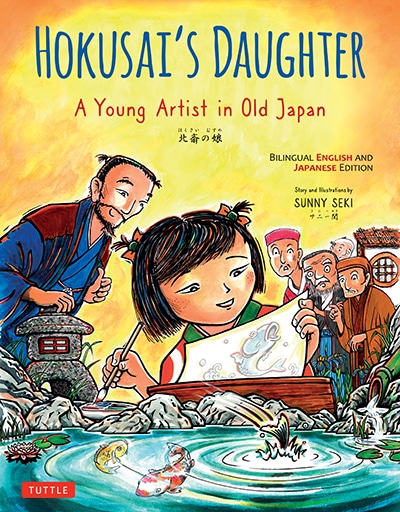
Hokusai’s Daughter: A Young Artist in Old Japan
Written and illustrated by Sunny Seki
(Tuttle Publishing)
(Tuttle Publishing)
- Fiction
- Set in Japan
Key words: Art, bilingual, biography, gender roles
Whether working in his studio or out in the field, Japanese artist Hokusai had a constant companion, his youngest daughter, Eijo. Wherever they went, Eijo brought along her own bag of brushes and the same artistic brilliance and passion as her dad. Hokusai’s Daughter tells the story of a clever girl who refuses to believe that only men can create great works of art.
Katsushika Hokusai (1760–1849) is one of the most famous painters and woodblock print designers of the early nineteenth century in Japan. Sunny Seki’s book about his daughter Eijo blends fact with fiction in a story that seeks to encourage young artists to persevere, even against prejudice, in this case the assumption that girls can’t be artists. The following are some notes based on my webinar presentation that are intended to provide some perspective on the differences between historical fact and fiction.
What was the situation for women artists in Japan during this period? It was probably as good or better than the situation for women artists in North America and Europe at the time. Women in that period could not become professional painters except under certain circumstances, especially if they came from upper-class families. Mary Cassatt, for example, did most of her paintings of women and children in her social circle, as it wasn’t proper for a Victorian woman to paint outdoors like her Impressionist male colleagues.
Having said that, opportunities increasingly opened up for Japanese women in the nineteenth century. It is true that, in accordance with Neo-Confucian and Buddhist thought, women in Japan were relegated to an inferior position in the two centuries leading up to Eijo’s lifetime. But there were certain social positions that enabled some women to break through social barriers. Two of the most important influences were (1) the emphasis on education in Japan and (2) the rise of merchant and artisan groups during this period. Women in merchant and artisan families often assisted in running the family business and on occasion became entrepreneurs themselves. For example, the foundations for the Mitsui corporation were laid by Shuhō (1590–1676), who ran her husband’s pawnbroking and sake business in the seventeenth century.
In the early nineteenth century, women artists suddenly came into fashion among the buying public. Publishers advertised that a woman had created the images for a book or a painting or print. Women as heroic figures or famous women poets and the like became popular as subjects for paintings and prints during this period as well.
Scholar-literati groups included a small number of women painters and poets. By the early nineteenth century some of the leading woodblock print designers had begun to accept women into their studios as apprentices. There were at least twenty women artists working within the popular ukiyo-e world of paintings and prints. One of the best known was Eijo, who used the art name of Katsushika Ōi.[i]
First, some caveats
This story is a good way to encourage young girls with examples like Eijo, and also a way to start teaching them about the historical (and even current) discrimination against women all over the world. But there is also a fair amount of “artistic license” in the story.
Hokusai’s given name wasn’t Hokusai. This was his art name. His given name was Tokitarō, and he took the name Katsushika from the Edo neighborhood where he was born. Japanese artists used art names up until around 1900, and those art names could and did change as an artist grew older or went through various life changes. Many painters and ukiyo-e print designers used the name of their studio instead of a family name or were given an art name by their teacher. It was not at all uncommon to change your art name frequently.
Hokusai, as an independent artist, adopted over thirty art names over the course of his long career. He would change his name according to circumstances, like when he changed residences or reached a milestone in his age. This was also true of Eijo.
Hokusai would not have had a beard or mustache. Hokusai’s appearance in Seki’s illustrations seems to reflect a stereotype, particularly of a French painter, with a pencil-thin mustache and beard. Japanese men did not adopt mustaches and beards until the late nineteenth century, after the influx of Western influences following the opening of Japan.
The clothing worn by Eijo and Hokusai is inaccurate at times. To be fair to the author, there are stories that in later years Hokusai liked to style himself as a peasant. “He is reported to have worn a peasant’s straw sandals, raincoat and hat to a brilliant artistic gathering, earning the scorn of his rival Utagawa Toyokuni.”[ii] Eijo and Hokusai appear to wear travel clothing throughout the book, which is a bit odd, although they did travel together on occasion. They more likely would have worn various types of robes that we now call kimono. Straw hats were worn by travelers as well as by samurai who were trying to hide their faces when out on the town. In the book Seki accurately depicts Eijo’s clothing and sometimes depicts Hokusai in kimono.
The pants that Hokusai is pictured wearing in some scenes look very Western (not what Hokusai would have worn). Some workmen in that period did wear a type of pants, with the torso covered by a short robe (not a jacket).
The process of woodblock printmaking was a collaboration that most often took place in different studios. That is, the designer (the artist), carver, and printer each had their own studio. A publisher would coordinate the overall process. (It is true that Hokusai started his training as a carver of woodblock prints, but that was unusual prior to the twentieth century.)
Some incidents in the story are drawn from facts. For example, Hokusai did paint a huge picture for the shogun and his wife. Hokusai was known for his flamboyant production of extremely large paintings. He produced these as bravado performances that enhanced his reputation. In 1804, he is known to have painted a colossal ink painting of the founder of Zen Buddhism, Bodhidharma, that was so big that spectators had to climb onto the roof of a nearby temple to see the entire painting. He duplicated the event in 1817, where his painting of Bodhidharma had to be hoisted to a temple roof with a block and tackle.
The story that Seki seems to have drawn upon occurred when the shogun Tokugawa Ienari commanded Hokusai and the literati painter Tani Bunchō to engage in a painting contest. Hokusai reportedly painted a swath of indigo on a long piece of paper that had been rolled out on the floor.
“Then he dipped the feet of a chicken in red paint and allowed the bird to walk down the length of the scroll. He entitled the result ‘Autmn Leaves on the Tatsuta River,’ a well-known artistic theme. The Shōgun is said to have been delighted, while Bunchō yielded the day to his rival.”[iii]
Of course, since none of these paintings exist today, we don’t have proof that the stories are true. But there are large-format works by Hokusai extant, giving some credence to these stories. And we have the evidence of the 1817 painting from a contemporary publication.
Would Eijo have helped with this work? The stories include mention of Hokusai’s students assisting him with the painting of one of the large Bodhidharmas, so this is a distinct possibility. The truth is, we really don’t know a lot about Eijo and her sisters or Hokusai’s other women students, and much of what we do know comes from only a few nineteenth-century sources.
Eijo’s Biography
Eijo (her given name) was probably the first child of Hokusai’s second wife, Kotome. We don’t know her birth and death dates, though she may have been born around 1800 and lived into the late 1860s. She did indeed start painting and designing prints at a young age, as evinced by this page from the anthology Mad Verse of Selected Provinces, published in 1810.The book is a collection of poetry, with an opening illustration by Hokusai and then illustrations by fifteen of his students (Fig. 1).
Eijo designed this page when she was around ten years old. This is a scene of sailboats in the mist.
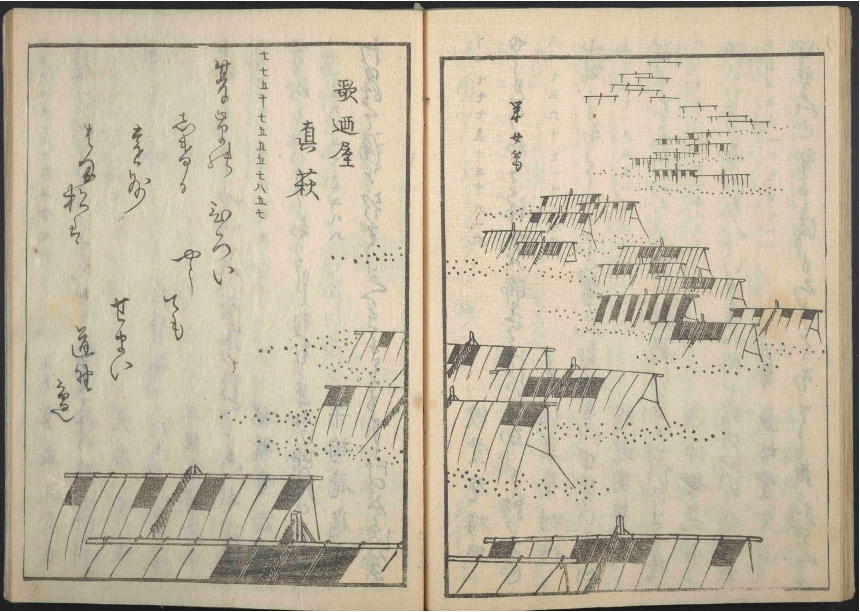
Here is a translation of the poem that appears in Fig. 1:
Hamamatsu, in the distant province of Enshū,
grows thick with summer grasses and
with its pines on the shore
seem so vast yet
the road and fields so narrow
(Julie Davis on Hokusai https://web.sas.upenn.edu/tressjapanese/2022/03/14/katsushika-hokusai-葛飾北斎-kyoka-kuni-zukushi-狂歌国尽-ca-1810/.)
Hamamatsu is one of the way stations on the Tōkaidō, one of the main routes between Kyoto and Edo, famous for its pine trees that grew in the sand by the shore.
Eijo and her sisters Miyo, Tatsu, and Nao were indeed brought up assisting Hokusai in his studio, so the focus in the book on Eijo as Hokusai’s assistant is accurate. The studio would also have included a number of male students who were apprenticing under Hokusai. There was also at least one brother, who apprenticed in the mirror trade and became an artisan.
Eijo left Hokusai’s studio in 1824 when she married one of his students, Tsutsumi Tōmei. The marriage lasted only three years. The rumor is that the couple had a falling-out when Eijo was critical of Tōmei’s painting skills. Legally, only the husband could divorce his wife in this period. All he had to say was that he divorced her (no reason needed). He could also add that she was free to remarry. We have no record of what might have actually occurred between Ei and Tōmei, but this was standard practice at the time. It appears that she never remarried.
Eijo moved back in with Hokusai and collaborated with him. There is some speculation that she might have even been his “ghost brush” (like a ghost writer).
We have a description by Saitō Gesshin (1804–1878), a city administrator who was a contemporary, in which he writes, “She paints and has done many designs for woodblock prints published under the name Iitsu.” Iitsu was the art name that Hokusai adopted when he was sixty.[iv]
It was common both in Japan and Europe for students and assistants to work on a painting with the master, particularly large works. For example, in Japan, a master painter might create the overall design of a composition across a long wall. Assistants and apprentices would be assigned to fill in various areas, such as painting in the rocks or ground. More skilled and experienced assistants would handle more complicated sections such as clothing or buildings. When all was nearly done, the master would add the finishing touches. The finished work, however, comes down to us in the name of the master painter.
This was also true in woodblock printmaking, so it is possible that Eijo contributed to both paintings and prints for which we credit Hokusai.
Why do we call her Ōi instead of her given name, Eijo? There are different stories about this. One story claims that Hokusai would call out “ōi ōi!” when he wanted her. This is a very casual and rather impolite way of getting someone’s attention. It’s the equivalent of “Hey, you!” There are a few problems with this theory, despite the fact that you will read it everywhere, even in scholarly writings. One is that “ōi” with the first vowel drawn out, is something that you call out from a distance. If you are calling your daughter to bring you tea from inside the house, the term is “oi”—these sorts of things matter in Japanese.
Another reason for the name seems to have to do with Hokusai’s art name and is more plausible. Eijo used the characters for “Loyal to Iitsu” to write Ōi, meaning a loyalty to Hokusai who had adopted the art name Iitsu when he turned sixty, as mentioned above. Iitsu means “to become one again” and refers to the fact that he had turned sixty and entered his second sixty-year cycle; he was starting over again at the age of one.
Eijo often signed her work with the art name Ōi: 葛飾 応為
When Eijo’s mother, Kotome, died in 1828, Eijo took over the role of caring for her father. By this point, Hokusai was in his late sixties but still painting and designing prints. Hokusai and Eijo were free spirits. She reportedly didn’t like to cook, so she would purchase meals and bring them back to the studio. She didn’t clean up afterwards, so the living area would pile up with discarded food and other trash.
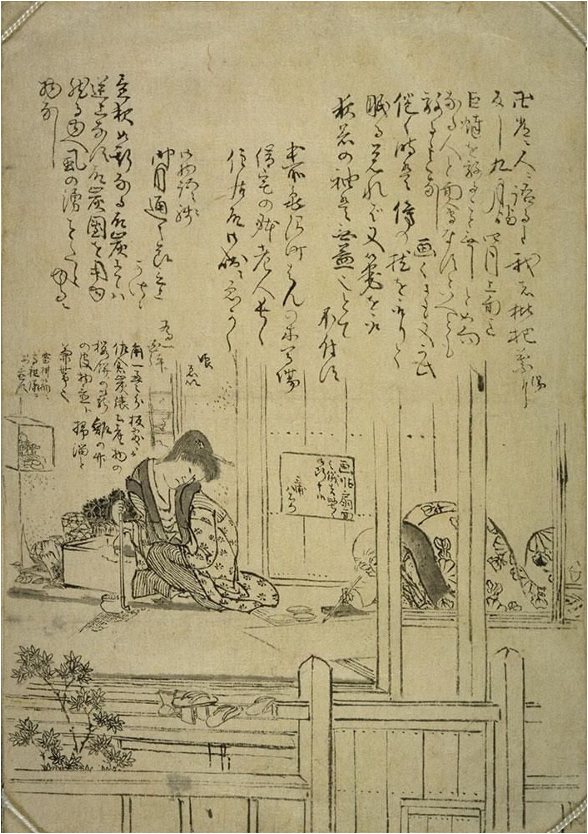
Saitō Gesshin wrote “His youngest daughter Ei resembles her father—instead of washing the dishes after a meal, she just leaves them lying around without thinking twice about it.”[v]According to Saitō, if they received raw fish for a meal, they would give it to someone else because they didn’t want to bother to prepare it.[vi]
Once the trash got to be too much, she and Hokusai would simply move to another dwelling. Hokusai changed his residences ninety-three times during his eighty-nine years![vii] Frequent changes of address were common in Edo literary and artistic circles. Many artists, poets, and writers had no official titles or holdings, and were long-term renters or even lived with their patrons or colleagues.
Hokusai was paid well for his work, but they were often impoverished. Although Hokusai didn’t squander his money in the true Edo fashion, he apparently shared the typical disdain for money. He also had financial difficulties due to a grandson who squandered money and needed to be bailed out from time to time. This was the son of Eijo’s sister Miyo who had been divorced from her husband and moved back in with Hokusai, bringing her son with her. There are stories that when publishers sent payments to him in the form of cash, Hokusai would leave the packets unopened in a basket, telling creditors to help themselves.[viii]
The picture in Figure 2 was painted by one of Hokusai’s students and depicts the pair in their rental house in the 1840s. Eijo is now in her forties and Hokusai in his eighties. She is smoking using a tobacco pipe and watching her father work.
Hokusai reportedly would spend much of his day under a futon (type of quilt in this case). He would sleep a lot and then wake up and commence to paint, as he is doing here. It was his usual practice to paint on the floor in this fashion.
On the wall behind them is a notice that states that they will not accept commissions for fans or albums—probably because they wouldn’t have been paid enough to make it worth their time. Eijo and Hokusai were absolutely devoted to one another. They even traveled together to Obuse in what is now Nagano prefecture, in order to visit Hokusai’s patron, Takai Kōzan. There is a letter written by Eijo, who probably helped her father prepare the pigments for the paintings that he did on this trip. The letter gives instructions on how to prepare red pigment and also an oil-based medium.
The painting technique was to use perilla oil (made from the shisō plant), putting it into a pitcher, adding lead dust from gun bullets, and leaving it buried for sixty days. She writes, “It is a particularly difficult technique to explain in writing, here I am just giving a few indications…”[ix]
The resulting oil was applied over sections of a painting as a final varnish.
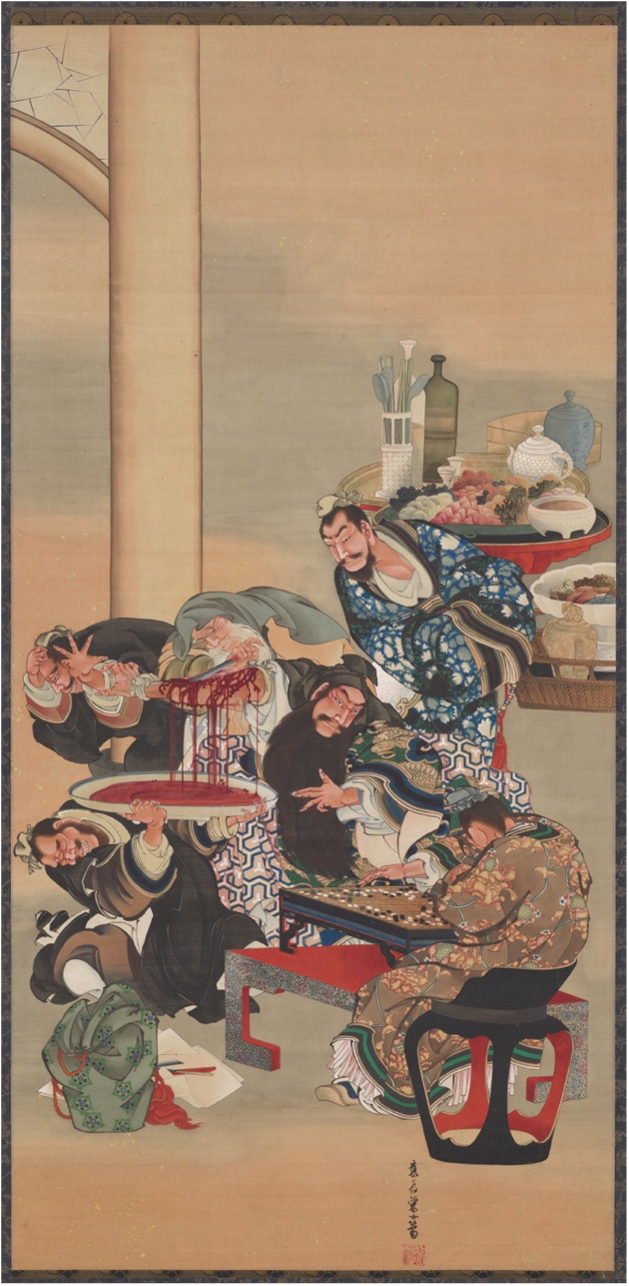
Works by Katsushika Ōi
There aren’t many extant works that we are certain were painted or designed by Eijo, but one among them is the illustration mentioned earlier in the Mad Verse of Selected Provinces (1810) and a collaboration with Hokusai on a finely produced private print commission (surimono), called Fisherman Sitting on a Rock by the Sea (early 1830s, The Art Institute of Chicago). This is often thought to be a self-portrait of Hokusai, and it includes poems by both Hokusai and Eijo.
Operating on Guan Yu’s Arm (1840s) (Fig. 3 above; Cleveland Museum of Art; public domain) is an example of Eijo’s painting skills. She would have learned a lot from her father about the subjects and techniques of different styles of painting at that time—including Hokusai’s fascination with heroes and martial stories, and his extensive study of all sorts of types of painting current at the time. This included Western techniques of shading and highlights, perspective, lowered horizon lines, and so on.
This painting depicts an episode from a fourteenth-century Chinese novel, Romance of the Three Kingdoms. Eijo portrayed the passage in which legendary third-century military leader Guan Yu undergoes a painful bone scraping to remove poisons received from an arrow wound.[x]
This is the largest painting known among Eijo’s work. Color and gold on silk tell us that this was an expensive hanging scroll to produce so someone had asked for the subject and paid for Eijo’s time, expertise, and materials.
Notice the juxtaposition between horror and beauty in this work. On one hand, the Chinese warrior Guan Yu is concentrating on a game of go while stoically submitting to the bone scraping. Men around him recoil from the scene. But in the background is a meticulously painted still life of a banquet: a tea pot, utensils, and various foods, all on lacquer trays. And if you look carefully at the black robes in particular, you’ll see shadows that indicate folds in the robes. This was an innovation that Japanese artists picked up on from access to Western prints, and it can be seen in her other paintings.
She signs “brush of Ōi, the woman Ei” in the lower right, followed by the Katsushika seal used by Hokusai—this denotes favor upon a long-time assistant or student. The master has given her his chosen last name (Katsushika) and allowed her to use his seal.
Other known works include:
Three Women Playing Musical Instruments (Museum of Fine Arts, Boston) https://customprints.mfa.org/detail/476828/oi-three-women-playing-musical-instruments-1818-44
Night Scene in Yoshiwara (Ōta Memorial Museum of Art) https://www.ukiyoe-ota-muse.jp/yoshiwarakoushi-eng/
Paintings illustrated in the exhibition catalogue Japanese Women Artists, 1600–1900.
Illustrated Handbook for Women (1847), a woodblock printed book, a copy of which is in the British Museum. This is the only example of this book illustrated by a woman. It contains passages on etiquette, personal deportment, cosmetic tips, and the cultivation of talents such as music, poetry, calligraphy. https://www.britishmuseum.org/collection/object/A_1979-0305-0-558?selectedImageId=1613199129
Eijo stayed with Hokusai through the rest of his life. Hokusai is said to have remarked that “when it comes to paintings of beautiful women, I can’t compete with her—she’s quite talented and expert in the technical aspects of painting.”[xi] The artist Keisai Eisen (1790–1848) wrote that she “is skilled at drawing, and following after her father has become a professional artist while acquiring a reputation as a talented painter.”[xii]
After Hokusai passed away at the grand age of ninety (by Japanese count) in 1849, our knowledge about Ōi is even more limited. She is thought to have worked independently until around 1870, producing paintings and two illustrated books. Other than this scant information, she simply disappears like many other women ukiyo-e artists.
Author: Brenda G. Jordan, Pitt NCTA Consultant and former director of the Pitt NCTA
2026
Some Resources in English for Teachers:
Patricia Fister with Fumiko Yamamoto. Japanese Women Artists, 1600–1900. Exhibition catalogue. Lawrence, KS: Spencer Museum of Art, University of Kansas, 1988. This is the most comprehensive study of Japanese women artists.
Hokusai Paintings: Selected Essays. Gian Carlo Calza with John T. Carpenter, eds. Venice: The International Hokusai Research Centre, University of Venice, 1994.
John T. Carpenter, “The Literary Network: Private Commissions for Hokusai and his Circle,” 143–167, in Julia Meech and Jane Oliver, eds., Designed for Pleasure: The World of Edo Japan in Prints and Paintings, 1680–1860. Seattle: University of Washington Press, 2008.
Julie Nelson Davis Picturing the Floating World: Ukiyo-e in Context. Honolulu: University of Hawai‘i Press, 2021.
———. “Hokusai and Ōi: art runs in the family.” British Museum blog. June 18 2017.
See also the webinar presentation by Brenda G. Jordan on the Freeman Book Award website.
Primary resources are also found in Mark Sandler, The Yomihon Illustrations of Katsushika Hokusai, PhD dissertation (Seattle: University of Washington, 1977).
The Japanese Wikipedia entry on Katsushika Ōi as well as the English entry contain fairly reliable information and citations to nineteenth-century documents.
[i] Patricia Fister with Fumiko Yamamoto, Japanese Women Artists, 1600–1900, exhibition catalogue (Lawrence, KS: Spencer Museum of Art, 1988), 127.
[ii] Mark Sandler, The Yomihon Illustrations of Katsushika Hokusai, PhD dissertation (University of Washington, 1977), 76.
[iii] Sandler, 123–124.
[iv] John T. Carpenter, “The Literary Network: Private Commissions for Hokusai and his Circle,” in Julia Meech and Jane Oliver, ed., Designed for Pleasure: The World of Edo Japan in Prints and Paintings, 1680–1860 (Seattle: University of Washington Press, 2008), 160.
[v] Carpenter, 160.
[vi] Gesshin Saitō; originally published in Iijima Kyoshin, Biography of Katsushika Hokusai (Katsushika Hokusai den) Tokyo: Kobayashi Bunshichi, 1893. Copy in the British Museum: https://www.britishmuseum.org/collection/object/A_1999-1130-0-1-1
[vii] Sandler, 84.
[viii] Sandler, 128.
[ix] Carolina Retta in Hokusai Paintings: Selected Essays, edited by Gian Carlo Calza with John T. Carpenter (The International Hokusai Research Centre, University of Venice, 1994), 243–244.
[x] Text adapted from the Cleveland Museum information.
[xi] Julie Nelson Davis, “Hokusai and Ōi: art runs in the family.” British Museum blog. June 18, 2017, and elsewhere; original source is from Iijima Kyoshin.
[xii] See the British Museum article by Davis and elsewhere; this comment by Eisen was published in a book in 1833 according to the Japanese Wikipedia article.
Selected Resources for Teaching with Hokusai’s Daughter: A Young Artist in Old Japan
Free Spirits: Katsushika Oi and Her Father Hokusai webinar with Dr. Brenda G. Jordan about the real Katsushika Ōi, her relationship with her father Hokusai, and their free spirited lifestyles and art in Edo, Japan of the early 19th century.
© 2024 NCTAsia