Pearl: A Graphic Novel
Sherri L. Smith; illustrated by Christine Norrie
(Graphix)
(Graphix)
- Fiction
- Set in Japan
Key words: Identity, war, coming of age, family
Amy is a thirteen-year-old Japanese-American girl who lives in Hawaii. When her great-grandmother falls ill, Amy travels to visit family in Hiroshima for the first time. But this is 1941. When the Japanese navy attacks Pearl Harbor, it becomes impossible for Amy to return to Hawaii. Conscripted into translating English radio transmissions for the Japanese army, Amy struggles with questions of loyalty and fears about her family amidst rumors of internment camps in America — even as she makes a new best friend and, over the years, Japan starts to feel something like home. Torn between two countries at war, Amy must figure out where her loyalties lie and, in the face of unthinkable tragedy, find hope in the rubble of a changed world.
I fled. But you cannot outrun change.
~Pearl (page 51)
Appropriate for Grades: 6–12
Best for Grades: 6–12
Introduction to the Book
Pearl is a visual-heavy, text-light book. The general dearth of written text belies the complexity of the story and could lead one to assume that this book can be easily accessed by young elementary students. In reality, the images alone demand skilled inferencing, and the story as a whole asks that the reader possess historical knowledge of the Pacific War, the internment of the Japanese, and more. Because the story spans such a broad range of topics during World War II, it could be used as an anchor text for an expansive unit about the Pacific War experience; or if not enough time is available, a few pages at a time could be excerpted for smaller units.
Teacher’s Note: This book truly does require the teacher to have some interest in the cultural and historical context of the Pacific War. Although it can be read in under 45 minutes, the book should be explored over a much longer period of time.
Best Matched Curricular Unit Themes
- Multiple Identities (English, History, Art)
- Motif (Art)
- Pacific War (Social Studies/History)
- Hawaiian statehood
- Pearl Harbor
- “monitor girls”
- Okinawa (Ryūkyū Kingdom)
- Internment of the Japanese
- Hiroshima
- As a companion novel in English (for example, Weedflower, The Girl with the White Flag, etc.)
Essential Questions (adapted from the back matter of the book)
- How do we determine “home”?
- What motivates civilian choices in war?
- What does it mean to “survive” war?
Suggested Activities
Geography. Before reading the book, it is worth exploring the geography of the different settings that occur in the book. Google Earth is a great way to help students visualize the the following places:
- Honshu (main island of Japan)
- Okinawa
- Hawai‘i
- California
- Hiroshima
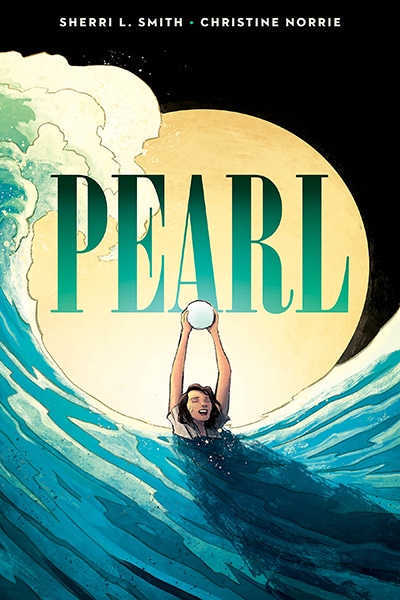
Color Palettes. The front cover features the illustration from page 133; likewise, the back cover features the illustration from page 65. The illustrations on both covers are full color; whereas, the matching illustrations inside the book are monochromatically blue-black-white. Consider how choices in color change the experience of the images. Find another important frame or spread in the book, trace it, and then color it to alter the reading experience.
Research Topics. During, before, and/or after reading Pearl, assign students to research the following topics from the book:
- Pearl Divers (page 1)
- Ryūkyū Kingdom, Okinawa (page 50)
- Pearl Harbor (page 42)
- Wartime school in Japan (page 53)
- Yūrei ghosts (page 34)
- Japanese Internment (page 74)
- Hiroshima (page 89)
- Hibakusha survivors of the atomic bombings of Hiroshima and Nagasaki (page 112)
Flags. Track the illustrations of national flags throughout the book. How does the illustrator use flags? Use one of the flag-centric frames from the story to inspire an illustration of yourself and a flag (or flags) that are important to your sense of national identity.
Home. Track how Amy holds onto her ideas of home throughout the story. Illustrate and write about how you would hold onto your idea of home were you thrust into a situation where it was taken from you.
Suggested Discussion/Writing Prompts
Racism (page 12). How is racism presented? Does racism occur elsewhere in the book? What would have fueled racist attitudes toward the protagonist when she was living in Hawai‘i at that time?
Illustrating Communication (Pages 24–25, 38–39). What techniques do the author and illustrator use to convey the difficulties of communication, and what makes them so effective?
Multiple Identities (pages 55, 81). Is it possible to have multiple national/cultural identities at once? That is, can others accept this? What obstacles impede acceptance? Can we only ever be one or the other, or something in-between, but not both at once?
Symbolism. Throughout the book, along with the United States and Japanese flags, other symbols are developed—particularly the HAIR COMB and the PEARL. What do these two items ultimately come to symbolize?
Yūrei (Japanese ghost, usually female) (pages 34, 83, 110). The great-grandmother appears as a ghost throughout the story. The illustrator depicts her using the conventions of yūrei. Why use this allusion in the illustration of Amy’s beloved great-grandmother? What purpose does her great-grandmother’s ghost serve in the story?
Compare & Contrast. The story begins and ends with scenes of diving for pearls. Compare and contrast the imagery on pages 4–5 with that on page 131. Also compare and contrast the images on page 6 with those on page 133. Those in the opening pages depict diving in 1886 while those in the closing pages depict diving in 1952. Discuss/describe how the meaning of the dives and the pearls changes over time.
Irony. Throughout the story, irony is a major literary tool the author and illustrator leverage. For example, Amy feels more at home in Hawai‘i, yet she would have been interned had she returned to the U.S. before Pearl Harbor; spying on the U.S. brings Amy a sense of being closer to her American home. Discuss the impact of the irony. Search for more examples of irony throughout.
Author: Josh Foster, Educator & Learner
2026
2025 Notable Social Studies Trade Book Award presented by the National Council for Social Studies (NCSS) and the Children’s Book Council (CBC).
© 2024 NCTAsia