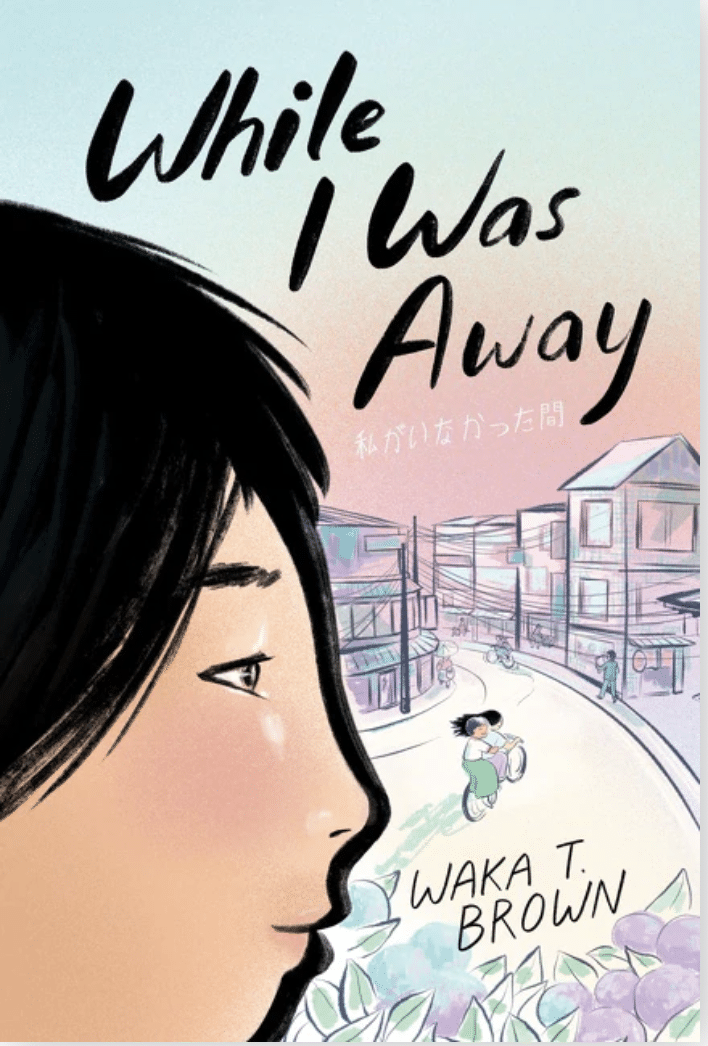
While I Was Away
By Waka T. Brown (Quill Tree Books)
- Fiction
- Set in Japan and America
Keywords: bullying, grandparents, indentity, school
When twelve-year-old Waka’s parents suspect she can’t understand the basic Japanese they speak to her, they make a drastic decision to send her to Tokyo to live for several months with her strict grandmother. Forced to say goodbye to her friends and what would have been her summer vacation, Waka is plucked from her straight-A-student life in rural Kansas and flown across the globe, where she faces the culture shock of a lifetime.
In Japan, Waka struggles with reading and writing in kanji, doesn’t quite mesh with her complicated and distant Obaasama, and gets made fun of by the students in her Japanese public-school classes. Even though this is the country her parents came from, Waka has never felt more like an outsider.
If she’s always been the “smart Japanese girl” in America but is now the “dumb foreigner” in Japan, where is home…and who will Waka be when she finds it?
Waka Brown’s memoir about her experiences as a Japanese American girl from Topeka, Kansas, who lived and studied in Japan for five months in 1984 is much more than a “coming of age” story. Brown’s experiences in Japan as she learned about Japanese culture and school life not only ring true for Japan in the 1980s but can also serve to educate students about aspects of Japanese life, many of which are still true today. Whether it is the practice of taking one’s shoes off in the entryway of a house, the temporary chaos in the classroom before the teacher enters, or the contrasts between life in the U.S. vs. Japan, much of what the book conveys is a rich tapestry of culture-specific information that readers learn along with Waka during her five months of study in a Japanese sixth-grade classroom.
Brown’s “Author’s Note” at the end should be read by both teacher and students for it contains some useful information about the Japanese language as well as caveats that life in 1980s Japan is not like Japan today in many ways. Most Japanese schools have moved to a five-day week —no more Saturday morning classes—and, as Brown writes, teachers no longer hit students as they once did. However, many other things about Japanese schools still occur: students are expected to clean the school themselves; elementary/intermediate students serve lunch to one another; students typically either walk or ride the trains to school and often do so from a very young age on their own or with friends. In fact, some of the best things about this story are the many descriptions Brown provides about cultural practices that she had not learned in her Kansas hometown and how she reacted and adjusted to those practices.
A couple of things should be noted. Early in the book, the Japanese writing system is referred to as an “alphabet,” which it is not. Japanese is a syllabary, which means that words are made up of syllables. There is a set of what we call vowels (see Author’s Note) and consonant/vowel combinations that make up the syllables of the language, such as O-ba-a-sa-ma (grandmother) or Wa-ka (the main character’s name). Additionally, as Brown explains, many words have what we might call double vowels or “long vowels,” and speakers have to pronounce each vowel or syllable in a word or they will accidentally say another word. (Note: in the webinar Brown refers correctly to the language as a syllabary.)
The Japanese language is not hard to pronounce but there are pitch levels, from high to low or low to high, that make all the difference in what word you are speaking. Thus, Waka is teased by her classmates because she doesn’t hear the differences in these pitch levels, and (for example) pronounces rain as a-MEH (candy) rather than AH-meh (rain) (p. 221). This is a typical language learner mistake, made more difficult by the fact that the pitch levels can be different in different regions of Japan compared to where Waka was studying in the areas in and round Tokyo.
Another interesting fact about Japanese that is only partially explained in the book is that the written language originated with Chinese characters, which were adapted to suit the Japanese language. These kanji (literally, Chinese characters) can be read in a number of ways, depending on whether the word is a Chinese reading, a Japanese reading, or a personal name. An example would be: 薬店 (read as “yakuten” meaning pharmacy using a Chinese-derived pronunciation, or “kusuriya” using the Japanese pronunciation). The writing system is complicated by the use of the two syllabaries mentioned in the book: hiragana (a curvilinear way of writing the syllables) and katakana (a more angular way of writing syllables). The use of all three systems within any Japanese text makes Japanese one of the hardest languages in the world to learn to read.
In the story, Waka explains that katakana is used for foreign words, but this angular system of writing is also used, particularly in manga and advertisements, to express action, sound, drama, or just to appear up-to-date and new.
Some other fun facts include the red backpack that Waka receives, called a randoseru, which many elementary children use. These are expensive items and thus this was a special gift that Waka’s extended family thought necessary for her to fit in with her classmates. Also, for some reason, the effects of jet lag are never mentioned despite the fact that the time change between Kansas and Japan is around 13 hours. With daylight savings time, for example, 2:48 p.m. on a Tuesday in Kansas would be 4:49 a.m. on Wednesday in Tokyo. It is likely that the author’s memories of her experiences don’t include how disruptive that is to sleep and brain functioning for a number of days after traveling between countries.
Waka’s family including her grandmother were practicing Catholics. Despite centuries of Shinto, Buddhist, Daoist, and Confucian practices in Japan, the vast majority of Japanese do not see themselves as “religious” in the sense that Americans would. Christians as a whole comprise only about 1.2% of the Japanese population with Catholics comprising around .4% of the 1.2%. Catholicism was first introduced in the 1500s, suppressed through the Tokugawa period (1603–1868) and then tolerated again beginning in the Meiji period (1868–1912). Waka Brown stated in her webinar that her grandfather converted during the period the family was in Manchuria just prior to WWII.
Overall, this story not only illustrates typical struggles of young ethnically Japanese children to adapt to life in Japan, but also tells of the many benefits and enjoyable aspects of Japanese life—from the reliable and safe transportation systems to department stores filled with everything from pastry to vast numbers of pencils and stationary supplies and the kindness that Japanese show one another without overt emotions or physical interaction like hugs. There is much to learn about Japanese culture even today from the rich descriptions in the book and Waka’s reactions to her experiences.
The webinar of Waka T. Brown’s presentation on her experiences in Japan is highly recommended, particularly for the pictures but also the information that Brown doesn’t include in her book. The presentation can be viewed from the NCTA website at: https://www.nctasia.org/award/while-i-was-away/
Author: Brenda G Jordan,[i] retired director and current consultant for the University of Pittsburgh NCTA
2026
[i] Note: Brenda Jordan is originally from Kansas like the author, has lived in Japan, and has also experienced school life in Japan with her daughter, who attended elementary school in Japan in 2007–2008.
Fill out the online form to access the NCTA webinar with author Waka T. Brown
Selected Online Resources for Teaching with While I was Away
© 2024 NCTAsia